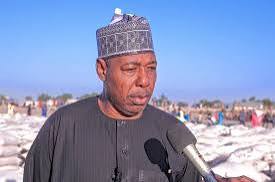

“For me, serving you, the good people of Borno State, has been the greatest honour of my life.”
– Zulum
Democratically, it is a tradition in any democratic system of government that power is transient in nature. Constitutionally in Nigeria, after eight years, a governor or president has to leave office for others to come and demonstrate their patriotism and style of leadership. For Borno state, it is just about one year and a few months left for Governor Babagana Umara Zulum to go and rest. But the question is: what have leaders in Borno state learned from him? Will his tenure serve as a mirror for young leaders to serve the state?
What lessons will those aspiring to leadership positions in the state emulate from him, and will his legacy remain? Or will the citizens of Borno State miss the Zulum administration?
However, whether you are a citizen, a leader in Borno state, an outsider, or just a reader, this piece will be helpful to you because it reflects an exemplary kind of leadership and years of service to humanity something that is difficult to find in contemporary society, particularly in Nigeria.
Keeping politics aside and speaking from the angle of truth, Professor Babagana Umara Zulum has taken some risks since assuming office that no governor in Nigeria has ever taken. This is not about praising, but about highlighting the goodness and sacrifice of leaders who perform excellently to bring back smiles to the faces of those they lead. Such efforts are commendable. Why is it commendable? What happened after he assumed office as Governor of Borno State provides the answer:
Revamped Education Sector: Education, it is said, is the backbone of any society, and Zulum, despite the insecurity bedeviling the state during his first term, built 24 new mega schools—some of which are dedicated to technical education and rehabilitated 108 existing schools. He employed about 1,000 teachers and is in the process of recruiting about 4,000 more.
Continuously, he has not stopped but has continued building mega schools, some of which were inaugurated a few months ago. When delivering his inaugural speech, he said: “The foundation of education is primary and secondary school. When a student gets it wrong at the primary and secondary level, he or she is unlikely to do well at tertiary level. To that effect, I must say that some of our policies will be tough.” It is not easy to fight insecurity and still make such contributions to establishing institutions of learning.
Taking Risks: When insecurity in Borno state was at its peak, Professor Zulum visited many local government areas and villages by road not by helicopter or airplane, demonstrating courage and commitment. To some extent, he was attacked severally but escaped by the will of God. His friend, Pantami, narrated how Zulum spoke about such challenges. Zulum has done many things for the people of Borno State, and his style of leadership is emulatable by any leader in the state who wants to take it to a higher level from where Zulum will stop.
It is under his leadership that Borno State has witnessed unprecedented development in infrastructure. The three flyovers he initiated, with one currently ongoing at the Post Office area in the state, are a testament to this. Zulum constructed many roads and went further to rebuild the international cattle market, which now looks like a special institution.
In conclusion, the leadership of Professor Babagana Umara Zulum has set a standard for governance in Borno state. His administration has shown that even in the face of insecurity and serious challenges, meaningful development is still possible through courage, commitment, and people-oriented policies. His tenure gradually coming to an end, the real question remains not only whether he will be missed, but whether future leaders will be willing to uphold and build upon the standards he has set because without doubt his legacy will not only be measured by the projects he completed, but by the inspiration he leaves behind for future generations of leaders in Borno state and Nigeria at large.


