The Nigerian Army’s 8 Division has intensified efforts to strengthen its operational readiness with the graduation of 27 newly trained drone pilots, as part of a broader strategy to deploy technology in tackling security challenges in the North-West. The pilots, trained under the Division’s Drone Pilots Training Cadre, graduated during……
The Nigerian Army’s 8 Division has intensified efforts to strengthen its operational readiness with the graduation of 27 newly trained drone pilots, as part of a broader strategy to deploy technology in tackling security challenges in the North-West.
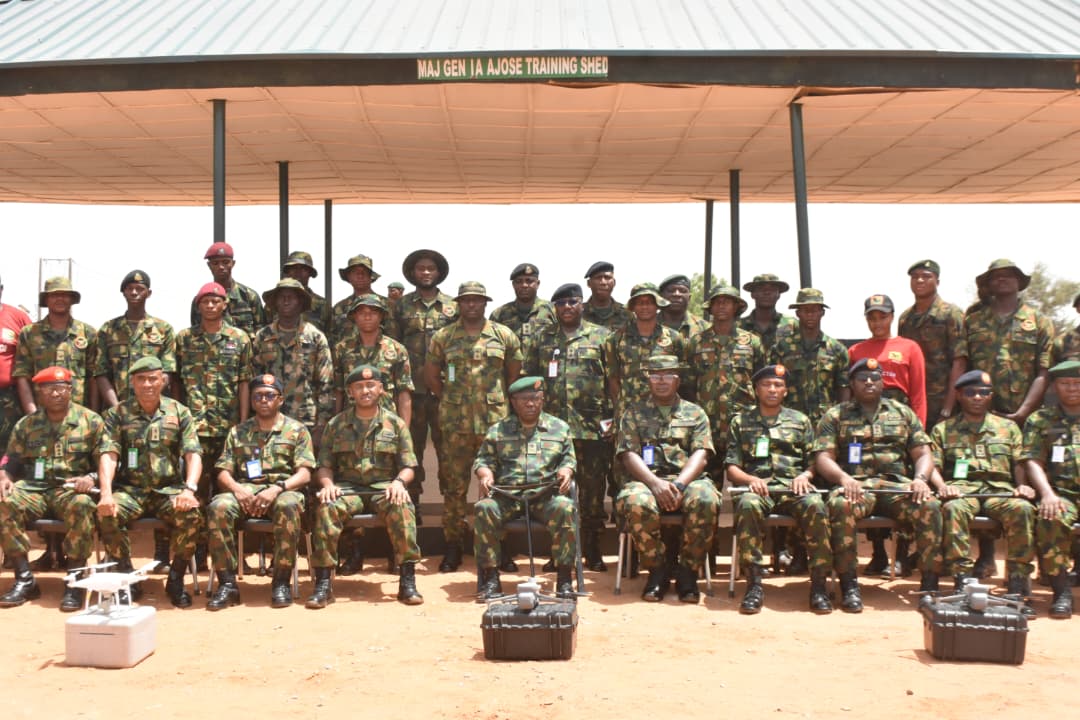
The pilots, trained under the Division’s Drone Pilots Training Cadre, graduated during a ceremony held at the Division Training School, Giginya Military Cantonment, under Sector 2 of Operation FANSAN YAMMA.
This was disclosed in a statement by the Acting Deputy Director, Army Public Relations, 8 Division, Nigerian Army / Sector 2 Operation FANSAN YAMMA, Lieutenant Colonel Olaniyi Osoba, on Friday, May 1.
Speaking at the event, the General Officer Commanding (GOC) 8 Division and Commander, Sector 2 Joint Task Force (North West), Major General Bemgba Paul Koughna, said the initiative reflects the Army’s shift towards integrating advanced technology into its operations.
READ ALSO: Army Rescue Kidnapped Victim, Recover N8m Ransom in Plateau
He noted that Unmanned Aerial Vehicles (UAVs) have become critical tools in modern warfare, particularly in enhancing surveillance, reducing troop exposure to danger, and improving mission efficiency.
According to him, “true military strength lies not in the accumulation of advanced weaponry but in their seamless integration into combat systems,” stressing that drone deployment is now essential rather than optional.
Koughna urged the newly certified pilots to deploy their skills effectively in the field, adding that drones provide a strategic advantage by enabling troops to scout ahead while conserving resources and minimising risks.
Earlier, the Course Coordinator, Captain Samuel Yakubu, described the training programme as a “visionary initiative” introduced to improve operational effectiveness across formations under the Division.
He said the exercise equipped personnel with critical surveillance capabilities, providing what he termed “eyes in the sky” for frontline troops.
Yakubu disclosed that the 27 participants, drawn from various formations within the Division’s area of responsibility, underwent intensive training covering drone navigation using offline maps, aircraft assembly and disassembly, ground control station setup, and operational procedures.
Other areas included takeoff and landing techniques, surveillance operations, imaging and video capture, gimbal control, aircraft handling, and coordinate mapping.
The training concluded with a practical demonstration, where the participants showcased their proficiency in pre-flight checks, tactical manoeuvres, aerial surveillance, and precision landings.
The display, according to the Army, impressed senior officers and commanders in attendance.
Major General Koughna subsequently decorated the graduates with pilot wings and presented cash awards to outstanding participants in recognition of their performance during the course.