When one of the world’s worst ever energy crises began in the Strait of Hormuz in February, few believed that their internet access – rather than their gas bill – would be the worst-affected aspect of daily life.
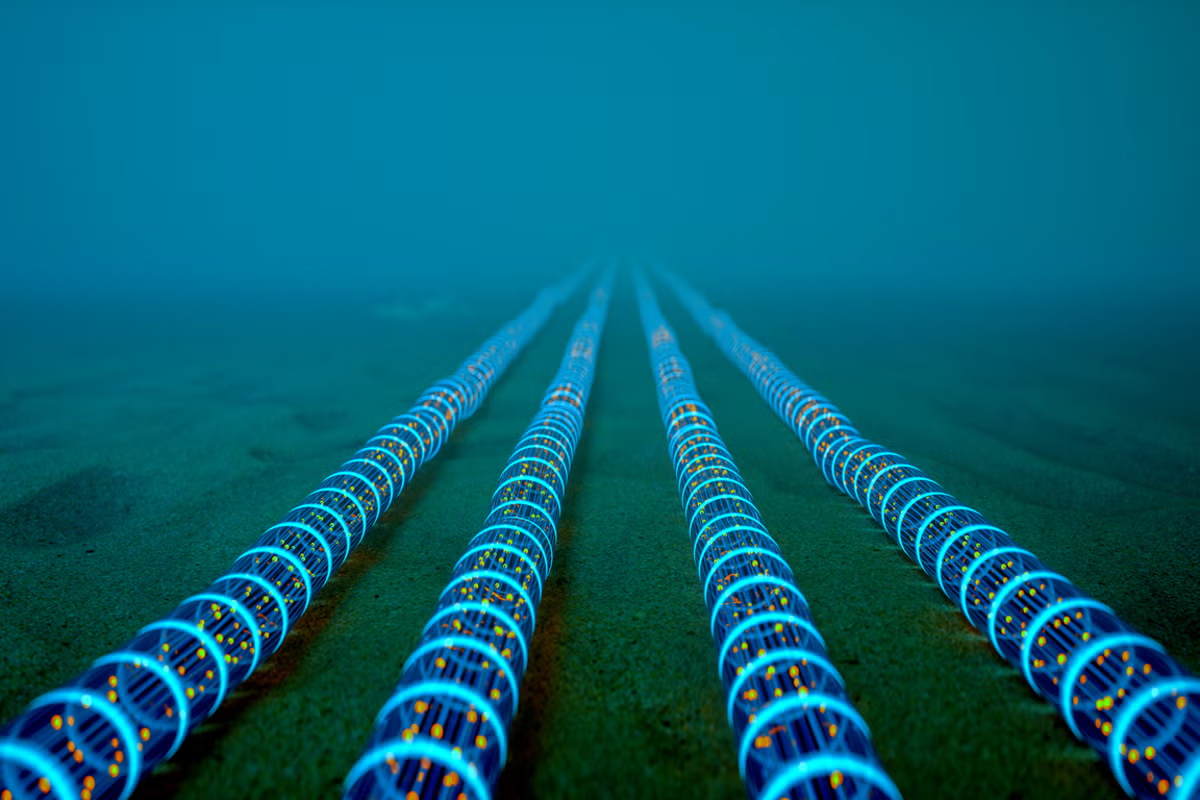
But lurking many thousands of metres beneath the oil ships being attacked by the Iranian navy lie a series of undersea cables that play a vital role in the global economy, helping to power our internet and keep the world connected.
Earlier this month, Tehran floated plans to impose tariffs on Strait of Hormuz submarine cables, warning that they were a vulnerable chokepoint for the region’s digital economy.
The Middle East is not the only region facing these concerns. In April, three Russian submarines conducted a covert operation over cables in waters north of the UK, although none were damaged. On Friday, the UK announced it is introducing stringent new laws to punish any saboteurs who deliberately damage undersea internet cables with a possible prison sentence.
China has also been accused by Taiwan of several attacks on undersea cables in the region. For the island, which relies on just 24 cables, this can pose a significant national security risk.
Undersea cables carry more than 99 per cent of all international digital data traffic, acting as an invisible backbone of the internet and facilitating emails, banking transactions, messaging and more.
But the so-called global network of undersea cables is more an assortment of “narrow corridors” through which the internet flows – including through the Strait of Hormuz and the Red Sea.
The roughly 600 submarine cables are primarily owned and operated by some of the world’s largest private telecommunications companies, including Google, Meta, Microsoft and Amazon, and other consortia. Modern ones use fibre-optic technology, with the cable delivering the information no wider than a human hair, sheathed in several layers of insulation and protection.
Data analysis company TeleGeography believes there are more than 1.5 million kilometres of submarine cables globally, reaching up to 20,000km in length.
They are installed by huge, specialised cable-laying ships, which unspool the cables, burying them under the seabed in shallow waters and laying them on the floor in deep waters. This is only done after the topography of the ocean floor on the route in question has been carefully mapped.
“Everyone knows where they are,” explains Tony O’Sullivan, CEO of global network provider RETN, which operates between Europe and Asia.
“The Red Sea, the Gulf of Oman, parts of the East China Sea, and the Strait of Dover are good examples. Given the volume of traffic that runs along these routes, if they do get affected, it would affect not [just] the edge of the internet backbone but a major conduit.”
Serious damage to the cables can cause significant problems for consumers, particularly businesses. Although the belief that cables break and the internet goes down at once is not strictly true – traffic will typically find another route – the speed of the services can degrade sharply.
A heavy load on the alternative cable routes means they become unstable, leading to unprocessed payments, feeds that don’t update, and messages that take longer to send.
Vital services such as healthcare and banking may also suffer under an increasing load, potentially causing chaos for public services.
The Iran crisis has highlighted a wider problem in how the internet is run, Mr O’Sullivan says, with the routes too vulnerable to hostile actors seeking to wreak digital chaos.
“If a malicious actor should wish to try and take out maybe one fifth to one quarter of it, certainly a particular territory, and then you get an accident affecting another quarter of them, of course this is when things become really problematic.”
The greatest threat in the Middle East is not the cables running through the Strait of Hormuz; rather it is the possibility of the Iranian-aligned Houthis launching attacks on undersea cables in the Red Sea.
“If we think about the Red Sea, [this is] where all of the major data cables, which connect Europe to Asia by subsea, pass through,” Mr O’Sullivan explains. “The Iranians have been friends with the Houthi rebels in Yemen, and that’s where they could potentially inflict a lot more damage.”
In 2024, four crucial Red Sea data cables were cut, affecting 25 per cent of data traffic flowing between Asia and Europe, when a Belize-flagged commercial ship dropped its anchor following a ballistic missile attack by Houthi militants.
The Rubymar, loaded with 41,000 tons of fertiliser, was evacuated by its crew after the attack before drifting for nearly two weeks with its anchor down, through an area densely populated with the vital cables.
Although it was not a direct attack by the Houthis on the cables, it was a clear demonstration of how vulnerable cables can be – not only to direct attacks by hostile actors but to accidental damage.
“This is the thing to remember,” Mr O’Sullivan adds. “There are lots of cable cuts every single year. These happen all the time, the vast majority related to either fishing nets or anchor drag.
“It’s very, very easy to damage a subsea cable accidentally – the Iranian concern is mainly in how they’ve actively threatened the cables rather than it just being an assumed thing.”
Efforts to prevent damage to undersea cables are unlikely to ever build comprehensive resilience. Instead, experts say, there is a need for a combination of sea, land and space routes.