The Africa Soft Power Gala & Awards brought the Summit to a powerful close in Nairobi, celebrating three women whose work has shaped how Africa is seen, valued and remembered: Bolanle Austen-Peters, Faith Kipyegon and the late Koyo Kouoh.
The Africa Soft Power Gala & Awards closed the 2026 Africa Soft Power Summit in Nairobi with a night that moved beyond ceremony into tribute. Across the evening, the summit honoured three women whose lives and work reflect the deeper meaning of African soft power: not simply visibility, but the ability to build institutions, shift global imagination, expand cultural value and inspire generations.
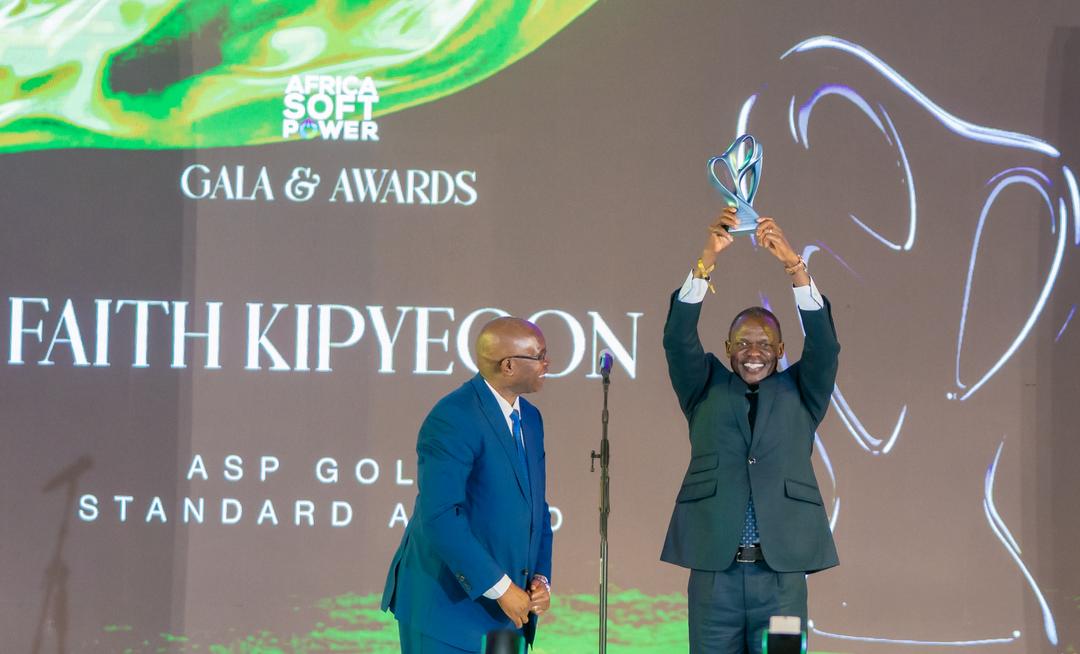
The honourees were Austen-Peters, recipient of the ASP Architect of Culture Award; Kipyegon, recipient of the ASP Gold Standard Award; and the late Kouoh, recognised posthumously with the ASP Creative Legacy Award. Together, their stories gave the gala its emotional and intellectual centre.
Austen-Peters was honoured for a career that has helped move African storytelling from performance into infrastructure. For more than two decades, through Terra Kulture, BAP Productions and the Terra Academy for the Arts, she has built stages, trained talent and expanded the commercial possibilities of Nigerian culture. Her work across theatre and film has helped prove that African stories can command scale, sustain audiences and travel across borders without losing their local force.
From Saro the Musical to Fela and the Kalakuta Queens, Moremi the Musical, 93 Days, Funmilayo Ransome-Kuti and House of Ga’a, Austen-Peters has consistently treated culture as something that must be produced with discipline, not merely celebrated with sentiment. Her recognition as ASP Architect of Culture captured the central logic of her work: stories become influence when they have institutions behind them. Talent becomes industry when it has training, production systems and access. Culture becomes power when it can preserve memory, create jobs, build audiences and hold commercial ambition.
Faith Kipyegon’s honour carried a different kind of force.
Raised near Keringet in Nakuru County, Kipyegon’s early running was not designed as elite training. It was the rhythm of daily life. As a child, she ran to school and back across the Rift Valley, barefoot, long before the world began to measure her in medals, records and impossible margins. What followed has become one of the defining careers in modern athletics. Olympic gold in Rio, Tokyo and Paris. Multiple world titles. World records across the 1,500 metres, 5,000 metres and mile. A standard of dominance that has made her not only one of Kenya’s greatest athletes, but one of Africa’s most powerful global sporting symbols.
The ASP Gold Standard Award recognised more than achievement. It honoured discipline, consistency and the quiet architecture behind excellence. Kipyegon’s story speaks to the Summit’s wider thesis: that African influence is not accidental. It is built through systems of practice, endurance, belief and repetition until the world has no choice but to pay attention.
The evening’s final tribute belonged to Koyo Kouoh.
Her posthumous recognition was a tribute to a life spent building rooms for African art to think, argue, mature and stand on its own terms. Born in Douala and raised in Switzerland, she would become one of the most important curatorial voices of her generation.
In Dakar, she founded RAW Material Company, creating a space that functioned as residency, academy, library, gallery and intellectual home for artists, writers and curators. It was not simply an art institution. It was a house built on the belief that African artists needed spaces of their own, not borrowed rooms in someone else’s castle.
Her later work at Zeitz MOCAA in Cape Town helped reposition the museum as a serious centre for contemporary African art. Her landmark exhibition, When We See Us, travelled from Cape Town to major European institutions, expanding the global conversation around Black figuration and African artistic memory.
In 2024, she was appointed to lead the 61st International Art Exhibition of La Biennale di Venezia, becoming the first African woman to hold the role. Her death in 2025 turned that appointment into something larger than a professional milestone. It became a measure of the doors she had opened and the institutions she had strengthened.
At the Gala, the tribute to Kouoh was not framed as a conclusion. It was framed as continuity. The institutions remain. The artists remain. The questions she insisted on asking of African art remain: who tells the story, on whose terms, and in whose room?
The evening’s award presentations reflected the Summit’s cross-sector character. H.E. Zainab Hawa Bangura, Under-Secretary-General and Director-General of the United Nations Office at Nairobi, presented the ASP Architect of Culture Award to Austen-Peters. The Managing Director of National Bank, George Odhiambo, presented the ASP Gold Standard Award, received on Faith Kipyegon’s behalf by her coach, Patrick Sang. The Chairman of Renaissance Capital, David Kinyua, presented the ASP Creative Legacy Award, which was received by Neneh Diallo, Founder of NDG Agency and former Chief Diversity Officer at USAID, on behalf of Koyo Kouoh.
The gala also showed ASP’s larger argument in practice: African soft power is not built by culture alone, or by capital alone, or by policy alone. It compounds when business, sport, media, creative enterprise and institutional power begin to recognise themselves as part of the same African growth architecture.