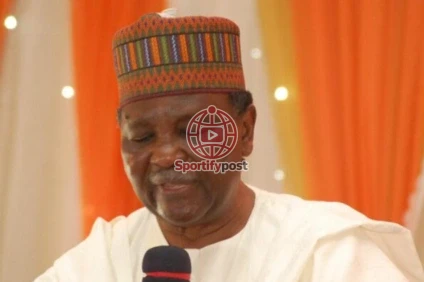
Nigeria’s oldest living former military Head of State, General Yakubu Gowon, has revealed that he never harbored any ambition to lead the country.…....
He explained that he was uplifted to power by junior military officers following the bloody counter-coup of July 1966.
The 92-year-old elder statesman made these known in his 859-page autobiography, “My Life of Duty and Allegiance.” The book was presented to the public yesterday at the Bola Ahmed Tinubu International Conference Centre in Abuja, drawing top government dignitaries, historians, and diplomatic corps.
Gowon, who became Nigeria’s youngest-ever leader at the age of 31, maintained that he was completely unaware of the bloody mutiny that resulted in the assassination of the then-Head of State, Major General Johnson Aguiyi-Ironsi, and his host, the Military Governor of Western Nigeria, Lt. Col. Adekunle Fajuyi.
According to the memoir, while the coup plotters succeeded in removing Aguiyi-Ironsi, they had no succession plan.
In a bid to maintain military hierarchy and avert a leadership vacuum, Gowon — then a Lieutenant Colonel — initially suggested that senior officers of Southern extraction be appointed to lead. However, his proposals were flatly rejected.
“Rather than consider my suggestions, the loud voices of the junior officers in the hall hit me with the force of a three-ton truck,” Gowon recounted in the book. “They wanted me to be their leader. They wanted me to assume the position of Head of State and Supreme Commander… they added that I was the only officer acceptable to them.”
The consequences of his refusal, Gowon noted, would have been catastrophic.
“Otherwise, they would keep up the momentum of the coup and execute it to its logical conclusion, which certainly would not be devoid of more bloodshed! I certainly did not want this. I instantly declined the offer.”
Gowon, who described himself at the time as “apolitical,” pleaded with the insurrectionists to let him focus instead on restoring discipline and loyalty within the fractured Armed Forces.
READ ALSO: Goodnight, Prince Nazir Ado Ibrahim
“I never aspired to and was unprepared for the new role that fate had now thrust on me,” he wrote. “Barely 24 hours earlier, I had been an independent arbiter seeking to put an explosive situation under control. Now, without warning, I had become the issue… Set before me was a semblance of what could be considered an alternative between the rock and the deep blue sea,” he wrote.
Realizing that both junior and senior officers viewed him as the only figure capable of preventing total anarchy, Gowon finally capitulated to their demands.
“It dawned on me that I could not hope to successfully resist the load of leadership responsibility that had been placed on my frail shoulders… When it was clear that I could not get out of the commitment to be the new Head of State, I was suddenly overwhelmed by indescribable fear—that the buck ends with me.”
Faced with the monumental task, the young officer turned to faith. “I requested everyone in the room with me to leave and I went down on my knees to pray to God for grace, mercy and guidance… beseeching God to grant me the wisdom of Solomon… I also prayed for the courage of David to fight every Goliath on my path. And what a relief I felt after that.”
The events of July 1966 altered the trajectory of Nigeria’s history. The “counter-coup,” led primarily by Northern officers, was a retaliatory strike following the January 15, 1966 coup, which had claimed the lives of key Northern political leaders, including Prime Minister Abubakar Tafawa Balewa and terminated Nigeria’s first republic.