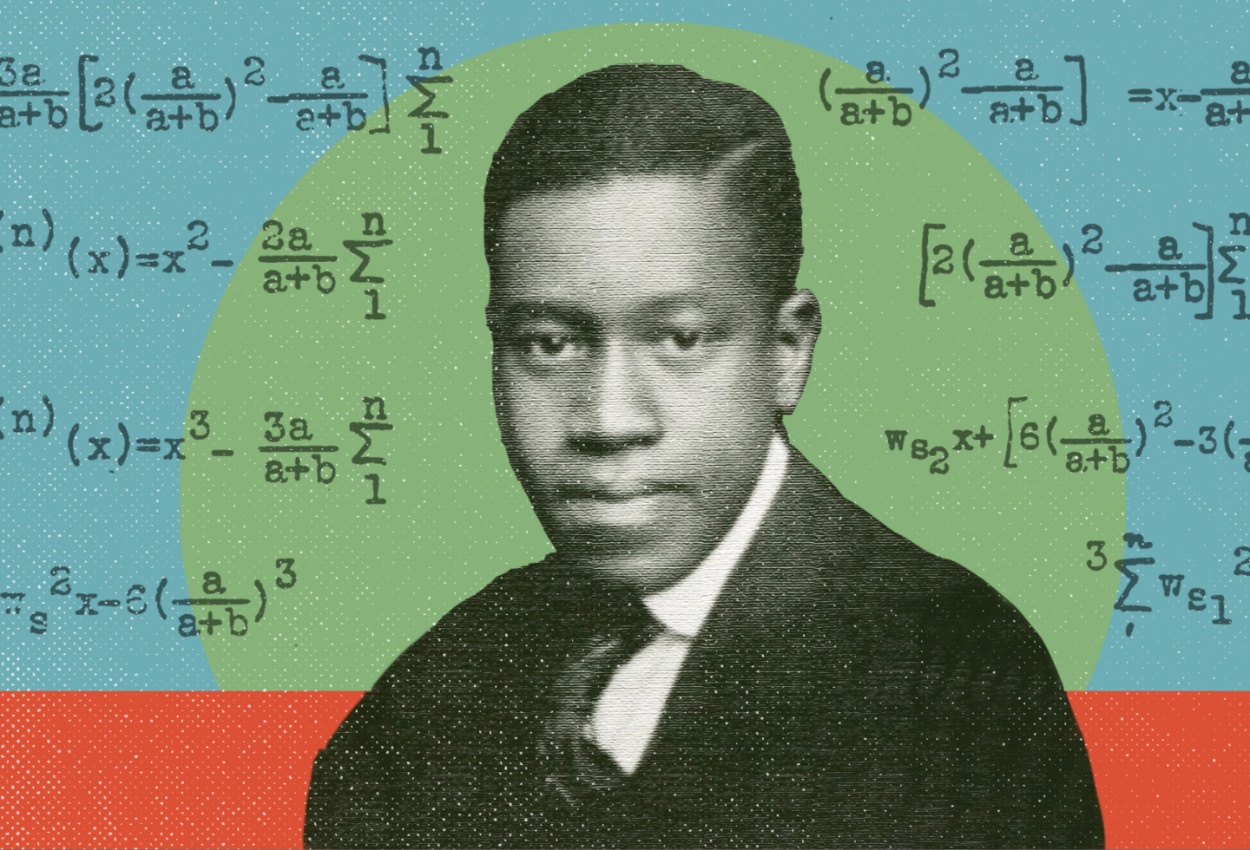
Elbert Frank Cox (December 5, 1895 – November 28, 1969) was an American mathematician. In 1925, he became the first African American to earn a PhD in mathematics, receiving his degree from Cornell University.
Profile Summary
| Category | Details |
|---|---|
| Full Name | Elbert Frank Cox |
| Date of Birth | December 5, 1895 |
| Place of Birth | Evansville, Indiana, U.S. |
| Date of Death | November 28, 1969 (aged 73) |
| Place of Death | Washington, D.C., U.S. |
| Spouse | Beulah Kaufman |
| Children | 4 |
Education
| Category | Details |
|---|---|
| Bachelor’s Degree | Indiana University, Bloomington (BA) |
| Graduate Degrees | Cornell University (MA, PhD) |
Scientific Career
| Category | Details |
|---|---|
| Field | Mathematics |
| Institutions | West Virginia State University; Howard University |
| Thesis | The polynomial solutions of the difference equation af(x+1) + bf(x) = φ(x) (1925) |
| Doctoral Advisor | Lloyd Williams |
Age
Elbert Frank Cox was born on December 5, 1895, in Evansville, Indiana.
Biography
Cox was born in Evansville, Indiana, to Johnson D. Cox, a teacher from Kentucky who was active in the church, and Eugenia Talbot Cox. He grew up with his parents, his maternal grandmother, and his brother in a racially mixed neighborhood. In 1900, his block included three Black families and five white families.
Cox was offered a scholarship to study violin at the Prague Conservatory of Music but decided to follow his passion for mathematics instead.
Education
Indiana University
Cox attended Indiana University Bloomington, where he studied mathematics along with courses in German, English, Latin, history, hygiene, chemistry, education, philosophy, and physics. His brother, Avalon also, also attended Indiana University. There were three other Black students in his class. Cox earned his bachelor’s degree in 1917, during a time when transcripts for Black students had the word “Colored” printed on them. He received A’s on all his exams and joined the historically Black fraternity Kappa Alpha Psi.
After graduating in 1917, Cox served in the U.S. Army in France during World War I from 1918 to 1919. Upon returning, he worked as a high school mathematics tutor.
Cox began teaching mathematcs a mathematics instructorn Henderson, Kentucky. In fall 1919, he became a professor of physics, chemistry, and biology at Shaw University in Raleigh, North Carolina, and served as chairman of the Department of Natural Sciences until 1922.
Cornell University
In December 1921, Cox applied for a graduate scholarship at Cornell University, one of only seven U.S. universities offering a mathematics doctoral program. While one reference was supportive, another expressed concern about potential challenges due to Cox being a “colored man.” He was accepted on May 5, 1922, and enrolled that fall.
At Cornell, Cox was mentored by William Lloyd Garrison Williams, a young instructor and co-founder of the Canadian Mathematical Congress, who became chair of Cox’s special committee in March 1923 and served as his supervisor. In fall 1924, Cox received the Erastus Brooks Fellowship in Mathematics, valued at $400 per year, and followed Williams to McGill University in Montreal. He returned to Cornell in spring 1925, completed his dissertation, The polynomial solutions of the difference equation af(x+1) + bf(x) = φ(x), that summer, and received his PhD on September 26, 1925. He was the first African American, and likely the first Black man globally, to earn a PhD in mathematics. Cox published his first paper in 1934.
During Cox’s time at Cornell, the Ku Klux Klan was also active in the area.
West Virginia State College
On September 16, 1925, Cox began teaching mathematics and physics at West Virginia State College, then an all-Black and underfunded institution. Few faculty members held PhDs, and Cox’s international connections distinguished him. He earned a salary of $1,800, equivalent to about $33,000 in 2025. From 1925 to 1928, he contributed significantly to curriculum development. In 1927, he married Beulah Kaufman, daughter of a former slave, who taught at an elementary school and worked with Cox’s brother Avalon. Cox and Beulah met in 1921 and courted for six years. Their first child, James, was born in 1928. In 1929, Cox joined the faculty at Howard University and relocated to Washington, D.C.
Howard University
Cox began teaching at Howard University in September 1930. Despite his credentials, he was outranked by professors such as William Bauduit and Charles Syphax, who had published more papers. Cox published his graduation paper at this time. His supervisor, Williams, sought international recognition for Cox’s work, but universities in England and Germany declined to consider his thesis. Tohoku Imperial University in Sendai, Japan, accepted it, and the thesis was published in the Tôhoku Mathematical Journal in 1934. Cox was highly active in teaching, and Howard University’s president, James M. Nabrit, noted that Cox had directed more master’s degree students than any other professor at the university.
Cox’s students often excelled compared to those of other professors, and he was highly regarded by them. Notable students included his son, Elbert Lucien Cox, and William Schieffelin Claytor, the third African American to earn a PhD in mathematics. Cox was promoted to professor in 1947 and became head of the Department of Mathematics in 1957, serving until 1961. He retired in 1965 at age 70, three years before his death. His portrait now hangs in the Howard mathematics department’s common room.
During World War II, Cox taught engineering science and war management from 1942 to 1944.
More…
During his life, Cox published two articles. He expanded on Niels Nörlund’s work on Euler polynomials as a solution to a particular difference equation. Cox used generalized Euler polynomials and the generalized Boole summation formula to expand on the Boole summation formula. He also studied a number of specialized polynomials as solutions for certain differential equations. In his other paper, published in 1947, he mathematically compared three grading systems.
Although Cox did not live to see the launch of Howard’s mathematics PhD program, he played a significant role in its development, as noted in his obituary:
“It is believed by many that Cox did much to make it. Cox helped to build up the department to the point that the PhD program became a practical next step. He gave the department a great deal of credibility; primarily because of this personal prestige as a mathematician, as being the first black to receive a Ph.D. in mathematics, because of the nature and kinds of appointments to the faculty that were made while he chaired the Department, and because of the kinds of students that he attracted to Howard to study mathematics at both the undergraduate and master’s levels.”
Honors
The National Association of Mathematicians established the Cox–Talbot Address in his honor, which is annually delivered at the NAM’s national meetings. The Elbert F. Cox Scholarship Fund, which helps black students pursue studies, is also named after him.
Mathematician Talitha Washington championed Cox, leading to the November 2006 unveiling of a plaque in Evansville commemorating his pioneering achievement.
Family
Elbert and Beulah Cox had four children.