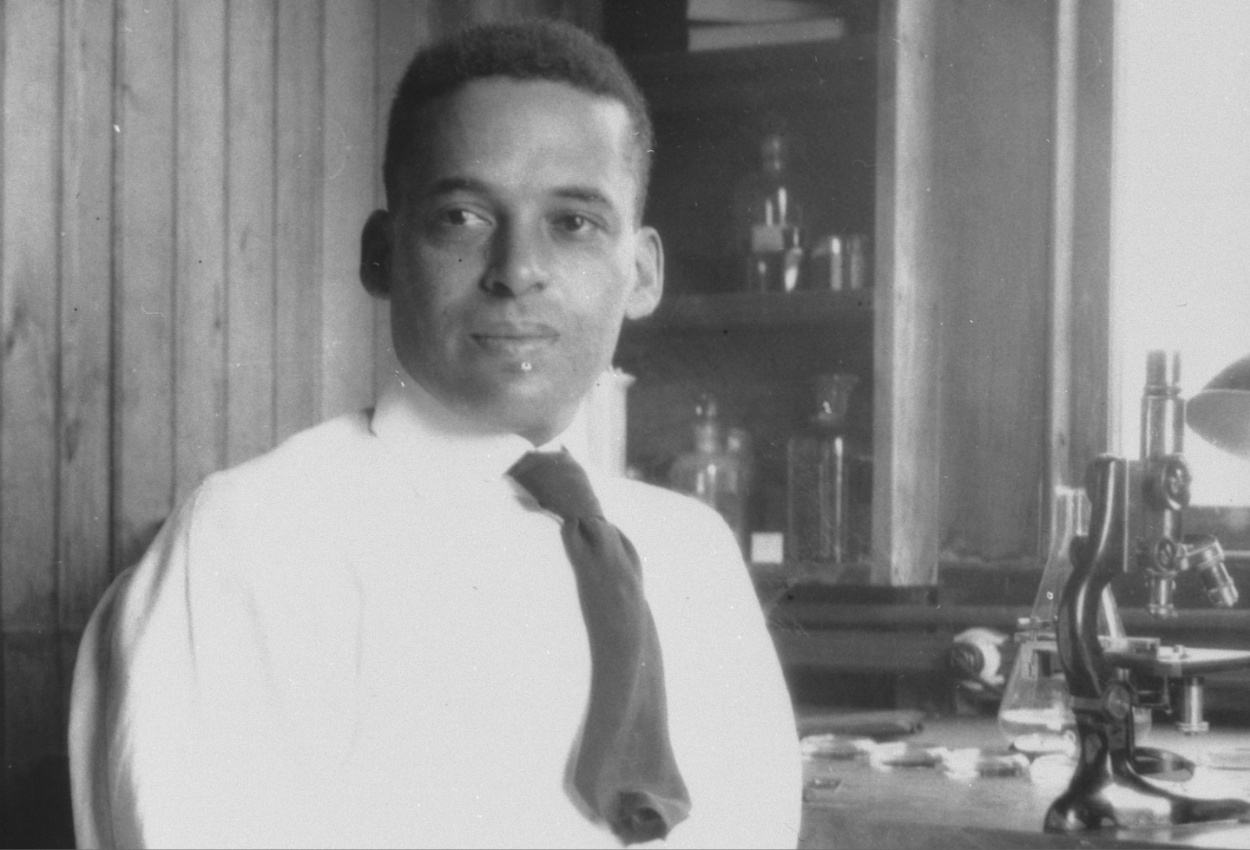
Ernest Everett Just (August 14, 1883 – October 27, 1941) was an American biologist, academic, and science writer. He is best known for recognizing how important the cell surface is in the development of living things. In his research on marine biology, cytology, and parthenogenesis, he encouraged studying whole cells in their natural state instead of only examining them after breaking them apart in the lab.
Profile Summary
| Category | Details |
|---|---|
| Full Name | Ernest Everett Just |
| Date of Birth | 14 August 1883 |
| Place of Birth | Charleston, South Carolina, U.S. |
| Date of Death | 27 October 1941 (aged 58) |
| Place of Death | Washington, D.C., U.S. |
| Resting Place | Lincoln Memorial Cemetery |
Education & Recognition
| Category | Details |
|---|---|
| Alma Mater | Dartmouth College; University of Chicago |
| Known For | Marine Biology; Cytology; Parthenogenesis |
| Awards | Spingarn Medal (1915) |
Scientific Career
| Category | Details |
|---|---|
| Fields | Biology, Zoology, Botany, History, and Sociology |
| Institutions | Howard University; Marine Biological Laboratory; Stazione Zoologica Anton Dohrn; Kaiser Wilhelm Institute; Station biologique de Roscoff |
| Doctoral Advisor | Frank R. Lillie |
Age
Ernest was born on August 14, 1883, in Charleston, South Carolina, United States.
Biography and Education
Ernest Just was born to Charles Just Jr. and Mary Matthews Just on August 14, 1883, and was one of five children. His father and grandfather, Charles Sr., worked as builders. When Ernest was four, both his father and grandfather died; his father died from alcoholism. After their deaths, his mother became the only provider for Ernest, his younger brother, and his younger sister. Mary Matthews Just taught at an African-American school in Charleston and worked in the phosphate mines on James Island during the summer to support her family. She noticed there was a lot of unused land near the island and encouraged several Black families to move there and start farming. The community they created, now part of the West Ashley area of Charleston, was later named Maryville in her honor.
As a child, Just became seriously ill with typhoid for six weeks. After the fever ended, he struggled to recover and his memory was badly affected. He had to relearn how to read and write, even though he had already learned these skills before. His mother tried to help him, but eventually she stopped.
More…
Hoping Ernest would become a teacher, his mother sent him to the Colored Normal Industrial Agricultural and Mechanical College of South Carolina when he was 13. This was the only land grant school for Black students in South Carolina at the time, and it later became South Carolina State University in Orangeburg. Ernest and his mother believed that schools for Black students in the South were not as good as those in the North, so they decided he should continue his education there. At 16, he enrolled at Kimball Union Academy, a college-preparatory high school in Meriden, New Hampshire. During his second year, he went home for a visit and found out his mother had been buried just an hour before he arrived. Even with this loss, Ernest finished the four-year program in only three years and graduated in 1903 with the highest grades in his class.
Just graduated magna cum laude from Dartmouth College in Hanover, New Hampshire, in 1907. While at Dartmouth, he became interested in biology after studying fertilization and egg development. He received special honors in zoology and also stood out in botany, history, and sociology. He was named a Rufus Choate scholar for two years and was elected to Phi Beta Kappa.
Personal life
On June 12, 1912, Just married Ethel Highwarden, who taught German at Howard University. They had three children: Margaret, Highwarden, and Maribel. They divorced in 1939. Later that year, Just married Hedwig Schnetzler, a philosophy student he met in Berlin.
In 1940, Just was imprisoned by the Nazis in Germany, but he was quickly released with help from his wife’s father.
Death
When World War II began, Just was working at the Station Biologique in Roscoff, where he was researching for his paper Unsolved Problems of General Biology. The French government asked foreigners to leave the country, but Just stayed to finish his work. In 1940, after Germany invaded France, he was briefly held in a prisoner-of-war camp. With help from his second wife’s family, who were German citizens, and the U.S. State Department, he was able to return to the United States in September 1940. Just had already been very ill before his imprisonment, and his health got worse in prison and during his trip home. In the fall of 1941, he was diagnosed with pancreatic cancer and died soon after.
Legacy
In 1983, Kenneth R. Manning wrote a biography about Just called Black Apollo of Science: The Life of Ernest Everett Just. The book won the 1983 Pfizer Award and was a finalist for the 1984 Pulitzer Prize for Biography or Autobiography. In 1996, the U.S. Postal Service honored Just with a commemorative stamp.
Since 2000, the Medical University of South Carolina has held the annual Ernest E. Just Symposium to encourage non-white students to pursue careers in biomedical sciences and health professions. In 2008, Howard University hosted a National Science Foundation-funded symposium to honor Just and his scientific work. Just had been a faculty member at Howard from 1907 until his death in 1941. Many speakers at the event contributed papers to a special issue of the journal Molecular Reproduction and Development, which was published in 2009 and dedicated to Just.
Since 1994, the American Society for Cell Biology has given an award and hosted a lecture named after Just. At least two institutions where Just studied have also created prizes or symposia in his honor: the University of Chicago, where he earned his PhD in zoology in 1916, and Dartmouth College, where he completed his undergraduate degree. In 2013, an international symposium to honor Just was held at the Stazione Zoologica Anton Dohrn in Naples, Italy, where he began working in 1929.
Founding of Omega Psi Phi
On November 17, 1911, Ernest Just and three Howard University students, Edgar Amos Love, Oscar James Cooper, and Frank Coleman, founded the Omega Psi Phi fraternity at Howard. The students had asked Just to help start the first Black fraternity on campus. At first, Howard’s faculty and administration opposed the idea because they worried it might challenge the university’s white leadership. Just helped resolve the disagreement, and despite the early concerns, the Alpha chapter of Omega Psi Phi was officially established at Howard on December 15, 1911. The fraternity was incorporated in the District of Columbia on October 28, 1914.