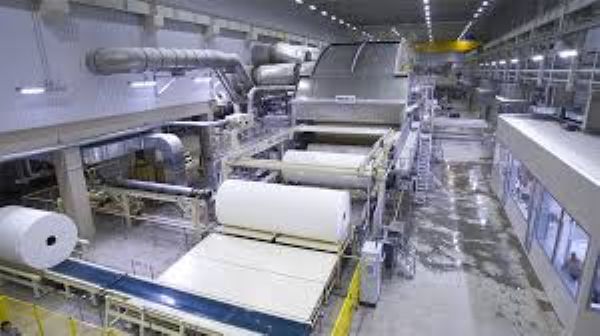
The Federal Government has launched a strategic initiative to save N250 billion annually by boosting local paper production and addressing severe structural bottlenecks within the country’s paper manufacturing industry.
This intervention targets long-standing fiscal and policy constraints to reduce Nigeria’s heavy reliance on imported educational materials and paper products.
Minister of State for Industry, Senator John Enoh, disclosed this during a factory tour and stakeholders’ roundtable with major paper manufacturers, Nixin Paper Mill Nigeria and Speciality Group.
The companies had raised concerns over what they described as unfair competition from imported paper products and textbooks.
They noted that while imported educational materials enter the country duty-free, local manufacturers are subjected to import duties on chemicals and other critical production inputs.
Enoh described the situation as detrimental to local industry and said the Federal Government was working on reforms under the new industrial policy framework to strengthen domestic manufacturing and conserve foreign exchange.
According to him, Nigeria loses an estimated N250 billion annually through the continued importation of textbooks that could be produced locally.
“It is a bit inexcusable and unconscionable that an industrial manufacturing concern like these can stay in the country, produce a product, and that product cannot be sold because of competition with foreign products that either have lower quality or find their way into the market through unauthorized routes,” he said.
He added: “Continuing the way we are, with nearly all textbooks printed abroad, the country loses in the neighbourhood of about N250 billion per annum. That is huge.”
The minister said the challenge was largely a fiscal policy issue, stressing that the Ministry of Industry, Trade and Investment would engage the Ministry of Finance and the Coordinating Minister of the Economy to review the existing duty structure affecting the sector.
“We need to step by step, sector by sector, enable operators producing within the country to remain competitive.
“The kind of fiscal policy that targets the paper and printing sector is very important,” Enoh stated.
“It makes no sense for Nigeria to import 90 per cent of its textbooks when we have mills here that can do the same job,” he added.
Managing Director of Nixin Paper Mill Nigeria, Eric Wang, said the company, which commenced operations in 2023, has the capacity to meet the nation’s total demand for printing, publishing and exercise paper.
He noted that the company sources cassava from farmers in Oyo State for the production of cassava starch used in papermaking, thereby supporting more than 10,000 Nigerians across its value chain.
Also speaking, Group Chief Operations Officer of Speciality Group, Dattei Ateinu, said the company had been producing paper locally since 2004 but currently operates far below its installed capacity of 6,000 tonnes monthly due to import pressure, high production costs and limited access to credit.