The Northern Christian Youth Professionals (NCYP) has raised fresh concerns over Nigeria’s worsening security landscape, warning that the growing emergence of community self-defence structures across the country signals a dangerous shift that could deepen national security fragmentation if not urgently addressed.
In a strongly worded statement issued on Monday, 25 May, 2026, and signed by its Chairman, Isaac Abrak, the group said Nigeria was approaching a “security turning point,” where communities increasingly feel compelled to defend themselves because of persistent attacks and the inability of existing security operations to maintain long-term territorial control in forested areas.
The group, while commending the Defence Headquarters and the Armed Forces for sustained offensives against terrorists and bandits operating within forest corridors, argued that military victories have repeatedly been undermined by the absence of permanent stabilisation and holding structures after clearance operations.
According to NCYP, the recurring pattern of dislodging armed groups from forests only for them to regroup and launch fresh attacks has remained one of the biggest weaknesses in Nigeria’s anti-terror campaign.
It noted that this pattern had played out across the North-East, North-West and North-Central regions and was now gradually extending into parts of the South-West, especially following recent security concerns linked to attacks around schools and rural settlements.
“The insecurity is no longer static; it is adapting geographically and exploiting governance gaps across forest territories,” the statement said.
The group warned that as insecurity spreads, more communities are resorting to local vigilante networks, hunters’ associations and informal defence groups for survival, a trend it described as both understandable and potentially dangerous if left outside a coordinated national framework.
Drawing parallels with international conflict zones, NCYP cited the experience of Iraq’s Sahwa (Awakening) Councils, where local Sunni communities mobilised against Al-Qaeda between 2005 and 2008, stressing that such initiatives only remained effective because they were eventually integrated into broader state security structures.
It also referenced community defence formations in Burkina Faso and Mali, warning that unregulated armed civilian groups often create new governance and security complications when multiple actors operate without central coordination.
The organisation, however, distinguished between informal vigilante groups and structured regional security outfits such as the Western Nigeria Security Network, codenamed Amotekun, which operates under state legislation and recognised institutional frameworks.
According to NCYP, the real danger lies in the unchecked rise of loosely coordinated armed groups operating independently across rural communities and forest regions.
The statement identified several major forest corridors allegedly exploited by criminal gangs and armed groups, including the Rugu forest belt spanning Katsina, Kaduna and Zamfara states, as well as the Birnin Gwari, Kamuku and Kuyambana forest axes.
It also pointed to Plateau State’s rural forest corridors linking Bokkos, Riyom, Bassa and Wase to neighbouring states such as Nasarawa, Benue, Kaduna and Bauchi, warning that the absence of integrated inter-state security coverage continues to provide escape and regrouping routes for armed elements.
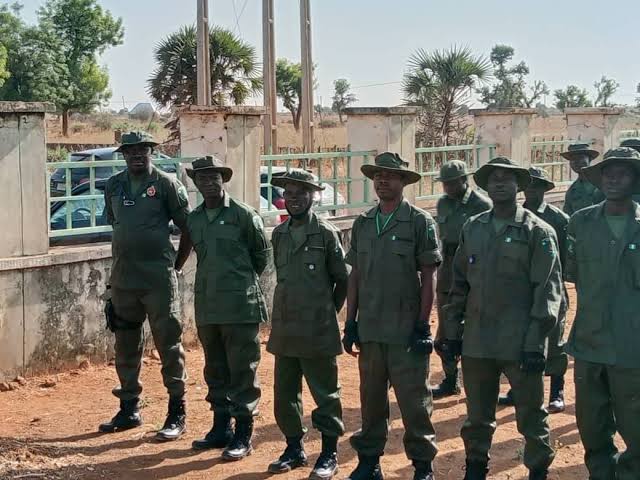
NCYP further argued that the current pilot Forest Guard programme being implemented in selected states remains inadequate without nationwide expansion.
While applauding the recruitment of Forest Guards in Plateau State and other pilot areas, the group said isolated deployments would merely push criminal groups into neighbouring unprotected forests.
“In such situations, security pressure in one state only displaces armed groups into adjoining territories where they regroup and return,” the statement added.
The organisation recalled how Boko Haram insurgents previously exploited porous border regions linking Nigeria with Niger, Chad and Cameroon to evade military pressure before re-launching attacks, insisting that the same lesson now applies to Nigeria’s internal forest security challenge.
NCYP therefore called on the Federal Government, Defence Headquarters, the Office of the National Security Adviser and the Office of the Special Adviser to the President on Homeland Security to urgently transform the ongoing Forest Guard pilot initiative into a nationwide security architecture.
The current pilot programme operates in Adamawa, Borno, Kebbi, Kwara, Niger, Sokoto and Yobe states.
According to the group, expanding the Forest Guard structure nationwide would provide the military with a stabilisation and territorial holding force capable of securing cleared forests, improving intelligence gathering and strengthening local surveillance systems.