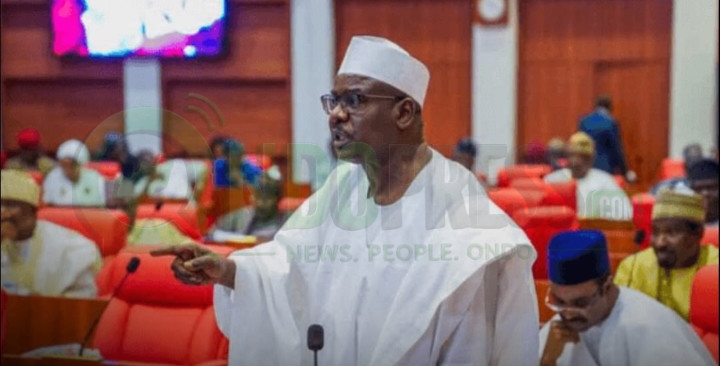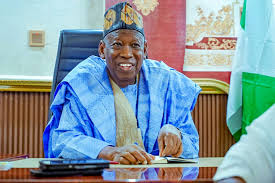
(Abdullahi Umar Ganduje. Photo by The Historica Nigeria)
Former APC national chairman Abdullahi Umar Ganduje has fired back at comments attributed to Rabiu Musa Kwankwaso, asserting that Kwankwaso was once his political protégé.
Ganduje made his position known through a statement released on Friday by his chief of staff, Comrade Muhammad Garba, while the former governor was in Saudi Arabia performing the Hajj pilgrimage.
In the statement, Ganduje reflected on the nature of politics, noting that successful political careers are rarely built alone and that mentorship and support play a crucial role.
He claimed to have been instrumental in Kwankwaso’s early rise, particularly in his election to the House of Representatives and his subsequent emergence as Deputy Speaker.
He further stated that during his time working in both Abuja and Kano, Kwankwaso regularly visited his offices to discuss political matters.
Ganduje also recalled the political events of 1998 in Kano, noting that he had won the governorship primary at the time but voluntarily stepped aside in the interest of party unity, agreeing instead to serve as Kwankwaso’s deputy.
Despite the political differences that later emerged between them, he acknowledged that the two had worked together during two separate periods from 1999 to 2003, and again from 2011 to 2015 in the service of Kano State’s development.
On the subject of current Kano Governor Abba Kabir Yusuf, Ganduje noted that while Yusuf once served under him, he now holds an elected office and is deserving of the respect that comes with that position.
Ganduje rounded off by appealing to politicians and their supporters in Kano to steer clear of divisive language, calling instead for a focus on peace, unity, and the overall wellbeing of the state.