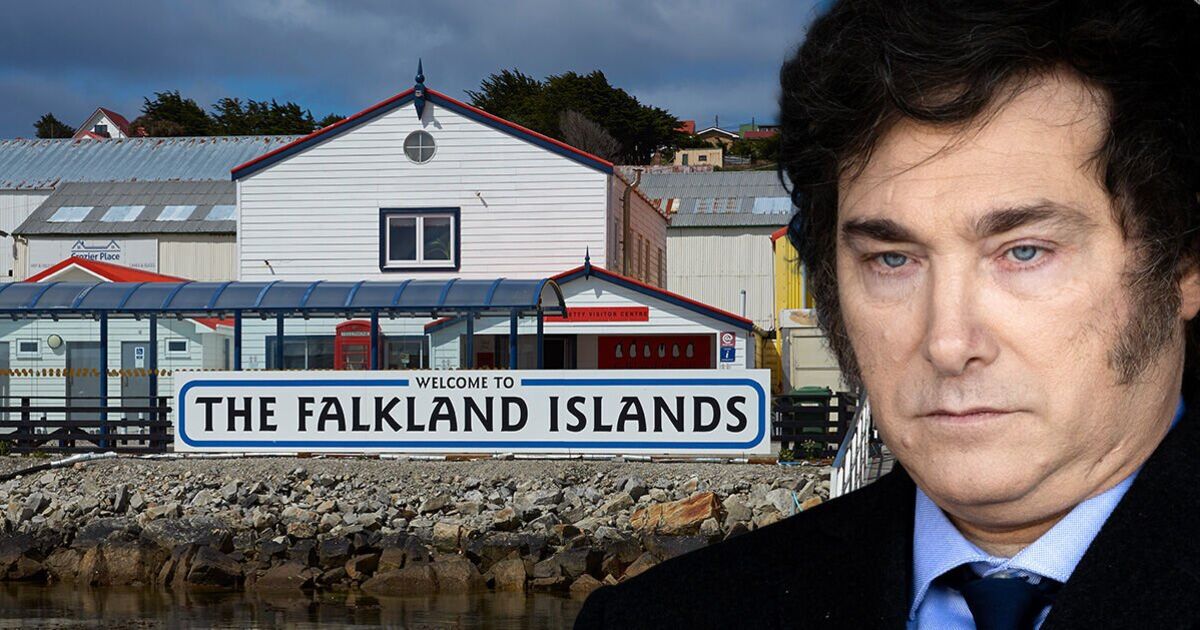
The Falkland Islands are set for a new oil project (Image: Jonathan Buckmaster)
A major new project is set to bolster economic infrastructure on the Falkland Islands, as Argentina sends a warning. The Sea Lion oil project was put forward by London-based Rockhopper Exploration and Israel-based Navitas Petroleum (NPDP) with a reported projected cost of £1.55billion. The field was discovered in 2010, and phases one and two of the operation has been approved by the The Falkland Islands Government, which has granted exploitation licenses valid for 35 years.
Argentine President, Javier Milei, warned in April that his government “will respond with all necessary diplomatic measures” to protect the country’s interests in the face of the scheme. He added: “We act with determination against unilateral and illegitimate activities that seek to exploit resources belonging to the Argentine people.”
The South American country considers hydrocarbon exploration and production schemes in the waters around the British overseas territory illegal, as it believes the islands are Argentine territory. There is also opposition to the project on the Falklands themselves.
READ MORE: I’m a Falklands War veteran – Argentina will never reclaim the islands
READ MORE: Falkland Islanders issue 5-word King Charles demand after Donald Trump threat

Javier Milei issued a warning after the Sea Lion project got the green light (Image: Getty)
Environmental charity Falklands Conservation told the Express that its focus is on marine protection and making sure that the archipelago’s inshore marine environment in particular “receives the level of protection that it needs”.
In its 2024 response to an environmental assessment, the organisation suggested in relation to the prospect of new oil and gas fields that “seabirds are at risk from a number of impacts, including oil spills and bird-strike”. It added: “In order to determine which seabirds could be at risk and how to avoid or mitigate such risk, up-to-date baseline data on the total range of seabirds that utilise potentially impacted areas are required.”
It also suggested that there would be a risk of whale entanglements and collisions with vessels. Artificial light, underwater noise and oil pollusion are also points of concern.
Ian Ramsay, NPDP’s chief operating officer, said: “The UK and Falkland Islands’ supply chain has already successfully delivered 29 exploration and appraisal wells in the region.
“The development will be progressed to industry and regulatory standards and create jobs both in the UK and the Falklands.”

Depiction from NPDP documents of the Sea Lion project (Image: NPDP)
As part of NPDP’s “responsible development” of the field, the company said it aims to create jobs and career opportunities for Falkland Islanders, without “diminishing its existing labour capacity and associated wider economic activity”.
The firm added that it will invest in housing and supply base upgrades, in “a commitment to bolstering the infrastructure on the islands in support of its onshore activities”.
“Sea Lion is expected to have several subsequent phases which will continue to be planned from the company’s UK offices,” the company said.
Mr Ramsay added: “We will be responsible and respectful custodians of the Sea Lion field throughout its lifetime. The potential to enhance the economy of the Falklands and responsibly open up a new production basin is an opportunity that provides us all with immense motivation.”
Over the course of the first two phases, it is expected that the development will create new direct and indirect jobs across the UK and Falkland Islands.

Jack Ford is Chair of the Legislative Assembly in the Falklands (Image: Jonathan Buckmaster)
The Chair of the Falkland Islands’ Legislative Assembly, Jack Ford MLA, said that the archipelago is pursuing a “very ambitious” infrastructure policy.
He added regarding the Sea Lion scheme: “I think it is a positive thing for the long-term economic future of the Falklands, and that long-term economic stability.”
Officials are” working to the highest standards we possibly can”, are being supported by the UK government, Mr Ford said.
The assessment of risks needs to be the “highest standard”, the 27-year-old added, also insisting that he and his colleagues are “operating to a strict environmental regime”.
Mr Ford added: “And of course then we’ll look to utilise any revenues in the best way for the long-term future of the Falkland Islands to safeguard the quality of life that we currently enjoy, but also make sure that’s in place for future generations.”
When asked if large-scale projects of this nature could mean Argentina sees the islands as a more valuable asset, Mr Ford said: “We’re always mindful of all potential risks as part of the project.”
He added: “We’re working closely with the UK government on this project, and the work required to ensure its success, and we’ll continue to do so.”