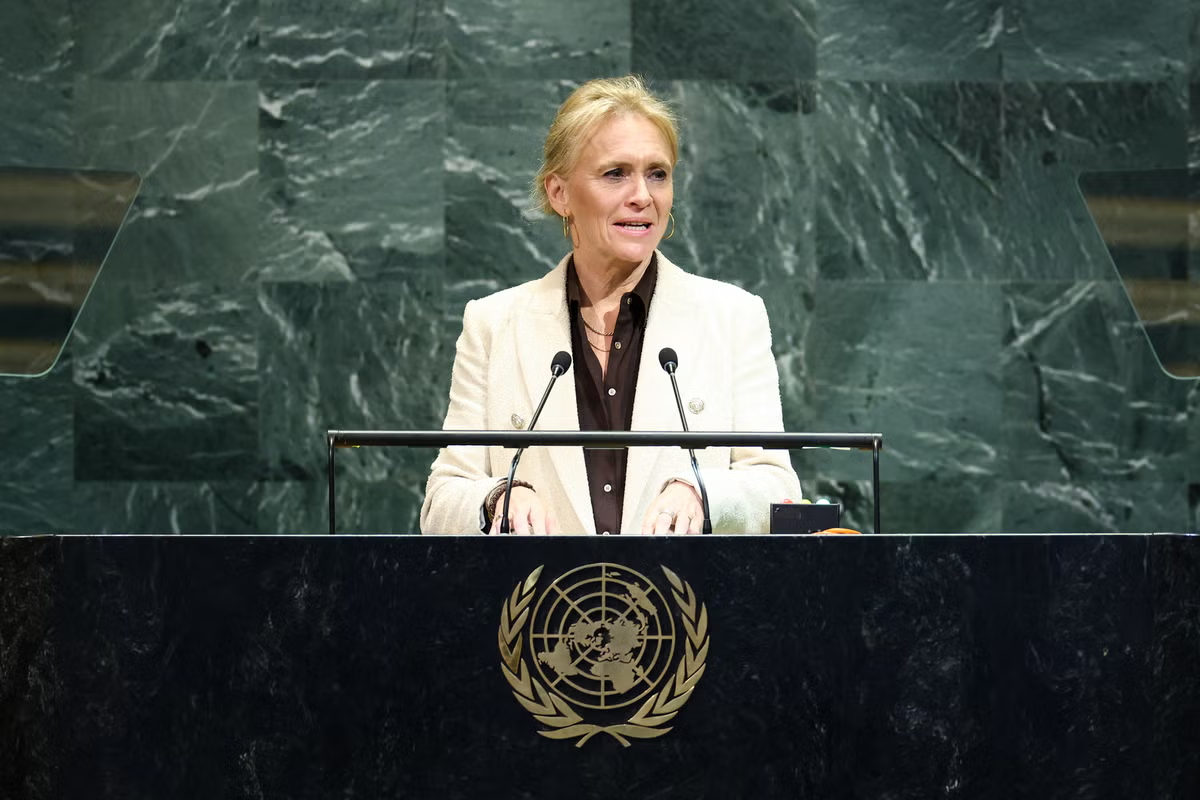
Iceland’s foreign minister has said her political rivals are using tactics “straight from Farage’s playbook” through spreading misinformation in their campaign to reject future EU membership.
The population of Iceland will head to the polls in three months over whether to continue accession talks with the economic bloc, in developments that are being keenly followed from Washington to Brussels.
Þorgerður Katrín Gunnarsdóttir warns there is a real risk of Russian interference and influence from other actors “who seek to influence our public debate in a negative way”, and warned such interference could affect the result.
“I am fearing that we will face a Brexit moment,” she said in an interview with The Guardian. “That would be, from my point of view, a rather dangerous path because… there were all kinds of lies put forward by the Brexiteers.”
Individuals both inside and outside the country are guilty of “fearmongering” in a similar vein to the leave campaign in the UK, she said, citing disputed figures regarding the sums of money sent from London to Brussels.
Iceland’s coalition government announced in March that it would hold the EU referendum on 29 August, a move that came as a surprise after it previously said it would not do so before 2027.
The coalition is formed of the left-leaning parties the Social Democratic Alliance and the People’s party, along with Þorgerður’s centre-right Liberal Reform party.
Brexit, Þorgerður said, should be an “example of how not to run a campaign” because “nothing of what they promised has actually been activated and realised”.
The desire to fast-track a referendum and subsequent accession to the EU was in part affected by recent threats made by Washington to acquire the semi-autonomous Danish territory of Greenland, a move that has been decisively rejected by Europe.
Trump also several times referred to Greenland as Iceland during a heated international spat about the president’s aim of acquiring the vast Arctic territory.
“The international order that underpinned our security and prosperity for decades is under serious pressure. The world has changed so decisively, I would say, so Greenland has of course affected, or had influence on, our decision.”
Residents in Iceland will not be asked whether they want to join the EU, rather they will be asked whether they would like the government to resume the accession talks with Brussels.
The rising cost of living, Russia’s war in Ukraine, and trans-Atlantic tensions have also contributed to growing concerns about Iceland’s security. The volcanic island nation has no army and relies on Nato and a bilateral defense agreement with the United States.
For decades, Iceland avoided seeking EU membership because it was concerned it would be forced to share its rich North Atlantic fishing grounds with boats from other European nations.
It applied to join the bloc in 2009, after the country’s debt-burdened banking sector collapsed during the 2008 global financial crisis. Talks were suspended in 2013, when a center-right government came to power, and they formally ended in 2015.
Iceland participates in the EU’s single market through the European Economic Area, and is part of the Schengen free-travel zone.
The vote will take place on 29 August.
More details here...