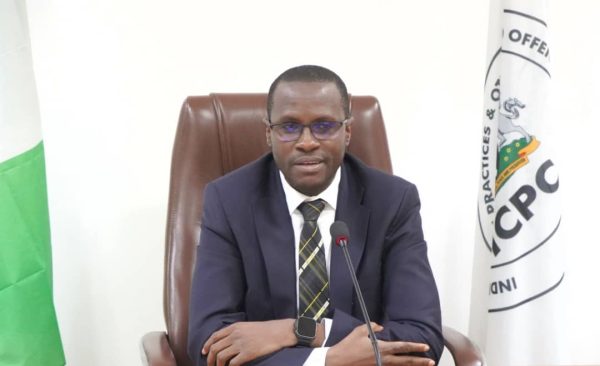
Dr. Musa Aliyu (SAN), the Chairman of the Independent Corrupt Practices and Other Related Offences Commission (ICPC), has called on federal parastatals, agencies, and commissions to strengthen institutional mechanisms for corruption prevention.
Aliyu made the call at an Induction Programme for Chief Executive Officers, Chairmen, and Members of Governing Boards of Federal Government Parastatal, Agencies, and Commissions organised by the Bureau of Public Service Reforms in Abuja.
The ICPC boss made the call in a paper titled: “The Role of the ICPC in the Prevention of Corrupt Practices in the Public Service.”
He stressed that sustainable anti-corruption efforts must prioritise prevention alongside enforcement.
While warning against governance failures that fuel corruption, he explained that the commission’s preventive mandate was as critical as its investigative and prosecutorial responsibilities.
He noted that corruption could only be effectively addressed through strong institutional safeguards, ethical leadership, and compliance mechanisms within public institutions.
“Enforcement alone will not solve the problem of corruption,” he stated, adding: “Prevention must be pursued in equal measure.
“We need to look inwards.”
The ICPC boss drew inference from a 2025 study conducted by the Commonwealth Africa Anti-Corruption Centre across 11 African countries, in which the ICPC and the Code of Conduct Bureau participated.
He noted that greed and lack of integrity accounted for nearly 50 percent of corruption cases identified in public institutions.
Aliyu noted that the findings underscored the urgent need for systemic reforms to address institutional weaknesses that enable corrupt practices across the public service.
To address such vulnerabilities, he outlined several preventive tools deployed by the commission, including Anti-Corruption and Transparency Units (ACTUs) in Ministries, Departments, and Agencies (MDAs).
Others, he said, included Systems Study and Review exercises, Corruption Risk Assessments, as well as integrity and ethics education programmes.
He also stressed the importance of adherence to legal and regulatory frameworks such as the ICPC Act, Public Procurement Act, Fiscal Responsibility Act, and United Nations Convention against Corruption (UNCAC).
Citing the Supreme Court judgment in Comptroller General of Customs and Others v. Gusau (2017), he reaffirmed the constitutional force of the Public Service Rules.
He described them as essential instruments for promoting accountability, transparency, and ethical conduct within federal institutions.
Aliyu further observed that procurement-related offences constituted a significant percentage of cases handled by anti-corruption agencies, including ICPC and the Economic and Financial Crimes Commission (EFCC).
He urged chief executives and board members to familiarise themselves with the statutory instruments guiding their organisations.
He also warned against governance conflicts arising from the overreach of governing boards into administrative functions, emphasising the need for clear boundaries between policy oversight and operational management.
Aliyu charged participants to recognise the strategic importance of their leadership positions in shaping public trust and institutional integrity.
“The ICPC remains committed to partnering with public institutions in building a culture of integrity, accountability, transparency, and efficiency in the Nigerian public service,” he said
The programme featured participation from several senior government officials, including the Minister of Budget and Economic Planning, Abubakar Bagudu, who urged public sector leaders to embrace technology and innovation in service delivery.
Also in attendance was the office of the Minister of Information and National Orientation, Mohammed Idris, represented by Oladapo Okunnu, who called for ethical leadership and responsible information management.
Dr. Abubakar Kana, representing the Secretary to the Government of the Federation, George Akume, raised concerns over undue interference in the offices of chief executives and misunderstandings regarding the respective roles of boards and management.
The induction programme, now in its 11th edition since its inception in 2018, is coordinated by the Bureau of Public Service Reforms under the leadership of its Director-General, Dasuki Arabi.
It is aimed at strengthening transparency, accountability, and effective governance in line with the Federal Government’s Renewed Hope Agenda.