President Bola Ahmed Tinubu has told Nigerians they must accept higher tax compliance and difficult economic reforms if the country is to fund infrastructure, healthcare, and long-term development, projecting that Nigeria will attract close to $20 billion in foreign direct investment in 2026 and declaring that the country would not have survived the ongoing Middle East conflict in peace without the Dangote Petroleum Refinery.
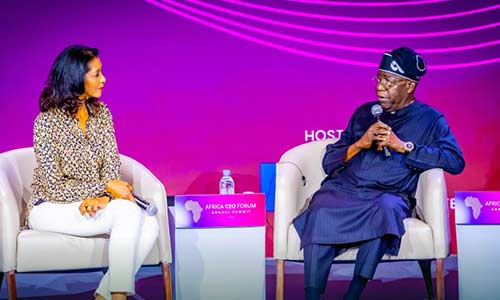
Tinubu made the wide-ranging remarks during sessions at the Africa CEO Forum in Kigali, Rwanda, where he defended his administration’s controversial fiscal policies, called for an African commodity exchange platform, and positioned Nigeria as a destination for value-adding investment rather than resource extraction.
Speaking during a panel session on the sidelines of the Forum on Friday, Tinubu addressed the tension between public demand for improved services and citizen resistance to taxation one of the central challenges facing his administration’s reform agenda.
“Nobody wants to pay taxes ordinarily. Every human being expects development, but the question they don’t answer is: are you willing to pay for it?” Tinubu said.
In one of the session’s most striking remarks, the President went further, directly linking citizenship to tax compliance. “If you are not a taxpayer and not exempted, then you are not a citizen,” Tinubu declared, highlighting his administration’s push to strengthen fiscal discipline and widen the tax net in a country where the tax-to-GDP ratio remains among the lowest globally.
Nigeria, Africa’s biggest oil producer, aims to increase its tax as a share of GDP from about 13 per cent in 2025 to 18 per cent next year, following the implementation of tax reforms that began in January 2026. The administration recently elevated tax reform advocate and former fiscal policy chairman Taiwo Oyedele to the position of Finance Minister, reinforcing signals that tax reforms will remain central to economic policy.
Tinubu’s administration embarked on sweeping economic reforms upon taking office, including the removal of the decades-old petrol subsidy and the liberalisation of the foreign exchange market twin policies that triggered a sharp surge in living costs and sparked widespread criticism from citizens struggling with the resulting inflation.
The President acknowledged the pain caused by the reforms but maintained they were unavoidable to prevent deeper economic deterioration. He compared the economic adjustment process to labour pains, saying the country was beginning to emerge from a difficult transition.
“There is a very bright light at the end of the tunnel,” Tinubu said, adding that the economy was becoming more stable and predictable for businesses and households.
He argued that governments cannot continue funding public services through borrowing and subsidies that impose burdens on future generations. “We cannot continue to spend the future of generations yet unborn,” Tinubu stated.
Speaking on Thursday during another session at the Forum, Tinubu projected that Nigeria would attract close to $20 billion in foreign direct investment in 2026, attributing the expected inflow to the transparency, efficiency, and openness his administration has introduced.
“This year alone, I can beat my chest that Nigeria is attracting close to $20 billion in foreign direct investment,” the President said. He added that his government had put in place the necessary incentives to attract investments into Nigeria and removed bottlenecks that had previously discouraged investors.
The projection comes two months after Tinubu approved a production tax credit to fast-track Shell’s $20 billion final investment decision in a deepwater project. Additionally, in November 2025, the Nigerian Upstream Petroleum Regulatory Commission (NUPRC) announced that the government had approved oil field development plans worth about $20 billion between January and October of that year.
In a remark that underscored the strategic importance of domestic refining capacity, Tinubu stated that if the Dangote Petroleum Refinery had not been established, Nigeria would not have survived the ongoing Middle East conflict in peace, given its population of over 200 million people.
The comment was a direct reference to the war between the United States and Iran, which has disrupted global energy shipping through the Strait of Hormuz and sent fuel prices soaring worldwide. For a country that was until recently almost entirely dependent on imported refined petroleum products, the availability of domestic refining capacity from the $20 billion Dangote refinery at Lekki, Lagos, has provided a critical buffer against the global energy supply disruption.
Tinubu signalled continued support for large domestic companies, arguing that strengthening local industries was essential for job creation and economic expansion.
“My philosophy is Nigeria first,” the President declared.
He defended the use of locally produced cement for major infrastructure projects, including the Lagos-Calabar coastal highway, saying the approach reduces pressure on foreign exchange and promotes domestic manufacturing. He described the 700-kilometre coastal highway project as a transformative infrastructure initiative aimed at connecting underserved regions and expanding economic opportunities across the country.
The President also used the platform to articulate a broader investment philosophy for Nigeria, saying the country was no longer interested in extractive investment relationships.
“Today, we don’t want scavengers, we don’t want extractors, we want people to add value. If you are an investor, we will encourage you to add value to what we have as a nation,” Tinubu stated.
In remarks directed at the broader African audience at the Forum, Tinubu called for stronger regional collaboration and proposed the creation of an exchange trading platform that would enable the 54 countries on the continent to trade their resources among themselves.
“Look around the entire continent, 54 countries. There’s none of us without a particular commodity available. Why not start an exchange commodity platform, where we can trade with one another?” the President said.
He urged African nations to activate the African Continental Free Trade Agreement (AfCFTA) rather than leaving it on the drawing board, calling for effective regional collaboration in the utilisation of the continent’s resources.
“Not walking in silos, but in collaboration with one another, using what we have. To me, I believe in ‘Africa First’, because I have started ‘Nigeria First,’” Tinubu said.
He advised African nations to match their rhetoric with action, saying: “Luckily, we have an African trade agreement that should not be left on the drawing board, but should be activated properly for regional collaboration and effective utilisation of our resources.”
Tinubu also addressed the growing security challenges across West Africa, calling for stronger regional and international security partnerships to combat worsening instability that he said was undermining the continent’s progress.
“We cannot do it alone,” the President said, referring to Nigeria’s collaboration with neighbouring countries and global partners on security challenges.
The remark acknowledged the limitations of any single nation’s capacity to address the complex and transnational security threats facing the region, including terrorism, banditry, separatist agitations, and the political instability that has led to military coups in several West African countries in recent years.
Tinubu’s remarks at the Africa CEO Forum represent a comprehensive articulation of his administration’s economic philosophy at a critical juncture one where the painful reforms introduced since 2023 are beginning to show structural results even as citizens continue to bear the burden of higher costs. The projection of $20 billion in FDI, the defence of tax reforms, the acknowledgment of the Dangote refinery’s strategic role, and the call for intra-African trade all point to an administration seeking to project confidence and long-term vision at a time of significant domestic and global uncertainty.
The elevation of Taiwo Oyedele to Finance Minister, the push to raise the tax-to-GDP ratio from 13 to 18 per cent, and the President’s uncompromising language on tax compliance suggest that the reform drive will intensify rather than moderate in the months ahead, even as the 2027 election cycle approaches.