Iran has temporarily closed the airspace over its western half from May 22 to May 25, suspending all civil flight permits in the western sector of the Tehran Flight Information Region (OIIX), as Washington weighs a fresh round of military strikes and Pakistani and Qatari mediators race to revive stalled US-Iran talks.
The Iranian Civil Aviation Authority issued a Notice to Airmen (NOTAM) — OIIX A1010/26 — on Friday, May 22, ordering the shutdown of all airports in the western part of the Tehran FIR, effective immediately and valid until May 25, the Gulf News reported.
Only eight airports across the country remain operational, including Tehran’s Mehrabad and Imam Khomeini International, alongside Isfahan, Shiraz, Yazd, Tabriz, Mashhad and Bandar Abbas. Even at these, flights are restricted to daylight hours from sunrise to sunset, and airlines must obtain fresh per-flight approval from the Civil Aviation Authority, according to the NOTAM.
Flight-tracking data shows commercial aircraft already rerouting away from western Iranian airspace, with multiple airlines avoiding the corridor entirely.
Why the airspace shutdown matters
The closure is a strong indicator that Tehran expects military action within days. Western Iran contains the bulk of the country’s nuclear, missile and air-defence infrastructure, including sites in Natanz, Fordow, Arak and Kermanshah that have been targeted repeatedly since the war began on February 28.
Iranian airspace has technically been classified as closed under international aviation safety advisories since the start of the war, but the new NOTAM formalises the most extensive restrictions in weeks. Reports from Tehran also flagged unusual Iranian Air Force movement, including fighter jet sorties from Mehrabad.
US weighs fresh strikes; Trump cancels golf weekend
The airspace shutdown came hours after CBS News and Axios reported Friday that the Trump administration was actively preparing for new strikes on Iran. CBS News reported that the US military was readying for “potential strikes against Iran over the weekend,” though no final decision had been taken.
Story continues below this ad
US President Donald Trump at an event in the Oval Office. (Photo: AP)
Axios reported that Trump huddled with his closest advisers on Friday morning to discuss Iran developments. Later that day, the US president cancelled his planned weekend at his New Jersey golf property in Bedminster and returned to the White House, citing “matters of state.”
He also announced he would skip the wedding of his eldest son, Donald Trump Jr., to Palm Beach socialite Bettina Anderson, scheduled for Saturday in the Bahamas.
“I feel it is important for me to remain in Washington, D.C., at the White House during this important period of time,” Trump wrote on Truth Social.
Several US military and intelligence officials have reportedly cancelled their Memorial Day weekend plans in anticipation.
Story continues below this ad
Rubio in New Delhi: ‘Something to say in the coming days’
US Secretary of State Marco Rubio, currently on a visit to India, sounded an optimistic note on Saturday.
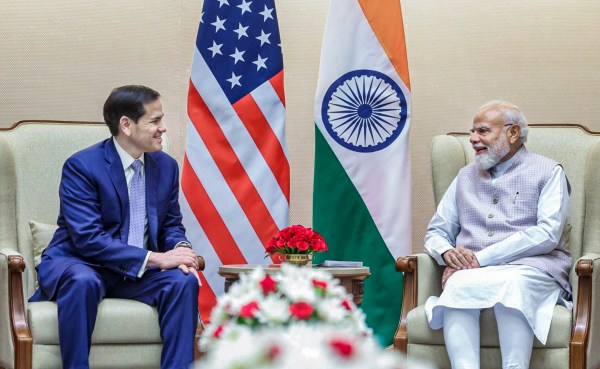 Prime Minister Narendra Modi with US Secretary of State Marco Rubio during a meeting, in New Delhi. (PTI Photo)
“There’s been some progress done, some progress made. Even as I speak to you now, there’s some work being done. There is a chance that, whether it’s later today, tomorrow, in a couple of days, we may have something to say,” Rubio told reporters in New Delhi.
Pressed on the contours of any potential deal, Rubio reiterated the three non-negotiable US demands first set out by Trump:
- Iran “can never have nuclear weapons”.
- The Strait of Hormuz must be reopened “without tolls”.
- Iran must “turn over the highly enriched uranium”.
“The President’s preference is always to solve problems such as these through a negotiated diplomatic solution. That’s what we’re working on right now… We hope it’s done through the diplomatic route,” Rubio said.
Story continues below this ad
Rubio had earlier said at a NATO ministers’ meeting in Helsingborg, Sweden, on Friday that some “slight progress” had been made but warned: “I don’t want to exaggerate it.” He added that all NATO allies “should reject” Iran’s plan to impose a tolling system on shipping through the Strait of Hormuz.
Mediators in motion: Pakistan and Qatar in Tehran
Pakistan Army Chief Field Marshal Asim Munir arrived in Tehran on Friday on his second mediation trip in five weeks, meeting Iran’s Parliament Speaker and chief negotiator Mohammad Bagher Qalibaf, President Masoud Pezeshkian and Foreign Minister Abbas Araghchi.
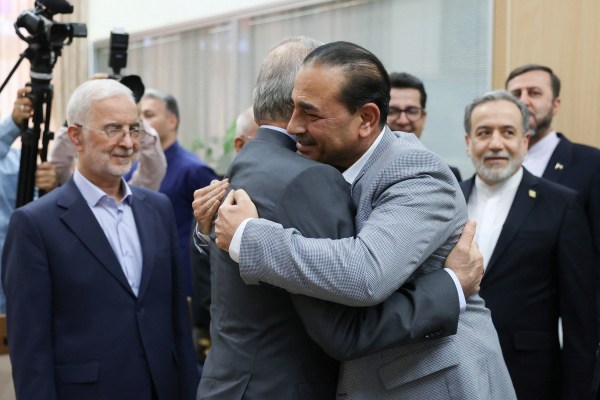 Iranian President Masoud Pezeshkian meets with chief of Defence Forces of Pakistan, Field Marshal Asim Munir, in Tehran, on May 23, 2026. (REUTERS)
Qatar has also dispatched a negotiating team to the Iranian capital, working in coordination with the United States, six weeks into what was once a Pakistan-brokered ceasefire that collapsed on April 13, Reuters reported.
The flurry of mediation comes against a backdrop of hardening Iranian positions. Qalibaf, during his meeting with Munir, warned that if Trump “acts foolishly and restarts the war, it will certainly be more crushing and bitter for America than the first day of the war.” Iranian armed forces, he said, had used the truce period to rebuild.
Story continues below this ad
Iranian foreign ministry spokesperson Esmail Baghaei added on Saturday that any mechanism concerning the Strait of Hormuz should be agreed between Iran, Oman and other countries bordering the waterway, and that the United States “has nothing to do with it.”
What’s at stake
The Strait of Hormuz handles roughly one-fifth of the world’s daily energy supplies in normal times. Its closure since the war began has driven a global energy crisis, with oil prices repeatedly spiking and Asian and European economies, including India, absorbing sharp inflation.
Iran’s enriched uranium stockpile, a core US demand, has emerged as the deepest sticking point. Reuters reported that Iranian Supreme Leader Ayatollah Mojtaba Khamenei, who succeeded his father Ali Khamenei after the latter was killed in the opening days of the war, has issued a directive that the uranium “should not be sent abroad.”
US Republican Senator Roger Wicker, a Trump ally, separately urged the president on Friday to “let the US military finish what it started.” Wicker said in a statement: “We are at a moment that will define President Trump’s legacy.”
(With inputs from agencies)