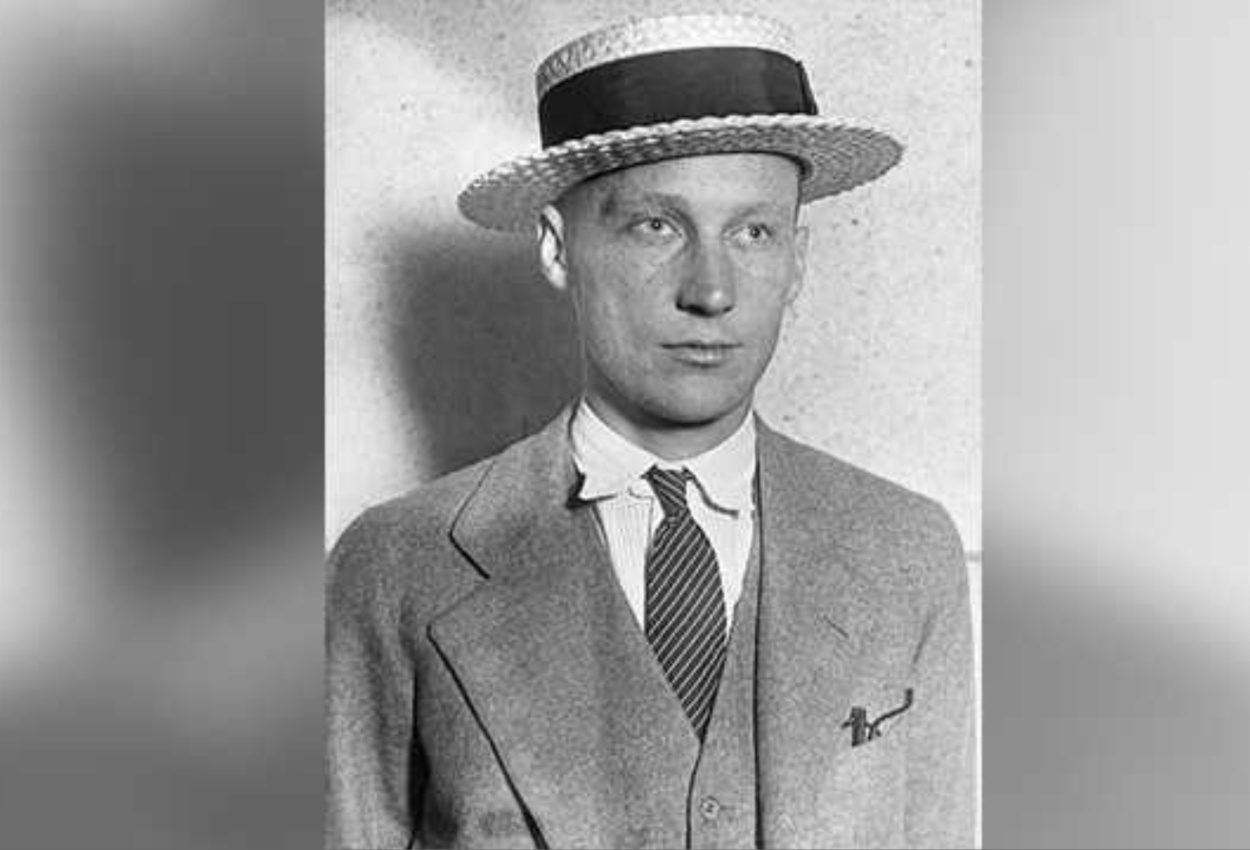
John Thomas Scopes (August 3, 1900 – October 21, 1970) was a teacher in Dayton, Tennessee. On May 5, 1925, he was charged with breaking Tennessee’s Butler Act, a law that banned teaching human evolution in state schools. Scopes went to court in what became known as the Scopes trial. He was found guilty and fined $100, which would be about $1,836 in 2025.
Profile Summary
| Category | Details |
|---|---|
| Full Name | John T. Scopes |
| Birth Name | John Thomas Scopes |
| Date of Birth | August 3, 1900 |
| Place of Birth | Paducah, Kentucky, U.S. |
| Date of Death | October 21, 1970 (aged 70) |
| Place of Death | Shreveport, Louisiana, U.S. |
| Alma Mater | University of Kentucky; University of Chicago |
| Occupations | Teacher; Football Coach; Geologist |
| Known For | Scopes Monkey Trial |
| Spouse | Mildred E. Walker |
| Children | 2 |
Age
John Thomas Scopes was born on August 3, 1900, in Paducah, Kentucky.
Biography
Scopes was born in 1900 to Thomas Scopes and Mary Alva Brown, who lived on a farm in Paducah, Kentucky. He was their fifth child and only son. When John was a teenager, the family moved to Danville, Illinois. In 1917, they moved again to Salem, Illinois, where he graduated from Salem Community High School in 1919.
He attended the University of Illinois for a short time but left because of health problems. In 1924, he graduated from the University of Kentucky with a major in law and a minor in geology.
Scopes moved to Dayton, Tennessee, where he worked as the football coach at Rhea County High School and sometimes filled in as a substitute teacher.
Trial
Scopes became involved in the Scopes trial after the American Civil Liberties Union (ACLU) said it would support a legal challenge to the Butler Act if a Tennessee teacher agreed to be the defendant.
A group of businessmen in Dayton, Tennessee, led by engineer and geologist George Rappleyea, saw the case as a way to bring attention to their town. Rappleyea pointed out that the Butler Act banned teaching human evolution, but the state-required textbook, George William Hunter’s Civic Biology (1914), included a chapter on evolution. At first, Scopes was hesitant to take part in the test case. After talking it over, he told the group at Robinson’s Drugstore, “If you can prove that I’ve taught evolution and that I can qualify as a defendant, then I’ll be willing to stand trial”.
When the trial started, Scopes’s defense team included Clarence Darrow, Dudley Field Malone, John Neal, Arthur Garfield Hays, and Frank McElwee. The prosecution, led by politician Tom Stewart, included Herbert Hicks, Sue K. Hicks, Wallace Haggard, Ben and J. Gordon McKenzie, and William Jennings Bryan with his son, William Jennings Bryan Jr. Years earlier, Bryan had spoken at Scopes’s high school graduation and recalled that Scopes was laughing during his speech.
More…
The trial ended on July 21, 1925, with Scopes found guilty and fined $100, which would be about $1,836 in 2025. In a 3–1 decision by Chief Justice Grafton Green, the court said the Butler Act was constitutional but overturned Scopes’s conviction because the judge, not the jury, had set the fine. The Butler Act stayed in place until it was repealed by the Tennessee legislature on May 18, 1967.
Scopes may not have actually broken the law he was charged with. After the trial, he told reporter William Kinsey Hutchinson, “I didn’t violate the law,” explaining that he had skipped the evolution lesson and that his lawyers had prepared his students to testify. The Dayton businessmen had assumed he had broken the law.
In 1955, the trial was turned into a play called Inherit The Wind, with Paul Muni playing a character based on Clarence Darrow and Ed Begley playing a character based on William Jennings Bryan. In 1960, a movie version starred Spencer Tracy as the Darrow character and Fredric March as the Bryan character.
Both the play and the movie change many facts from the real trial. For example, Bertram Cates is shown being arrested in class, put in jail, burned in effigy by angry townspeople, and taunted by a preacher. Matthew Harrison Brady, who is portrayed as a fanatic, dies suddenly while giving his closing speech in a chaotic courtroom. None of these events actually happened during the trial in Dayton, Tennessee.
Life after the trial
The outcome of the Scopes Trial had a big impact on Scopes’s career and personal life. He was often mocked in cartoons, animations, and other media in the years that followed. Scopes mostly avoided the spotlight.
In September 1925, Scopes began graduate studies in geology at the University of Chicago, where he later earned a master’s degree. Frank Thorne observed that Scopes was troubled by media attention: “You may be interested to know that Mr. John T. After the Tennessee Supreme Court decision in 1926, the press resumed its focus on Scopes. The media’s attention clearly affected Scopes emotionally.
After graduating, he was “barred” from career opportunities in Tennessee and accepted a position as a field engineer with Gulf Oil in Venezuela.
After leaving education, Scopes pursued a political career and ran unsuccessfully as the Socialist Party candidate for Kentucky’s at-large congressional seat in 1932. He later worked as an oil expert for the United Production Corporation, which became the United Gas Corporation. He was first based in Beeville, Texas, then worked in the Houston office until 1940, and later in Shreveport, Louisiana, where he remained until his death. United Gas merged into Pennzoil in 1968.
He attended the 1960 premiere of Inherit The Wind and participated in the celebration of John T. Scopes Day.
Scopes and the story of his trial were featured on the television game show To Tell The Truth on October 10, 1960.
In June 1967, Scopes published Centre of the Storm: Memoirs of John T. Scopes. The Butler Act was repealed that same year.
Personal life and death
In February 1930, while working in Maracaibo, Venezuela, Scopes married Mildred Elizabeth Walker (1905−1990). Together, they had two sons.
Scopes died of cancer on October 21, 1970, in Shreveport, Louisiana, at the age of 70.