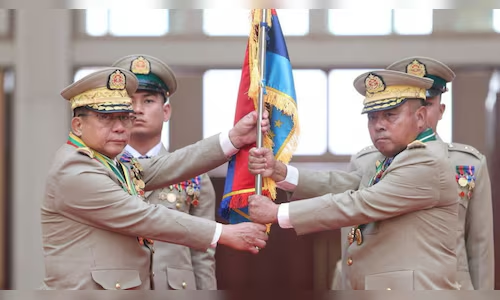
Myanmar President U Min Aung Hlaing is set to make an official visit to India from May 30 to June 3, accompanied by a high-level delegation comprising several Cabinet ministers, senior officials, and business leaders. India’s Ministry of External Affairs (MEA) said Hlaing is scheduled to hold discussions with Prime Minister Narendra Modi on June 1 to further strengthen historical and civilisational ties, and will also participate in a business forum.
Hlaing is slated to travel to Bodh Gaya on May 30 and to Mumbai on June 2 for business and industry interactions, as well as site visits.
Stating that Myanmar lies at the confluence of India’s Neighbourhood First, Act East, and MAHASAGAR policies, the MEA said Hlaing’s visit is expected to further strengthen and deepen the multi-faceted relationship between the two countries. Myanmar is part of the 10-member ASEAN bloc, which also comprises Brunei, Cambodia, Indonesia, Laos, Malaysia, the Philippines, Singapore, Thailand, and Vietnam.
It is among the trading blocs India is looking to boost exports to amid global trade uncertainties. ASEAN accounted for around 11% of India’s global trade, with bilateral trade touching $123 billion in FY25.
On May 6, the MEA had said India aims to achieve overall tariff liberalisation across 80% of tariff lines in its review of the ASEAN-India Trade in Goods Agreement (AITIGA), with liberalisation of at least 70% for each individual country.
Addressing the media in New Delhi during the state visit of Vietnam’s President earlier this month, MEA Secretary (East) P Kumaran said the AITIGA review was discussed at a broad level by the heads of state, with talks focused on an early conclusion of the review to help both sides achieve their trade targets.
On the demands raised by India, Kumaran said: “India had broadly indicated that it wanted to achieve an overall tariff liberalisation of 80%, with at least 70% for each individual country,” citing “multiple levels of development among ASEAN members”, with “some economies” being “extremely open like Singapore”, while others are less open. He added that the offer to India “shouldn’t be a simple weighted average of tariff liberalisation, but should be weighted by the size of the economy” as the comparison yardstick.
On negotiations between both sides, Kumaran said: “We seem to have arrived at some kind of understanding; details are being threshed out. We hope for greater clarity in the coming months on the review getting completed.”
On the AITIGA review, government sources had indicated last year that options remain open for separate FTAs with ASEAN member countries, noting that India already has FTAs with Singapore and Malaysia.
Earlier, sources had indicated that India was looking for a country-wise review of the AITIGA to contain its rising trade deficit with the 10-nation bloc. While India’s exports to ASEAN member countries rose 65.23% from $26,628 million in FY11 to $44,000 million in FY23, imports from ASEAN countries grew 186% from $30,608 million in FY11 to $87,577 million in FY23.
Even in FY24, India’s imports from ASEAN countries stood at $66,551 million against exports of $32,713 million to the bloc. In FY25, India’s exports to ASEAN stood at around $39 billion compared to imports of nearly $84 billion.
On the AITIGA review, sources had earlier pointed out that India had opened 71% of its tariff lines, while Indonesia had opened only 41%, Vietnam 66.5%, and Thailand 67%, despite India having a lower per capita income.
Stating that the government has merely reflected the concerns of Indian industry while renegotiating and reviewing the ASEAN FTA, sources had questioned why duties on Chinese imports were reduced during the UPA regime. Pointing out that subsidised goods from a third country were dumped into India until anti-dumping duties were imposed, sources said India had also cracked down on steel dumping through safeguard duties, as the “melt-and-pour” clause was not included in the ASEAN FTA.
In October 2024, Indian government sources had told CNBC-TV18 that bilateral positions of several ASEAN countries have changed since the agreement came into force in 2010, and some countries no longer hold the same positions. Stating that ASEAN is not a common customs union but a grouping of countries at different stages of development, sources added that India is trying to build flexibility into the review while engaging with individual member nations. Indian industry has repeatedly raised concerns over cheap imports from ASEAN countries affecting domestic sectors such as steel and electronics.