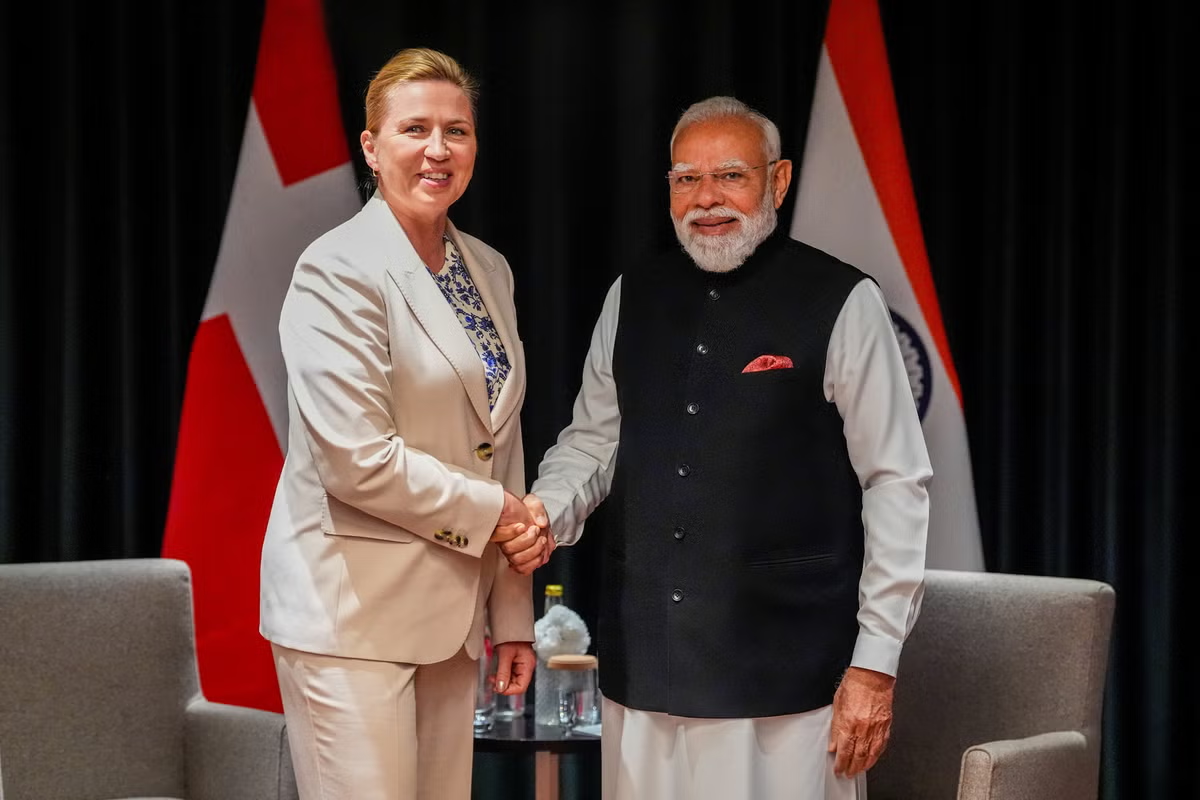
A Norwegian journalist is getting praise for asking tough questions to Narendra Modi and his officials during the Indian prime minister’s visit to the Scandinavian nation.
Helle Lyng, who works with the newspaper Dagsavisen in Oslo, went viral on social media after she sparred with Indian diplomats and asked the visiting leader why he did not address the press.
Mr Modi has not fielded a question at a solo press conference in India since becoming prime minister in 2014.
He has been repeatedly questioned about the erosion of press freedom and human rights during his four-nation European tour, which started with a two-day visit to the Netherlands on Saturday.
On Monday, the Indian leader appeared alongside Norwegian prime minister Jonas Gahr Store to make a joint statement and as they began leaving the room, Ms Lyng shouted: “Prime Minister Modi, why don’t you take some questions from the freest press in the world?”
Mr Modi did not stop to respond and continued walking out of the venue. It was unclear whether he heard the journalist’s question.
She later shared the video of Mr Modi walking out of the room, with a caption: “Prime minister of India, Narendra Modi, would not take my question, I was not expecting him to.”
“It is our job to question the powers we cooperate with,” the journalist added.
India is ranked 157th out of 180 countries in the 2026 World Press Freedom Index released by the advocacy group Reporters Without Borders, remaining in the “very serious” category. The country dropped six places from its 2025 ranking. Norway ranks first in the freedom index.
Ms Lyng’s questioning of Mr Modi snowballed into a tense exchange at a subsequent press briefing by the Indian foreign ministry where officials were pressed on press freedom and human rights.
“I am wondering as we strengthen our partnership, why should we trust you?” Ms Lyng asked.
She also questioned the officials whether India could “promise to stop the human rights violation that goes on” in the country and if Mr Modi would begin taking questions from the Indian media.
Senior diplomat Sibi George responded by defending India’s democratic credentials, arguing that the country’s actions during major international crises had earned global trust.
“Let me give a background of what India is and why should the world trust India,” he said, referring to the Covid pandemic as an example of its contribution to the world.
He continued to talk about India being “a civilisational country which has something unique to offer to the world”.
“We have a constitution which guarantees the fundamental rights of the people. We have equal rights for the women of our country, which is very important,” he said.
Mr George criticised the “limited” international understanding of India’s media landscape and targeted reports questioning violations of human rights in India.
“People have no understanding of the scale of India,” he said, adding that Delhi alone had hundreds of television news channels. “People read one or two reports published by some godforsaken, ignorant NGO and then come and ask questions,” he said, referring to non-governmental organisations.
In a subsequent post on X, Ms Lyng said she tried multiple times to “get them to be specific on human rights, but I was unsuccessful”.
“The representatives talked about India’s effort during Covid and also yoga, among other things,” she noted.
Indian opposition leader Rahul Gandhi criticised Mr Modi. “What happens to India’s image when the world sees a compromised PM panic and run from a few questions?” he asked “When there is nothing to hide, there is nothing to fear.”
Over the weekend, Dutch prime minister Rob Jetten had voiced concern about the erosion of press freedom and minority rights in India ahead of his meeting with Mr Modi, prompting a sharp reaction from Delhi.
Mr Jetten was speaking to the press ahead of the meeting when he was asked about concerns over the state of press freedom and minority rights in India, according to the newspaper De Volkskrant.
“It is not only about press freedom but also about the rights of minorities, who are under severe pressure. That applies in the first place to the Muslim community but also to many other smaller communities,” Mr Jetten was quoted as replying by the paper.
“The concern is to what extent India remains an inclusive society where the same rights apply to everyone.”