By Kunle Somorin
There is a particular kind of silence that precedes a tectonic shift in the Nigerian political landscape—a silence not of absence, but of heavy, expectant mass. In Ogun State, that silence has been broken. The political plates, which for decades have settled into a comfortable, if exclusionary, duopoly between the East (Ijebu/Remo) and the Central (Egba) axes, are undergoing a realignment. This feels less like a standard election cycle and more like a generational settlement.
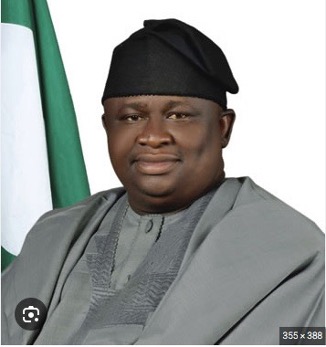
We are witnessing the end of a long-standing political subalternity. At the center of this reconfiguration stands Senator Solomon Olamilekan Adeola, known colloquially as ‘Yayi’—a figure whose gubernatorial trajectory has moved from the realm of ambitious speculation into the airless heights of near-certainty.
To observe Adeola’s rise is to witness the politics of overwhelming presence. In the granular world of Ogun politics, his projects do not merely exist; they saturate the public consciousness. Across the rugged terrains of Ogun West, the mercantile hubs of the East, and the historic corridors of the Central district, his interventions—ranging from high-tech schools and primary health centers to expansive solar grids—have effectively blurred the line between legislative representation and a shadow executive. It is a campaign conducted in the language of concrete, steel, and light, executed with such logistical precision that it has begun to function as a de facto government years before a single ballot is cast.
Yet, to reduce Adeola’s ascendancy to mere “financial muscle” is to overlook the sophisticated psychological engineering at play. His transition from the hyper-competitive furnace of Lagos politics to the Yewa heartland represents perhaps the most successful political repatriation of Nigeria’s Fourth Republic. He has deftly neutralized the “outsider” stigma—once a potent weapon for his detractors—by repositioning himself as the singular vessel for a fifty-year-old grievance. Ogun West, the perennial bridesmaid of the state since its creation in 1976, has found in Adeola a candidate who possesses the rare alchemy of local legitimacy and cosmopolitan clout.
Unlike previous cycles where the West’s ambitions were cannibalized by a surplus of ego and a deficit of strategy, 2027 presents a unified, almost sacred consensus. The “Yewa-Awori” identity has transitioned from a sociological category into a disciplined, formidable voting bloc.
Equity, however, is merely the moral scaffolding. The true structural integrity of the Yayi movement lies in the “Triple Alliance” he has meticulously curated. Adeola does not run merely as an individual; he runs as the consensus choice of a regional and national hegemony. He enjoys the explicit imprimatur of the Tinubu Presidency—a federal backing that provides both a psychological shield and a strategic sword. This is bolstered by the unwavering support of the APC’s South-West leadership and the crucial endorsement of the incumbent, Governor Dapo Abiodun.
This fusion of state incumbency, federal might, and sub-ethnic unity has created a machinery of terrifying efficiency. Crucially, the demographic wind is at his back; the youth population, largely indifferent to the atavistic rivalries of the old guard, see in the “Yayi” brand a promise of high-capacity, modern governance. The “Friends of Yayi” initiative, which has seen voluntary contributions exceed ₦1.5 billion, is not merely a fundraising exercise; it is a signal of a grassroots-plutocratic fusion that is increasingly rare in the fractured landscape of Nigerian party politics.
Against this formidable array of forces, the candidacy of Honourable Ladi Adebutu increasingly resembles a study in tragic persistence. Adebutu represents “the missed road.” His insistence on contesting the governorship from the Remo axis—a region that already enjoys the incumbency of the Governor and the senatorial presence of Gbenga Daniel—violates the unwritten, yet ironclad, “federal character” of Ogun’s internal politics.
Sub-regional overcrowding is not just a logistical problem for Adebutu; it is a moral one. In the eyes of the electorate, his ambition appears out of sync with the state’s historical pendulum. Had he pivoted to the Ogun East Senate seat, he might have emerged as a sophisticated third-way figure—a compromise between the clashing ambitions of the Abiodun and Daniel camps. Instead, he finds himself tilting at windmills, fighting both the moral logic of the West’s turn and the overwhelming incumbency logic of the APC.
The judicial intervention of May 2026 has added a layer of procedural intrigue to this drama. Justice M.G. Umar’s ruling on the sanctity of electoral timetables, which nullified INEC’s attempt to truncate the calendar, has provided a necessary “constitutional pause.” For Adeola, this is a period of further absorption—a time to continue the quiet work of dismantling the PDP’s peripheral networks and folding them into his movement. For Adebutu, the ruling is a reprieve that feels increasingly like a stay of execution; a narrow window to recalibrate that is being shuttered by the daily reality of defections and endorsements.
The intellectual and administrative engine driving the Adeola campaign is equally significant, guided by a “praetorian guard” of high-caliber mandarins. Dr. Isiaq Salako provides a layer of policy gravitas; Alhaja Salmot Badru effectively dismantles opposition networks at the grassroots; and Senator Tokunbo Afikuyomi navigates the complex power currents of Abuja and Lagos. Furthermore, the endorsement of Oba Kehinde Olugbenle, the Olu of Ilaro, and other traditional rulers has given the bid a communal sanctity that is difficult to pierce.
Statistically, the terrain is unforgiving. Current modeling suggests a 72% probability of an Adeola victory. The “Lagos stigma” rings increasingly hollow against the backdrop of massive, tangible investment across all three districts. To secure the Egba heartland, Adeola needs only ensure a judicious selection of a Deputy Governor from Ogun Central, reassuring traditional powerbrokers—the Obasanjos and the Amosuns—that their regional interests remain protected. Should he choose a credible running mate from Ijebuland, the possibility of a crushing defeat for Adebutu becomes nearly incontrovertible.
In the final analysis, the 2027 Ogun gubernatorial race appears less like a traditional contest and more like a correction of history. The “oak tree” of Ogun West has not just been planted; it has taken deep, immovable root in the fertile soil of consensus and capacity. Adebutu may continue to crow like the rooster in a crowded compound, but the dawn has already been claimed by the oak. For a state that prides itself as the intellectual and political gateway of the republic, this realignment is the inevitable arrival of a new, well-engineered era. The plates have shifted; the settlement is here.
*Somorin, a veteran journalist, was Chief Press Secretary to Ogun State governor