Puri said the visit comes at a crucial time after India signed what he described as a landmark free trade agreement with the European Union earlier this year.
“This outreach is very important as we push to try and get the EU FTA on board and operational,” Puri said, adding that the deal carries “game-changing possibilities for India”.
According to Puri, the European Union remains one of India’s most important economic partners, serving as a major investor and among the country’s largest trading partners. He said India’s effort to engage not only France and Germany, but also other influential European economies such as the Netherlands, Sweden, Norway and Italy, reflects a broader strategic shift.
“We are already the fifth-largest economy, and nothing is going to stop us from becoming the third-largest economy, larger than any other economy in Europe,” he said.
Puri noted that Europe’s approach towards Asia is also evolving, with countries increasingly looking beyond China as India’s economic influence expands globally. He said India’s growing ties with Europe would support “multipolarity and multi-alignment in the world”.
The former diplomat also highlighted the importance of technology partnerships with Europe, especially in semiconductors, pharmaceuticals and advanced manufacturing. Referring to the COVID-19 pandemic, Puri pointed out that RNA vaccines were originally developed by a German company before being commercialised globally.
“Their abilities in semiconductors and high tech are tremendous,” he said, adding that major Indian firms such as Tata Consultancy Services, Infosys and Wipro already have a significant presence across Europe.
Prime Minister Modi’s Europe tour began after his visit to the UAE, where India signed key energy and infrastructure agreements amid growing global concerns over disruptions around the Strait of Hormuz. Puri said the Gulf relationship remains central to India’s energy security strategy.
“In the current context, with the Strait of Hormuz in the tied-up state it is very important that we reach out to others and find other ways of doing so,” he said.
He also linked the outreach to the India-Middle East-Europe Economic Corridor (IMEC), launched during India’s G20 presidency, which aims to strengthen connectivity between India, the Gulf region and Europe through multimodal transport networks.
After concluding his UAE visit, Prime Minister Modi travelled to the Netherlands, where discussions covered trade, investment, semiconductors, renewable energy and geopolitical developments, including the Ukraine and Iran conflicts. India and the Netherlands signed 17 agreements, including a semiconductor partnership involving ASML and Tata.
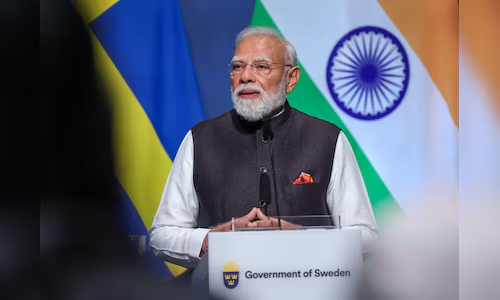
The Prime Minister later visited Sweden, where talks focused on innovation, sustainability and research and development. Modi also met chief executives from major global companies including Vodafone, Nokia, Shell, Airbus, Volvo, Maersk, Nestlé and Unilever.
Puri described Sweden as a “powerhouse economy” despite its relatively small size and said Swedish firms have historically had a “game-changing impact” in India.
Prime Minister Modi then travelled to Norway for the India-Nordic Summit, marking the first visit by an Indian Prime Minister to the country in more than four decades. Discussions are expected to focus on green technology, defence, supply chains, the blue economy and space cooperation.
Puri said Norway’s importance extends beyond bilateral ties, noting that its sovereign wealth fund is among the largest in the world and is actively looking at investment opportunities in India.
“It’s a way of reaching out across the board, not just to the biggies of Europe, France and Germany, but also across Northern Europe,” he said.
During the Oslo visit, Prime Minister Modi was awarded the Grand Cross of the Royal Norwegian Order of Merit, the highest grade of the honour. Leaders from Denmark, Finland, Iceland, Norway and Sweden are attending the summit, with India-Nordic trade reaching $19 billion in 2024.
The final leg of Modi’s tour will take him to Italy for talks with Italian Prime Minister Giorgia Meloni aimed at deepening trade and investment ties following the India-EU FTA.
Also Read | PM Modi says India-Europe ties entering ‘golden age’ as Norway pledges $100 billion investment
Calling Italy a “powerhouse” and a key G7 member, Puri said India’s engagement with Rome spans sectors including defence, chemicals and water management. He stressed that countries such as Italy, Sweden and the Netherlands are critical to India’s long-term European strategy.
“The signal that India has been giving since the FTA was signed is that we are open for international business,” Puri said.