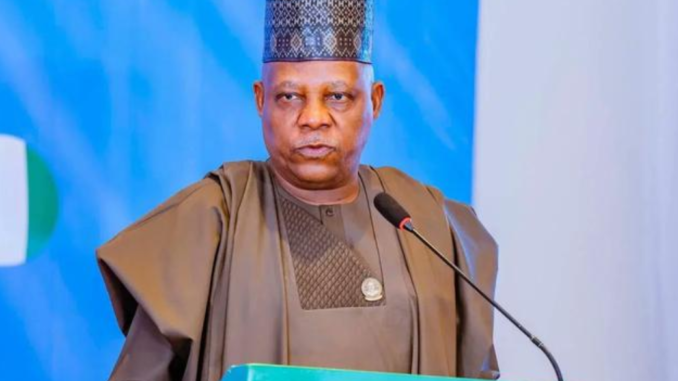
According to a report by Vanguard on Tuesday, May 19, 2026, Vice President Kashim Shettima has revealed that President Bola Tinubu was once advised by some individuals from Borno State to stop wearing traditional outfits given to him during the 2023 election campaign, following claims that the clothing had been used for mystical purposes and could allegedly cause harm.…....
Shettima said the allegation suggested that the garments were “spiritually manipulated,” with those making the claim warning that continued use might endanger the President’s life.
He, however, stated that President Tinubu rejected the insinuation outright and responded by continuing to wear the outfits for several days in a symbolic gesture meant to dismiss the claim.
The Vice President made the disclosure in Abuja while representing the President at the public presentation of the autobiography of former Head of State Yakubu Gowon, titled My Life of Duty and Allegiance.
Shettima used the anecdote to draw attention to what he described as an increasing atmosphere of mistrust in Nigeria’s political and social interactions, contrasting it with earlier eras of leadership marked by greater confidence and openness.
He referenced historical accounts shared at the event involving goodwill exchanges between past leaders and traditional institutions, noting that such relationships were once built on trust rather than suspicion.
According to him, earlier generations of Nigerian leaders engaged with one another and with traditional institutions in a spirit of openness that is gradually diminishing in contemporary times.
Shettima also revisited his role during the 2023 campaign period, explaining that he had personally arranged traditional attire from Borno State for then-presidential candidate Bola Tinubu to wear during campaign visits to northern Nigeria.
He said the intention was to help the candidate connect more easily with local communities, and the outfits reportedly became a regular feature of Tinubu’s appearances throughout the campaign season.
However, he noted that the issue resurfaced after the election, when he returned from an official engagement abroad and was briefed about concerns allegedly raised by some visitors regarding the origin and meaning of the clothing.
Shettima recounted that Tinubu later informed him of the matter, saying he had been told by some individuals that the outfits should no longer be worn due to unfounded fears linked to spiritual interpretations.
He added that the President dismissed the claims as baseless and inconsistent with known facts surrounding the campaign period, when political roles and outcomes had not yet been determined.
According to Shettima, Tinubu’s decision to continue wearing the attire was a clear indication of his rejection of the allegations and an attempt to demonstrate confidence in the relationship built during the campaign.
The Vice President further stated that such incidents reflect broader challenges in the country, where misinformation and suspicion can sometimes distort perceptions of political relationships and intentions.
In his remarks, Shettima also paid tribute to former Head of State Yakubu Gowon, describing him as a symbol of national unity whose leadership style emphasised reconciliation and institutional stability.
He highlighted Gowon’s contributions to post-war reconciliation, the establishment of the National Youth Service Corps (NYSC), and his role in regional cooperation through the Economic Community of West African States (ECOWAS).
Shettima described Gowon as a defining figure among Nigeria’s post-independence leaders and said the autobiography represents an important contribution to documenting the nation’s historical journey at a time when reflection and unity are needed.