A coalition of Democratic-led states has filed a lawsuit against the Trump administration over a new rule limiting access to federal student loans for students pursuing advanced degrees in healthcare and other fields.
In a complaint filed Tuesday in the U.S. District Court for the District of Maryland, officials from 23 states and the District of Columbia argued that the Department of Education’s rule is both “arbitrary” and “unlawful.” Attorneys general from New York, California, Michigan, Wisconsin, and Virginia, among other states, joined the suit, along with the governors of Pennsylvania and Kentucky.
“Across the nation, healthcare systems are underwater, with doctors, nurses, and other health professionals stretched to meet the needs of their communities,” California Attorney General Rob Bonta said in a press release. “Now, the Trump Administration is threatening to make this crisis even worse by limiting students’ access to the federal student loans that make it possible to pursue the professional degrees needed for critical specialized work.”
The lawsuit centers on a provision in the “Big, Beautiful Bill,” a sweeping spending package signed into law by President Donald Trump last July.
The law imposed new limits on federal student borrowing, creating a distinction between “graduate” and “professional” students. Graduate students are capped at $20,500 annually and $100,000 in total loans, while professional students — including those in medical and law schools — can borrow up to twice those amounts. Previously, students could take out loans covering the full cost of attendance regardless of classification.
Last month, the Education Department issued a final rule to implement the new caps, clarifying that “physician assistant, physical therapy, occupational therapy, social work, graduate-level nursing programs, Doctor of Public Health programs, and similar graduate programs” do not “fall within the incorporated professional degree framework.”
In their lawsuit, the Democratic-led states argue that the new rule conflicts with existing law governing the definition of a “professional degree.”
“The Department arbitrarily relied on several factors Congress did not intend it to consider — such as whether professionals are subject to supervision,” the complaint states.
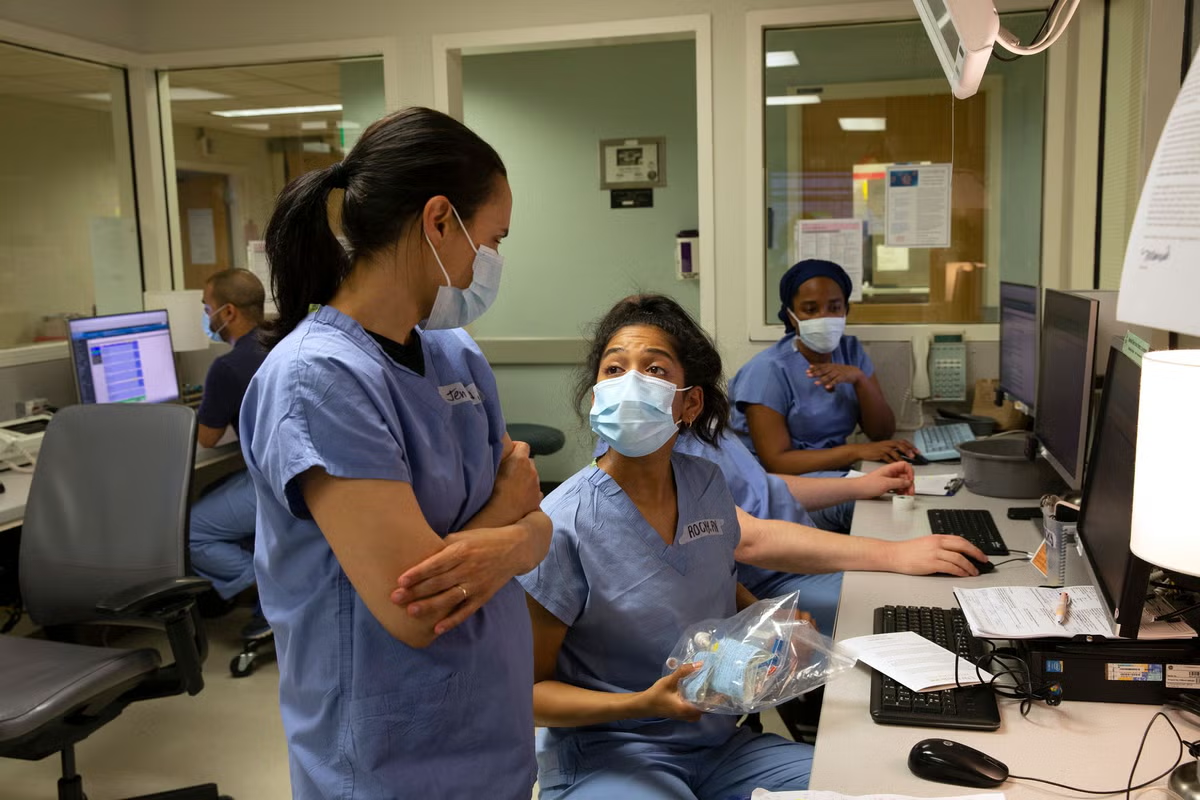
The filers also contend that the new loan caps could have drastic consequences for a health care system already under strain.
“The change in definition will discourage potential healthcare workers from entering the field, at a critical time when more dedicated professionals in these roles are needed,” Bonta said. “The new rule will also discourage students from seeking graduate degrees by making such degrees inaccessible or more expensive and may push students toward often-predatory private student loans.”
The Department of Education has pushed back against these claims.
“For years, Democrats parroted illegal student loan forgiveness to ‘end the debt crisis’ and buy votes, and now the same people are fighting against the Trump Administration’s legal efforts to drive down the cost of college,” Under Secretary of Education Nicholas Kent told The Independent.
“After decades of unchecked student loan borrowing that gave schools no reason to control costs, these commonsense loan caps – created by Congress – are already incentivizing colleges and universities to lower tuition,” Kent added. “Clearly, these Democratic governors and attorneys general are more concerned about institutions’ bottom-line rather than American students and families’ ability to access affordable postsecondary education.”
In a November press release, the department stated that most nursing students borrow less than the annual limit and therefore would not be affected by the caps.
Under Secretary Linda McMahon, the department has reduced its workforce by nearly 50 percent and shifted dozens of programs to other agencies, including transferring the federal student loan portfolio to the Treasury Department.
Critics argue that McMahon has systematically dismantled the federal government’s education system, depleted public school funding and slashed civil rights enforcement. She has said she’s following through on Trump’s pledge to “sunset” a “failed federal education bureaucracy” and return power to state and local officials.
The U.S. has among the most expensive higher education systems in the world, with college costs rising 169 percent since 1980, according to a 2021 study from Georgetown University researchers.
At the same time, student loan debt has also ballooned. As of 2023, 43 million borrowers owed $1.6 trillion in federal student loans — exceeding total credit card and auto loan debt.