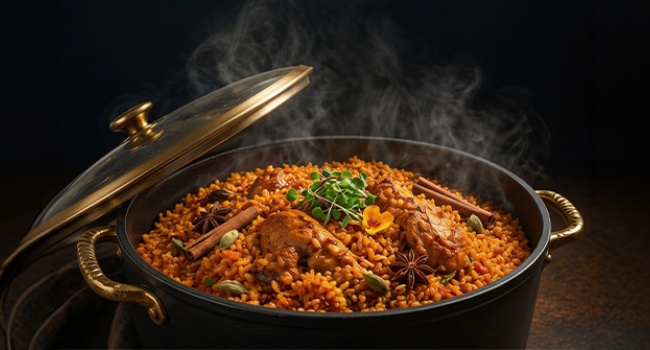
The story of inflation in Nigeria is not written in central bank communiqués or quarterly GDP reports. It is written in the cost of a pot of jollof rice.
SBM Intelligence has tracked the price of this national staple across markets since 2016, and the trajectory is a chronicle of a country slowly pricing itself out of its own citizens’ reach.
In the first quarter of 2026, the national average cost of a standard pot of jollof rice hit an all-time high of ₦30,435. To understand what this number means, you have to walk back through the wreckage of the past six years.
In April 2020, at the peak of the COVID-19 lockdowns and the land border closure, a pot cost ₦7,590. The pandemic disrupted supply chains, and the border closure, imposed in August 2019 to curb rice smuggling, had unintended consequences.
READ ALSO: UPDATED: Nigeria’s Inflation Rate Hits 15.69% – NBS
It choked off legal imports and drove up local prices without a corresponding boost to domestic production. By early 2022, the cost had climbed to ₦8,595. Diesel prices had surged, petrol was scarce, and insecurity in food-producing regions was beginning to bite.
Year Of Shocks
Then came 2023, the year of shocks. In March 2023, the naira redesign cash crunch and fuel scarcity pushed the price to ₦10,882. In May, the new government removed the fuel subsidy and unified the exchange rate.
The pass-through was almost instantaneous, and by June, the same pot cost ₦12,373. Imported inputs, from rice to vegetable oil to seasoning, became more expensive as the naira lost value.
By September 2023, the price had reached ₦13,106, driven by the continued effects of subsidy removal and the closure of the border with Niger, which disrupted grain and onion supplies.
This trend has not relented. By March 2024, the naira had plunged to over ₦1,600 per dollar, and imported food inflation was rampant, and a pot cost ₦16,955. By June 2024, a tomato pest infestation (the Tuta absoluta) had doubled the price of fresh tomatoes, pushing a pot to ₦20,274.
In September 2024, petrol prices were hiked to ₦1,030 per litre, and unprecedented floods across 29 states further devastated farmland. The cost rose to ₦21,300. By March 2025, it had reached ₦25,486. In June 2025, it peaked at ₦28,066.
The only respite came in the third quarter of 2025, when a seasonal harvest influx brought a temporary decline to ₦26,656. But even that correction was fragile and localised. In Kano, the index still rose 6.8 per cent, driven by logistics costs, informal checkpoints, and the embedded risk premiums that insecurity imposes on every bag of grain moved from farm to market.
Iran War
Then came the Iran War. In February 2026, Brent crude spiked above $110 per barrel. Nigeria, despite being Africa’s largest oil producer, has no strategic fuel reserve, so petrol prices nearly doubled, while diesel surged above ₦1,500 per litre.
Transport fares tripled on some corridors, grain freight costs rose 56 per cent, and by the end of March 2026, the Jollof Index hit its record high of ₦30,435.
What does this mean for the average Nigerian?
When a pot of jollof rice costs more than the monthly minimum wage in some states, the meal moves from a daily staple to a weekly luxury. Families adjust by reducing portion sizes, substituting ingredients, or skipping meals altogether.
A report from the National Bureau of Statistics in early 2026 found that 63 per cent of households had reduced their food intake over the previous year, and 41 per cent had skipped an entire day’s meal because they could not afford to eat.
The impact extends beyond hunger. When transport fares triple, a teacher in Dugbe may find that commuting to work in Bodija consumes half their daily earnings. The rise in diesel prices will cause a cold room operator in Port Harcourt to discard spoiled produce because they cannot afford to run the generator, creating more competition for what remains, and raising the cost.
As we have seen due to the Iran War, when fertiliser becomes too expensive, a farmer in Kaduna may plant less, harvest less, and earn less, perpetuating a cycle of poverty that no interest rate cut can break.
Political Expediency
The government’s response has been a mixture of macroeconomic orthodoxy and political expediency. The fuel subsidy removal and exchange rate unification were necessary, even overdue. Keeping the subsidy would have meant borrowing an additional ₦4 trillion in 2025 alone, money the country simply does not have.
But these reforms were implemented without a credible safety net, without a functional strategic fuel reserve, and without the complementary investments in agriculture and logistics that would have cushioned the blow for those least able to bear it. The poor have shouldered the adjustment almost alone.
Looking forward, the government must move beyond macroeconomic fixes and address the structural fragility that the Jollof Index exposes. The first step is to decentralise the National Strategic Grain Reserve, if it is still functional at all.
Currently, the government owns 33 silo complexes scattered across the country with a combined capacity of over one million metric tonnes, but many of these silos remain underutilised, and in some cases, dilapidated. The proposed National Food Reserve Agency Bill, currently before the National Assembly, seeks to institutionalise grain reserve management, but the legislation does not go far enough in devolving authority to state and local governments.
Reserves that are controlled exclusively from Abuja will always be slow to respond to localised shortages. Storage facilities should be managed at the state level, with federal support and oversight, so that grain can be deployed quickly to communities facing acute scarcity without waiting for distant bureaucracies to act.
The second priority is the creation of off‑grid cold storage infrastructure at market and community level. Post‑harvest losses in Nigeria are estimated at between $2.3 billion and $3.7 billion annually, with some government estimates placing the figure as high as $10 billion, and agritech expert Ayomide Olugbade has warned that over 50 per cent of the country’s fruit and vegetable output is lost primarily due to a lack of storage.
The solution already exists. ColdHubs, a Nigerian company, operates solar‑powered cold rooms that can extend the shelf life of fresh produce from two days to up to three weeks, and HortiNigeria has reported cutting post‑harvest losses by 83 per cent in its intervention areas using exactly such technology.
With off‑grid solar cold rooms, produce stays fresh, farmers gain control over market timing, and food prices stabilise without reliance on expensive diesel generators. This technology exists; what is missing is the political will to scale it nationally.
Until Nigeria decentralises its grain reserves and deploys solar cold storage at every major market and farming cluster, the Jollof Index will continue to climb, and the arithmetic of survival will become an equation that too many Nigerians can no longer solve.
Nwanze is a partner at SBM Intelligence.