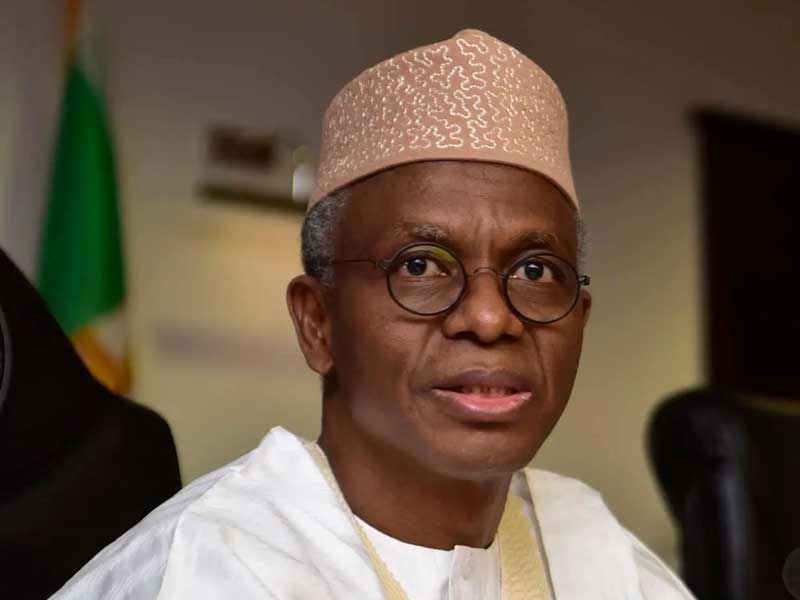
Is El-Rufai above the law? asks
ADAMU MUHAMMED
The recent call by former a presidential aide, Lauretta Onochie for the release of former Kaduna State Governor, Nasir El-Rufai, has once again exposed a dangerous tendency among sections of Nigeria’s political elite: the deliberate politicisation of accountability and the weaponisation of public sentiment against the institutions of justice.
From emotional social media campaigns to alarmist accusations of political persecution, the growing attempt to portray El-Rufai as a victim of state oppression is deeply misleading. It is an orchestrated effort to intimidate investigative institutions, undermine judicial processes, and manipulate public opinion before the courts have had the opportunity to determine the facts.
Democracy does not function on sentiments. The rule of law is not built on emotions, propaganda, political affiliations, or media outrage. It is built on evidence, procedure, and judicial determination. This is the inconvenient truth many of El-Rufai’s defenders appear unwilling to accept.
The statement credited to Onochie, demanding El-Rufai’s immediate release while alleging political intimidation, exemplifies the disturbing trend of attempting to substitute legal reasoning with political theatrics. Her argument essentially assumes that because El-Rufai belongs to the opposition, he must automatically enjoy immunity from investigation or prosecution. That is not democracy. That is political exceptionalism. The core question Nigerians should ask is simple: Is Nasir El-Rufai above the law?
If the answer is no, then he must submit himself fully to the legal process like every other citizen. If there are allegations against him bordering on abuse of office, financial misconduct, illegal wiretapping, or other grievous infractions reportedly under investigation, then the proper place to clear his name is in court, not on social media platforms or through orchestrated political campaigns.
Ironically, many of those now shouting “political persecution” were either silent or openly supportive when state institutions pursued political opponents during previous administrations. Some even applauded the aggressive use of anti-corruption agencies when it suited their political interests. It is therefore hypocritical to suddenly discover democratic sensitivities only when one of their own becomes the subject of investigation.
Even more troubling is the attempt to create a false binary between opposition politics and criminal accountability. In any functional democracy, opposition status does not confer legal immunity. Being a critic of the government does not exempt anyone from investigation where credible allegations exist.
The opposition cannot arrogate to itself the role of intermediary between the Nigerian state and the judiciary. Neither political parties nor pressure groups determine guilt or innocence. Courts do. Investigative agencies do not require opposition approval before carrying out their constitutional responsibilities.
The dangerous narrative being pushed by El-Rufai’s supporters seeks to delegitimize any legal action against opposition figures, regardless of evidence. By this logic, every investigation involving a politician outside the ruling party automatically becomes “political persecution.” Such reasoning is not only intellectually dishonest but also destructive to democratic institutions.
It is important to remind Nigerians that due process includes investigation, arraignment, bail hearings, prosecution, defence, and judicial determination. Selectively embracing only the parts of due process that favour the accused while condemning lawful investigation is not a defence of democracy. It is an assault on justice.
If indeed El-Rufai believes the allegations against him are fabricated, then the courts provide him with the constitutional avenue to challenge them. He is not without legal representation. He is not denied access to judicial remedy. He is not the first politically exposed person to face investigation. What then exactly is the basis for the hysteria?
The notion that his detention alone proves persecution is legally weak and politically manipulative. Courts routinely decide matters concerning bail, detention, and prosecutorial procedure based on the specifics of each case. These are judicial matters, not political popularity contests.
Furthermore, the repeated claim that El-Rufai’s release is being tied to political conditions such as returning to the ruling party remains speculative and unsupported by verifiable evidence. Serious democratic discourse cannot be built on rumours, insinuations, and politically convenient conspiracy theories.
What is perhaps most ironic about the current campaign is that El-Rufai himself was never known as a political moderate during his years in power. He was often unapologetically combative, dismissive of dissenting voices, and unrestrained in deploying state power against perceived opponents. Many Nigerians still remember the numerous controversies that trailed his administration in Kaduna State, including accusations of political intolerance and divisive governance.
It is therefore curious that some of his supporters now seek to present him as the symbol of democratic victimhood.
Nigeria’s democracy cannot mature if political elites only support accountability when it affects others. The anti-corruption fight loses credibility when politicians demand selective justice depending on party affiliation. The judiciary becomes endangered when public pressure campaigns seek to blackmail courts into predetermined outcomes.
This is why Nigerians must resist attempts to reduce serious legal proceedings into partisan propaganda battles.
The real test of democracy is not whether opposition figures are investigated. It is whether they are afforded fair hearing, legal representation, and constitutional protections during the judicial process. So far, there is no credible evidence suggesting that El-Rufai has been denied these rights.
Democracy is not endangered because a politician is being investigated. Democracy is endangered when political actors seek to intimidate institutions from performing their constitutional duties.
The Nigerian state also has a responsibility to ensure that investigations and prosecutions are conducted professionally, transparently, and within the ambit of the law. Justice must not only be done; it must be seen to be done. But insisting on due process is entirely different from demanding immunity from accountability.
There is also a broader national implication. If high-profile politicians can successfully mobilise ethnic, partisan, and emotional sentiments to evade legal scrutiny, then ordinary Nigerians lose confidence in the justice system. The perception that powerful individuals are untouchable is precisely what has weakened public trust in governance over the years.
No democracy survives when the elite treat accountability as persecution.
Those calling for El-Rufai’s unconditional release should therefore exercise restraint and allow the judiciary to perform its constitutional role. Courts are not extensions of political parties. Judges are not campaign managers. Investigative agencies are not expected to suspend lawful inquiries simply because political actors raise noise.
If El-Rufai is innocent, the courts will provide him the opportunity to establish his innocence. If the allegations are weak, competent lawyers can dismantle them through legal argument and evidence. That is how constitutional democracy works.
What must be rejected, however, is the dangerous attempt to delegitimise the Nigerian state and judicial institutions through sensational accusations designed to inflame partisan passions.
The rule of law does not pander to sentiments. It answers only to facts, evidence, and judicial interpretation. That is the principle that must prevail, regardless of who stands accused.
Muhammed writes from Kaduna State