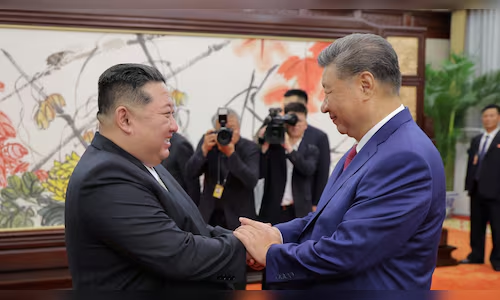
The leaders of the world’s two largest economies will hold their first face-to-face talks in more than six months as they try to stabilise ties strained by trade, the U.S. and Israeli war with Iran and other areas of disagreement.
Trump is scheduled to arrive in Beijing on Wednesday, ahead of talks set to take place Thursday and Friday. It will be his first trip to China since 2017.
AGREEMENTS ON PLANES, AGRICULTURE AND TRADE
The US and China are expected to agree to forums to facilitate mutual trade and investment, while China is expected to announce purchases related to Boeing airplanes, American agriculture and energy, the officials said.
Plans for a Board of Trade and Board of Investment may be formally announced at the meeting, but those mechanisms may need subsequent work before they can be implemented, one of the officials said.
The two countries will also discuss lengthening a truce in their trade war that allows rare earth minerals to flow from China to the US, though it is not yet clear if that agreement will be extended this week, that official said.
He nonetheless expressed confidence that the deal, which was struck last autumn and remains in effect, will eventually be extended.
“It doesn’t expire yet,” the official told reporters. “I’m confident we’ll announce any potential extension at the appropriate time.”
China’s embassy in Washington declined to comment.
THORNIER ISSUES INCLUDE TAIWAN, NUCLEAR ARMS, IRAN AND AI
The Trump-Xi talks are also expected to veer into areas that have long been a source of US-China tension, including Iran, Taiwan and nuclear arms.
China maintains ties with Iran and remains a major consumer of its oil exports. Trump has been leaning on China to use its influence to push Tehran to make a deal with Washington and end the conflict that began when the US and Israel launched strikes on Iran in late February.
The Trump administration also has pressed China on its dealings with Russia.
“The president has spoken multiple times with General Secretary Xi Jinping about the topic of Iran and about the topic of Russia, to include the revenue that China provides to both those regimes, as well as dual-use goods, components and parts, not to mention the potential of weapons exports,” said one of the officials. “I expect that conversation to continue.”
Xi, meanwhile, is frustrated with Washington over Taiwan. The US remains the most important international backer and arms supplier for the democratically governed island, which Beijing claims as its own Chinese territory.
China has ramped up its military presence near Taiwan in recent years, but US policy will not change, the official said.
The Trump aides expressed increasing concern about advanced artificial intelligence models being developed in China and believed the two sides need “a channel of communication” to avoid conflicts arising from their use.
“What that looks like is yet to be determined, but we want to take this opportunity with the leaders meeting to open up a conversation and to see if we should establish a channel of communication on AI matters,” said one of the officials.
Washington has also long hoped to open up talks with Beijing about nuclear weapons, though China remains reluctant to discuss its arsenal. The Chinese government has said privately to the US that “they have no interest in sitting down and discussing any kind of nuclear arms control or anything along those lines at this point,” the official said.
Trump and Xi’s last meeting was in October in South Korea, where they agreed to pause a bruising trade war that had seen the US impose triple-digit tariffs on Chinese goods and Beijing threaten to restrict the global supply of rare earths.
In February, the Supreme Court said Trump did not have the authority to impose many of his tariffs on imports worldwide. He has vowed to re-impose some levies using other legal avenues.