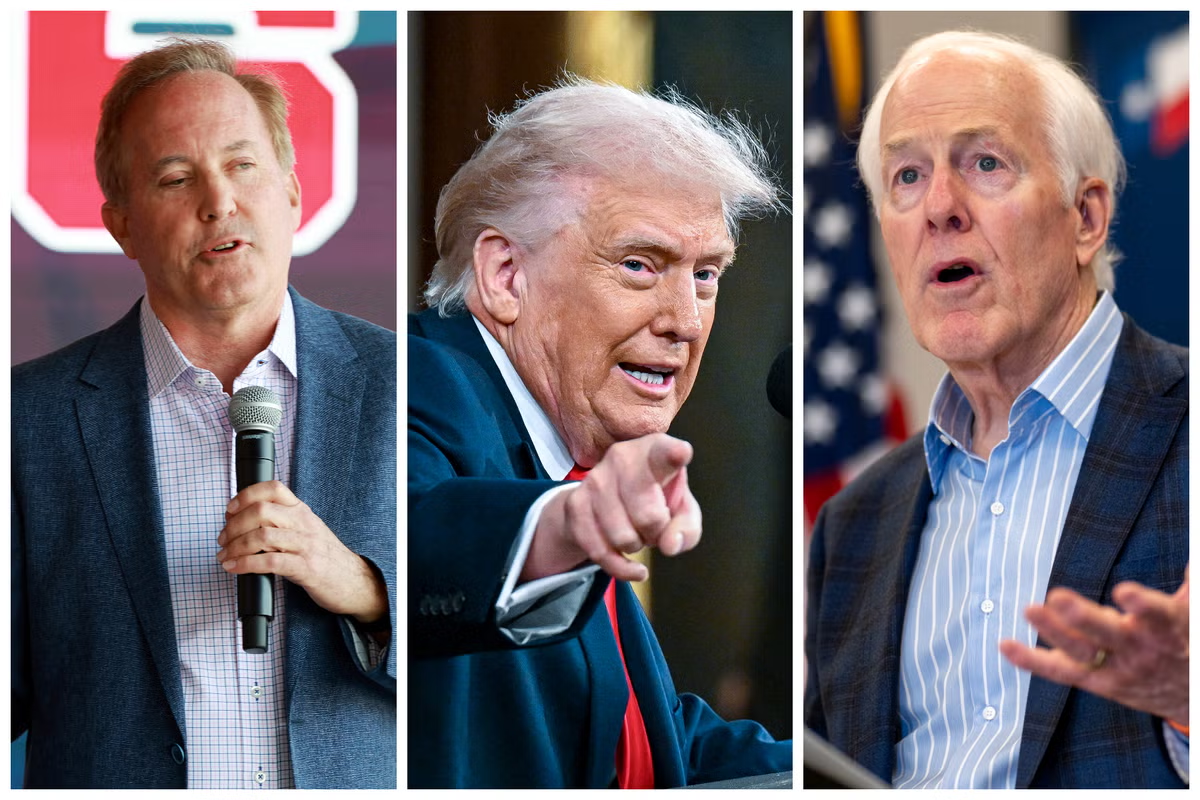
Donald Trump’s formidable influence within the Republican Party is undeniable, evidenced by his recent endorsement of Ken Paxton, who secured a primary runoff victory in Texas.
Yet, this tightening grip on the party is sparking growing apprehension among Republican strategists, who fear it could jeopardize their prospects in the upcoming November midterms, where a broader electorate, increasingly wary of the president’s second term and the economy, will cast their votes.
The risk is compounded, according to Republican operatives, by what they describe as President Trump’s cavalier approach to addressing Americans’ financial anxieties.
These concerns have been exacerbated by his administration’s trade policies and the ongoing conflict with Iran. David Urban, a Republican strategist and Trump ally, acknowledged the challenges this presents for his party. “It’s going to be a tough fall unless things dramatically change,” Urban warned.
He emphasized that Trump cannot afford a haphazard exit from the war with Iran, a conflict that has choked global oil supplies and driven up gas prices for American consumers. “I think the president wants to help,” he stated, but “you do not want to give the Iranians a win just because of the midterms.”
President Trump has consistently brushed aside economic troubles, even as prices have climbed following his tariffs and the conflict with Iran. He has repeatedly dismissed affordability concerns as a “hoax.”
Trump famously mused that increases in gas prices – which have surged by over 50% in the U.S. since his administration and Israel initiated attacks on Iran – amount to “peanuts.”
He has also asserted that he does not consider Americans’ personal finances “even a little bit” when weighing options in Iran, insisting that preventing the country from obtaining nuclear weapons remains his sole priority.
This stance comes as Trump simultaneously pressures Congress to allocate $1,8 billion to compensate individuals who believe they were politically prosecuted. This latter group could potentially include those involved in the violent attack on the U.S. Capitol on January 6, 2021.
This cascade of issues creates a difficult landscape for Republicans in every battleground House district, Senate election, and statewide contest this fall. Rick Tyler, a Republican strategist and Trump critic, observed, “You keep the House and Senate by having a message, by dealing with the issues voters are clearly complaining about.”
He added, “The administration has utterly failed to do this.” Messaging documents reviewed by The Associated Press reveal that it has been over two weeks since the Republican National Committee (RNC) distributed talking points to surrogates that even mentioned the economy.
Last week’s talking points, in contrast, focused solely on defending Trump’s $1.8 billion “anti-weaponization fund.” “Democrats and the fake-news media are deliberately ignoring the fact that this fund is not limited to Republicans or Trump supporters,” read the May 23 message.
Two weeks prior, the RNC had encouraged surrogates to praise the president and his party for “delivering lower costs,” despite ignoring soaring gas prices while noting decreases in the cost of eggs, school supplies, and butter. “President Trump promised to lower prices, and he is doing just that,” the talking points claimed.
Democrats are seizing on Trump’s perceived struggles. Republicans began Trump’s second presidency with a narrow 220-215 advantage in the House and have sought to bolster their chances by redrawing congressional maps in several Republican-controlled states.
However, Democrats remain confident they can flip enough seats to reclaim a majority. While Republicans hold a more significant 53-47 advantage in the Senate, leaders from both parties agree that control of the chamber is very much in play.
Some Republicans attribute this vulnerability to Trump’s backing of candidates like Paxton, whose history of scandals could make him more susceptible in a general election against Democratic nominee James Talarico.
Viet Shelton, a spokesperson for House Democrats’ campaign committee, suggested that Trump’s redistricting efforts betray an understanding of his party’s difficulties.
“They’ve given up on trying to win over voters fair and square, so they’re resorting to rigging the midterms through illegal gerrymanders and voter suppression,” Shelton asserted.
Democratic advisers indicate that Trump’s challenges have shifted dynamics in numerous races, expanding their list of Republican-held House targets to include many districts Trump previously carried by double digits.
In special and odd-year elections since Trump’s second inauguration, Democrats have consistently outperformed their 2024 results. Voters can anticipate seeing clips of Trump’s economic comments featured prominently in Democratic advertising this fall.
Party operatives, however, emphasize that the broader strategy involves acknowledging the president’s populist appeal while arguing that he and his Republican loyalists have failed to deliver.
This translates to highlighting how tariffs have impacted the farm economy and how the Iran conflict has driven up diesel fuel and fertilizer prices in Iowa’s U.S. House districts. In the Rio Grande Valley of Texas, the focus will be on how Trump’s immigration crackdown has disrupted the local economy in Latino communities.
Behind closed doors, Republican strategists express concern over Trump’s lack of focus on the economy and the absence of transparency from his team regarding the deployment of its substantial campaign funds.
The pro-Trump super PAC, MAGA Inc., reported holding over $356 million at the end of April. Yet, several operatives, speaking anonymously to discuss private conversations, claim they have received no clear indication of how, where, or when Trump’s team intends to spend this money.
More details here...