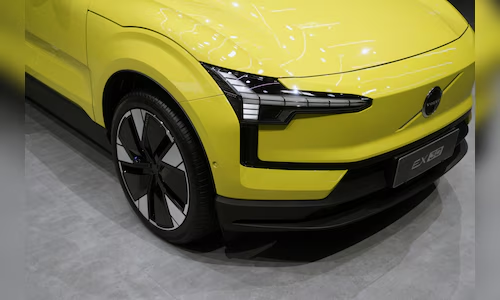
Volvo, which is majority-owned by China’s Zhejiang Geely Holding Group, received a specific authorisation from the US Commerce Department allowing it to continue importing and selling connected passenger vehicles in the US, the automaker said Tuesday, confirming an earlier report by Bloomberg News.
The agreement spares Volvo from one of the US barriers that have effectively walled off the American market from Chinese cars over national and economic security concerns. Along with the Commerce Department’s ban on Chinese connected vehicle technology, Chinese cars also face punitive tariffs, including a 100% import tax on electric vehicles from the country.
Those measures have blocked companies such as Geely and BYD Co. from selling in the US, even as Chinese cars make inroads elsewhere in the world, including Canada and Mexico.
Volvo builds vehicles in the US at a plant near Charleston, South Carolina, where it has invested more than $1.3 billion. The company also imports models from Sweden, where it’s headquartered, and started assembling one of its better-selling electric SUVs in Belgium last year in part due to the US raising tariffs on cars manufactured in China.
The US ban on connected vehicles and related hardware and software technology with ties to China takes effect starting with the 2027 model year. Many modern cars contain an array of sensors, such as cameras, that can collect data, as well as systems that can wirelessly transmit information beyond the vehicle, raising concerns that automobiles could become targets for hackers or foreign adversaries.
Volvo’s Chinese ownership had raised questions about how the company would be affected by the Commerce Department’s policy, including whether it could potentially be barred from selling its vehicles in the US, the world’s second-largest auto market.
Volvo’s approval does not appear to extend to Polestar, the EV maker that is also effectively controlled by Geely’s billionaire founder, Li Shufu. Polestar said in a statement that it continues to work with US authorities to meet the requirements of the regulations.
Representatives for the White House and Commerce Department did not respond to requests for comment.
The rule implementing the ban was finalised in January 2025, shortly before President Donald Trump began his second term in office. It went into effect in March of that year, after Trump was inaugurated.
Volvo said the authorisation followed “constructive discussions with the US Department of Commerce and other US officials regarding Volvo Cars’ governance, technology and data security,” the carmaker said in its statement.
“With this specific authorization, Volvo Cars can continue its growth plans in the US,” the company said.
The timing of the decision comes as the company awaits shipments of 2027 model-year vehicles. It is unrelated to Trump’s recent visit to Beijing, nor is it a sign that his administration is considering approvals for other Chinese-owned carmakers, said US officials familiar with the matter, who asked for anonymity to discuss the decision.
Volvo Car Chief Executive Officer Håkan Samuelsson told Bloomberg earlier this year that it would be “unthinkable” for Volvo to be banned from selling in the US. He said the company was working to receive approval and expected the Commerce Department to announce a decision by this summer.
“It is about showing how we handle data, that US customer data isn’t transferred to China,” Samuelsson said in a March interview. “These are basic requirements, and our setup is no different from other Western manufacturers.”