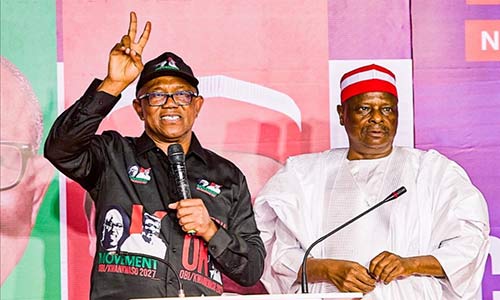
The presidential candidate of the Nigerian Democratic Congress, Peter Obi, has announced former Kano State Governor, Senator Rabiu Musa Kwankwaso, as his running mate for the 2027 presidential election.
Obi made the announcement on Saturday shortly after he was officially confirmed as the NDC presidential candidate ahead of the general election.
The development followed the party’s formal adoption of Obi as its flagbearer during its presidential primary.
Obi and Kwankwaso recently defected from the African Democratic Congress to the Nigerian Democratic Congress, citing internal divisions and prolonged court cases within their former party.
The decision to pair Obi with Kwankwaso is expected to reshape the political landscape ahead of the 2027 election, bringing together two prominent opposition figures with significant support bases across different parts of the country.
While Obi enjoys strong support among many young voters, especially in the South-East and parts of the South-South, Kwankwaso remains influential in Kano and across sections of Northern Nigeria through his political movement.
The NDC leadership expressed confidence that the Obi-Kwankwaso ticket would strengthen the party’s chances in the forthcoming presidential contest.
Speaking shortly after his emergence as the party’s presidential candidate at the NDC national convention in Abuja, Obi said his administration would work to drastically reduce corruption if elected president in 2027.
The former governor of Anambra State, who was the Labour Party presidential candidate in the 2023 election, had earlier pledged to serve only a single four-year term if elected.
Obi said his government would use the period to tackle wastage in public spending and reduce the cost of governance.
According to him, public resources currently “wasted on luxuries” would be redirected to critical sectors of the economy.
“We will drastically reduce the cost of governance and corruption. This waste must stop,” Obi said.
He said corruption would reduce significantly when public officials and their families stop abusing public resources.
Obi also pledged to uphold the rule of law, promising that his administration would end government interference in the judiciary and ensure that court judgments are based strictly on legal interpretation.
He said respect for the rule of law is necessary to attract investment and restore confidence in public institutions.
“We need the law to work because that is what will attract investment for us. We need people to be sure that when they go to court, the judgment will be an interpretation of the law,” he said.
Obi recalled his experience in Anambra State, saying he successfully challenged electoral and tenure disputes through the courts without influencing judges or offering bribes.
He said his victories at different levels of the judiciary, including the Supreme Court, strengthened his belief that the rule of law remains the foundation of a functional democracy.
“When the rule of law prevails, the country will work,” he added.
The NDC candidate also called for reforms to deepen Nigeria’s democracy, insisting that government must truly reflect the will of the people.
“It must be a government of the people, by the people and for the people. The people must be the ones determining what is happening,” he said.
Obi further accused the current administration of suppressing opposition parties, alleging that opposition groups are being harassed and denied access to public venues for political activities.
He claimed that the NDC faced difficulties securing a venue for its convention after being turned down at several locations.
“Opposition parties are being treated like criminals, harassed and intimidated,” he alleged.
He also claimed that some political parties had their activities disrupted by security agencies, while organisers of the NDC convention were allegedly instructed not to publicise the event until the day it was held.
Obi, however, promised that his administration would protect political pluralism and create an environment where opposition parties can operate freely.
“Our government will not suppress the opposition. We will encourage them. We will make sure they exist because that is what democracy should be,” he said.