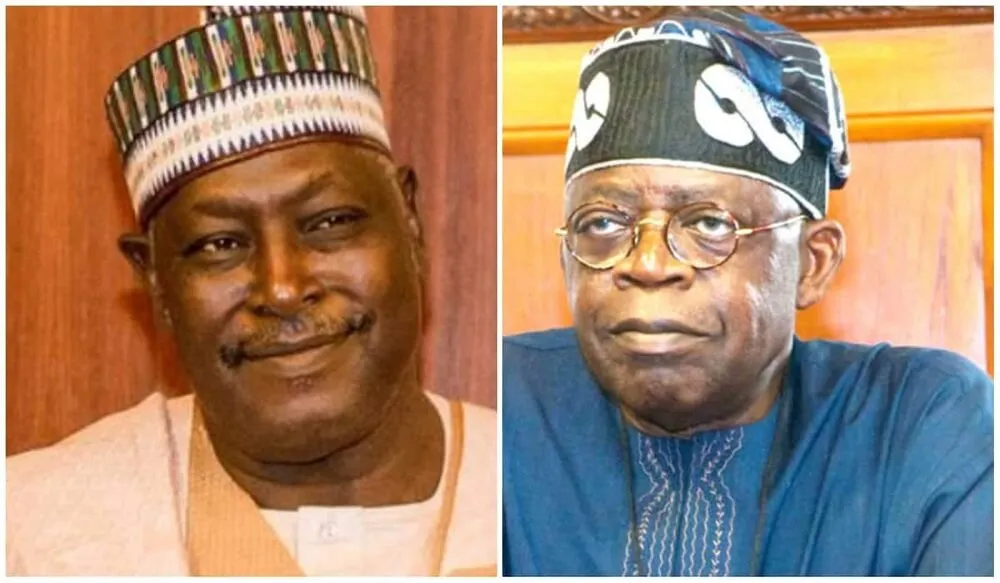
Former Secretary to the Government of the Federation (SGF), Babachir David Lawal, has said Nigerians are experiencing worsening hardship and insecurity under President Bola Ahmed Tinubu’s administration, insisting that governance must be assessed strictly by results rather than political loyalty, ethnicity, or sentiment.
He made the remarks during an interview on Frontline, a current affairs programme on Eagle 102.5 FM, Ilese-Ijebu, Ogun State, where he spoke extensively on governance performance, national security, and the 2027 general elections.
Lawal said the realities in the country show that citizens across all regions are struggling, arguing that leadership should be held accountable for outcomes rather than defended on identity grounds. He maintained that governance must reflect improvement in people’s daily lives, not just statements of intent or acknowledgment of problems.
According to him, “Bola has not been able to give us good governance. Even Nigerians believe that, except for you Yoruba who say, even if he’s killing everybody, as long as he’s a Yoruba man, he’s okay with us. Yoruba people have that mindset. He’s our son. He can do no wrong. Even if he’s doing wrong, we look the other way now. Even if there’s no other person alive, people still defend him. But I am not that kind of person. I judge governance by results, not by tribe or sentiment. Nigerians are suffering everywhere, whether in the North, South, East or West, and government must be held accountable for that suffering.”
He further insisted that insecurity remains one of the clearest indicators of governance failure, saying repeated attacks on rural communities show that citizens are not adequately protected. He argued that leadership must go beyond acknowledging insecurity to taking decisive action that prevents loss of lives.
Lawal said, “Insecurity is still one of the most urgent challenges. You cannot build a country where people are being killed in their villages and life continues as normal. Government cannot just keep acknowledging problems without solving them.” He added that rural communities remain the most exposed to violence and neglect.
He referenced incidents in local areas where, according to him, multiple lives were lost in violent attacks that did not receive sufficient national urgency. He said such situations weaken public trust in government and deepen frustration among citizens.
According to him, “When people are killed in villages, houses are burned, churches are destroyed, and nothing meaningful happens afterward, it creates a sense that life is cheap. That is not how a government should operate.” He maintained that leadership must respond with urgency and visible action.
Lawal also criticised what he described as overreliance on official statements without corresponding results, insisting that citizens are no longer interested in explanations but in solutions. He said governance must be measured by improvement on the ground, not press releases or acknowledgements.
He said, “People are tired of hearing that government is aware of insecurity or economic hardship. Awareness is not the issue. Action is what matters. Nigerians want to see results, not statements.” He argued that leadership credibility depends on delivery.
He maintained that political criticism of his position is misplaced, insisting that his comments are not driven by partisanship or ethnic loyalty. He said Nigerians should be free to evaluate leaders without being labelled or politically boxed.
According to him, “My criticism has nothing to do with political alignment. Nigerians must be free to assess leadership based on performance. That is how democracy should work.” He said governance evaluation should remain open and continuous.
Lawal added that leadership accountability does not end after elections, stressing that elected officials must remain responsible to citizens throughout their tenure. He argued that democracy requires constant engagement between the people and those in power.
He said, “Democracy does not end on election day. Leaders must remain accountable all the time. That is the only way governance improves.” He insisted that public office is a continuous responsibility.
He further said rural communities remain the most affected by insecurity and economic hardship, arguing that government presence is often weak in such areas. He maintained that national attention is disproportionately focused on urban centres.
According to him, “The people suffering the most are in rural communities. They are the ones being attacked, displaced, and forgotten. Government must do more to reach them.” He said protection of vulnerable populations must be prioritised.
Lawal insisted that leadership must always prioritise human life above political or economic considerations. He argued that no meaningful development can occur without security.
He said, “If you cannot protect lives, then nothing else matters. Security is the foundation of everything.” He maintained that stability is central to national progress.
On governance performance he reiterated that Nigeria’s current challenges require urgent, practical responses rather than political explanations. He said, “People are suffering. Leadership must act, not just speak.”
NIGERIANS MUST LOOK FOR THE RIGHT PERSON THAT CAN DEFEAT BOLA TINUBU-EX SGF, BABASHIR LAWAL
In the meantime, the Former Secretary to the Government of the Federation has urged Nigerians to approach the 2027 general elections with a stronger focus on competence, capacity, and governance performance rather than popularity, ethnicity, or political emotion.
Lawal said the central issue for Nigerians should not just be who defeats the incumbent president, but who is capable of delivering better governance outcomes if elected. He warned that political change without improvement would amount to a repetition of failure.
According to him, “Nigerians must look for the right person that can defeat Bola Tinubu. But defeating an incumbent is not enough. If we remove him and bring in someone worse, it will not help the country.” He stressed that leadership quality must remain the priority.
He added that the focus should shift from personality-driven politics to capacity-driven evaluation, where candidates are assessed based on what they can deliver rather than how popular they are.
Lawal said, “The issue is not just about removing anybody. It is about making sure that whoever comes in is better, more competent, and capable of delivering results Nigerians can feel.” He insisted that governance must be practical and measurable.
He maintained that opposition politics must evolve beyond emotional alignment and regional loyalty, arguing that Nigeria’s diversity requires careful and objective assessment of candidates.
According to him, “Leadership should not be based on emotion or tribe. It should be based on what people can do and what they have done before.” He said voters must begin to interrogate political records more seriously.
Lawal also rejected suggestions that his position is tied to personal or ethnic bias, insisting that his focus remains national interest and governance improvement.
He said, “My concern is Nigeria. It is not about any individual or group. It is about who can govern better and improve the lives of people.” He argued that leadership evaluation must be issue-based.
He further stressed that political office should not be treated as a reward for loyalty or popularity, but as a responsibility that requires competence and accountability.
According to him, “Governance is not about sentiment. It is about results. Nigerians must start asking the right questions.” He said political branding should not replace performance assessment.
Lawal added that Nigeria must begin to shift away from identity-based voting patterns toward issue-based political decisions where performance and capacity matter most.
He said, “We must move away from identity politics. What matters is who can fix the country, not where they come from.” He argued that this shift is necessary for national development.
He also noted that citizens have the constitutional right to choose their leaders and reject underperformance through the ballot.
According to him, “If you are not satisfied, you have the power to change leadership through your vote. That is democracy.” He encouraged active civic participation.
Lawal concluded that the 2027 elections present another opportunity for Nigerians to make informed decisions about leadership direction, stressing that the country’s future depends on such choices.
He said, “We still have time. Nigerians must think carefully. The future depends on the choices we make.”