Just about the last thing I wanted to do on a summer weekend in the Berkshires was to see a play called The Zionists.
The title alone practically dares audiences to arrive with their defenses up. Its subject is the bitter family and communal fractures that followed Oct. 7, 2023. Its Jewish characters argue angrily, sometimes violently, over Israel, Zionism, antisemitism, the politics of protest, and Jewish identity, blurring the personal and the political.
And yet the play, now running at Barrington Stage Company in Pittsfield, Massachusetts, after a premiere earlier this year at Miami New Drama, manages to turn the post-October 7 debates that have torn many Jewish families apart into something like catharsis.
“This is ultimately what the world needs right now,” the playwright, S. Asher Gelman, told me Monday. “It needs us to lean into discomfort and to work through our discomfort with each other.”
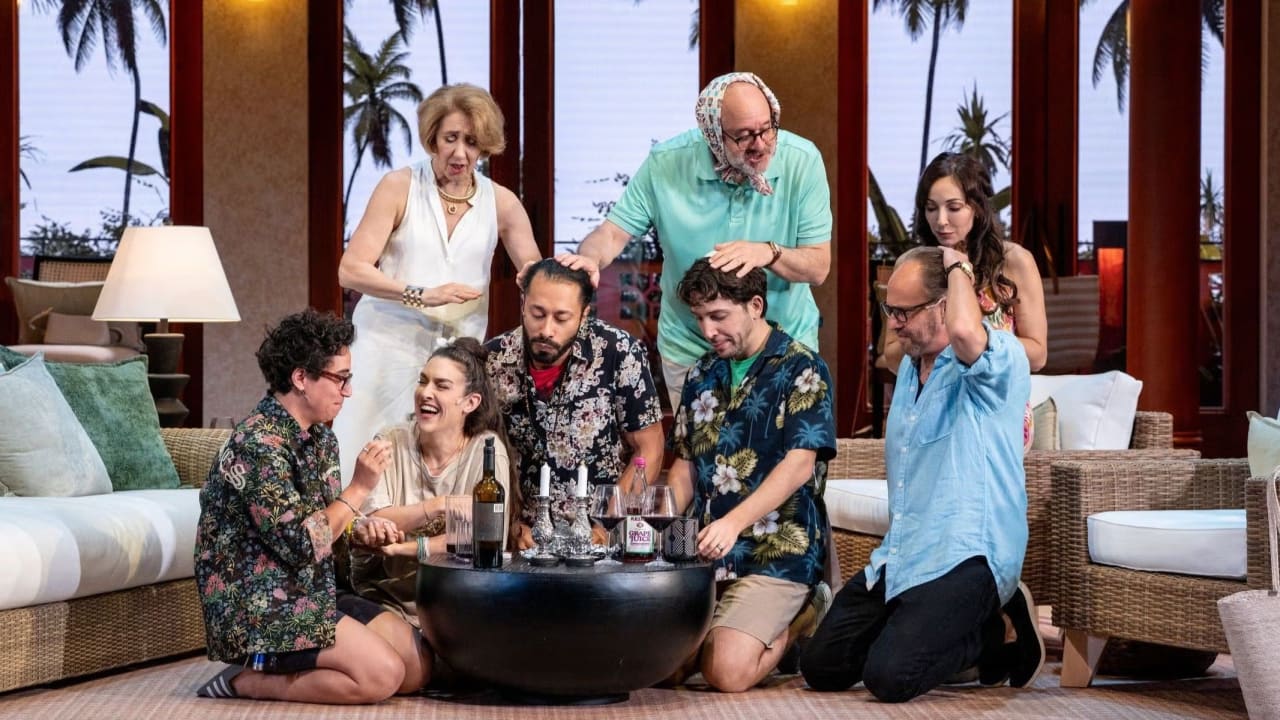
The Zionists (subtitled A Family Storm) follows the affluent Rosenberg family as ideological fault lines open up during a vacation in the Caribbean.
Mom’s a philanthropist and Jewish communal leader. One daughter is married to an Israeli. The family’s youngest son has embraced anti-Zionism and contributed to groups supporting the pro-Palestinian encampments. Other relatives hold varying relationships to Israel, Judaism, and Jewish communal life. Nobody leaves unscathed. (Did I mention it’s set during hurricane season?)
Artists are moving from avoiding to embracing Israel-related topics
Since October 7, artists and cultural institutions have frequently found themselves pressured to choose sides or avoid the subject altogether. A play called The Zionists risks alienating audiences before the curtain even rises, a possibility that suggests why there have been so few attempts by writers of fiction to tackle the ugly discourse. Two short stories published in The New Yorker since October 7 – “My Camp” by Joshua Cohen (Oct. 13, 2024) and “From, To” by David Bezmogis (April 14, 2025), each about families deeply split over Israel – are the conspicuous exceptions.
Perhaps that’s shifting. In New York, Jonathan Spector’s play Birthright, running off-Broadway through July 26, explores some of the same territory as The Zionists.
The play by Gelman, 42, who wrote the Off-Broadway hit Afterglow, emerged from his own sense of alienation in the weeks after Hamas’s October 7 attack on Israel.
He recalls learning about the attack through social media posts from people he considered friends.
“They were busy contextualizing and explaining October 7,” he said, “and what caused [Israelis] to be raped and murdered and kidnapped.”
What sounded like justifications for terrorism left him disillusioned with online discourse. Social media, he said, flattens complexity into slogans and rewards performance over conversation.
“Nuance goes to die there,” he said.
A play, he felt, could accommodate multiple truths, conflicting narratives, and uncomfortable questions. Instead of reducing arguments to memes or hashtags, it could place them in the mouths of fully realized human beings.
Gelman knew some theatergoers would arrive expecting propaganda and others expecting condemnation. He wasn’t interested in either.
“Art is not supposed to be comfortable,” he said. “It’s to sit in the deep discomfort of the characters onstage and experience that catharsis.”
The play also examines a distinct slice of American Jewish life: wealthy, liberal characters who are materially and physically privileged yet still feel an unshakeable sense of vulnerability. For some that translates into a hypersensitivity to antisemitism; for others a universalizing, even self-erasing, empathy with the Other.
Gelman took inspiration from his own family life
Gelman’s examination of this donor class, and the tensions over Israel that have put a strain on its members, draws heavily on his own biography. His parents are the longtime Jewish philanthropists Susie and Michael Gelman, each of whom has been president of the Jewish Federation of Greater Washington, and who have in recent years backed liberal pro-Israel groups, including the Israel Policy Forum. A sister, Rachel Gelman, has helped fund left-wing Jewish and pro-Palestinian groups, before and after October 7.
“They set an incredible example for me and my sisters, about how to be really active in your community, whether your local community or your national community or your participation in the global community,” he said.
Israel was an essential part of his upbringing. Starting at age 19, Gelman spent years living in Tel Aviv as a dancer and choreographer and eventually founder of an English-language theater organization. He moved back to New York in 2016 to pursue his stage career.
He is careful not to present The Zionists as a definitive statement about Israel or Zionism. No play, he said, could possibly contain every argument.
“It was never meant to be the end of the conversation,” he said. “It was meant to be the beginning of one.”
That meant creating characters whose arguments feel credible even when he disagrees with them. Gelman said he worked deliberately to give anti-Zionist characters some of the play’s strongest arguments.
“The people who feel themselves seen in those characters have appreciated that we didn’t write them to be dumb or uninformed,” he said.
‘The Zionists’ has received emotional reactions
That openness has produced some volatile reactions. During the Miami run, one audience member became so upset during an anti-Zionist monologue that he began shouting at the actor, forcing the performance to stop temporarily. The cast resumed after addressing him directly, and several audience members later assumed the interruption had been scripted.
The play arrives at a moment when many families – Jewish and otherwise – have been strained by political polarization, which is a polite way of saying “torn apart.” Audience members frequently tell him that the issue dividing their own families isn’t Israel at all, but politics, abortion, transgender rights, or something else entirely. Nevertheless, they see the Rosenbergs’ story as their own.
“By being quite specific about telling this very specific story about these very specific people,” he said, “it allows us to tell a more universal story.”
And yet the language and ideas in the play are deeply, even microscopically, steeped in the history of Israel and Palestine. Pamela Nadell, the scholar of Jewish history at American University, saw the play this month and said she would have loved to have brought her students.
“What he captured for me, which was so stunning, was the emotional power of the history. What really jumped out is his ability to convey in two hours why there is the argument and how both sides tell the narrative,” said Nadell, whose most recent book is Antisemitism, an American Tradition.
The play’s development also reflected the tensions it depicts. Gelman described long conversations among collaborators who did not always agree with one another politically but remained committed to staying engaged.
That idea – staying in the room – has become something of a credo for the playwright, even if it becomes more difficult on other stages.
Again and again during a recent interview, Gelman returned to what he sees as the central challenge of contemporary life: resisting the urge to cut off people with whom we disagree.
He worries that Americans increasingly treat disagreement as danger and discomfort as harm. Social media’s block and mute functions, he argues, have become metaphors for how people navigate real-world relationships.
“We no longer have the tools to handle discomfort,” he said. “Discomfort is the price we pay for community.”
The Zionists, directed by Chloe Treat, plays through July 3 at the Boyd-Quinson Theater (30 Union Street, Pittsfield, Massachusetts).