The prosecution lawyer said he watched the leaked video on the page of social media influencer Martins Vincent Otse, popularly known as VeryDarkMan (VDM).
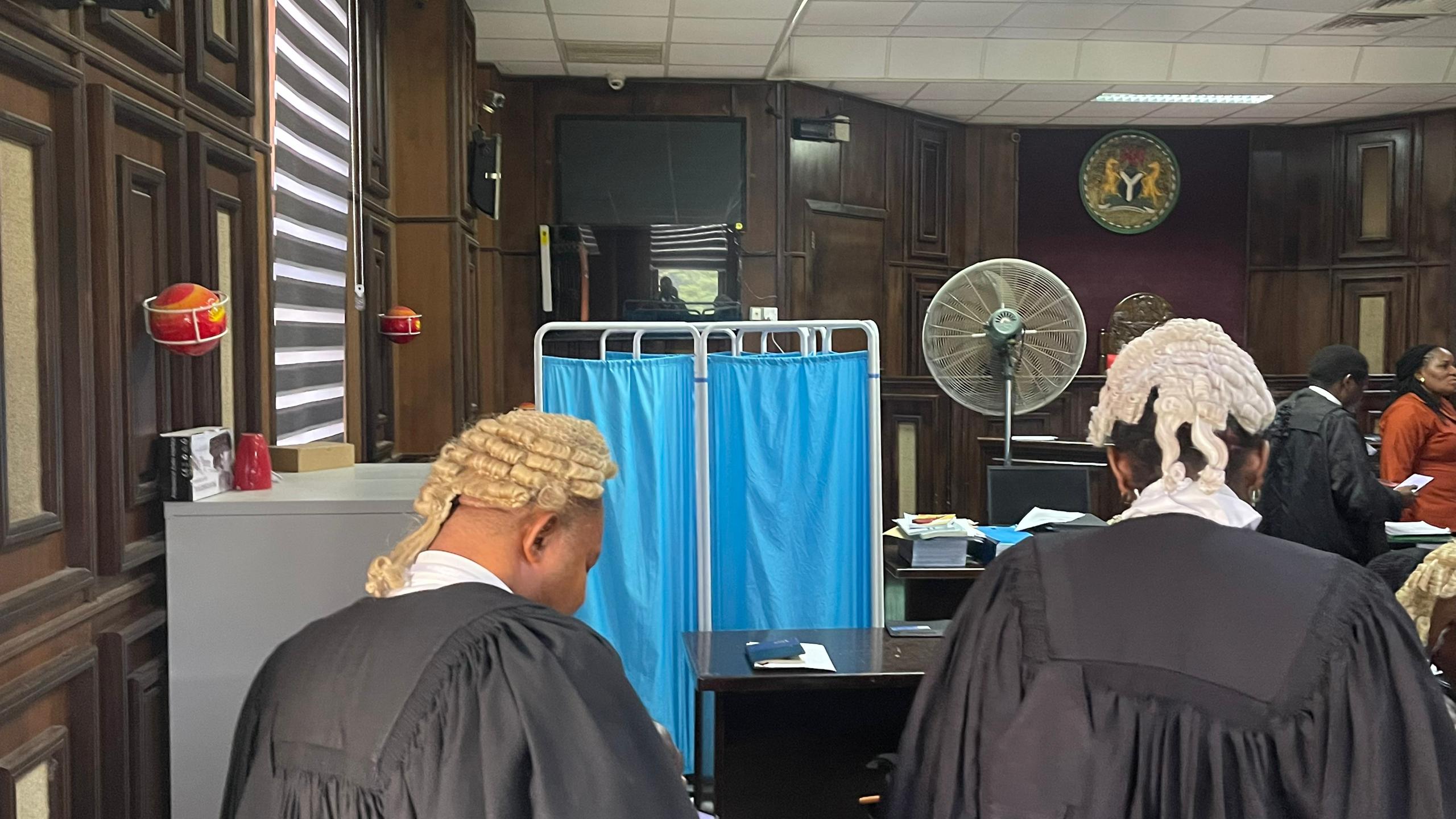
The Federal High Court in Abuja on Tuesday ordered an investigation into an alleged leaked video which has stirred controversy in the trial of five suspects charged with being being part of last year’s failed plot to topple President Bola Tinubu’s administration.
Judge Joyce Abdulmalik made the order following claims by prosecution lawyer Rotimi Oyedepo, a Senior Advocate of Nigeria (SAN), who is the Director of Public Prosecution (DPP), that the video recording of one of the defendant’s statements had appeared on social media, contrary to an earlier court order.
He said he watched the video on the page of social media influencer Martins Vincent Otse, popularly known as VeryDarkMan (VDM).
He described the development as a national security issue. “We tendered the video recording and served it on the defence. I know I served my colleagues,” he said.
Continuing, Mr Oyedepo argued that the development was extremely prejudicial and disturbing. He noted that the social media post had attracted more than 6,000 views.
He argued that since there is a law protecting witnesses, the court should direct an investigation into the matter.
“What I saw yesterday is quite disturbing. I urge your lordship to investigate this video and confirm whether it is the same video before the court and whether it contravenes your lordship’s order,” he said.
He also informed the court that VDM was present in court to perhaps tell the court how he got the video.
Reacting to the claim, all the defence lawyers took turns to deny knowledge of how the video leaked into the social media space.
“Our worry is that this is coming at the stage when we are trying to move our bail application. I am not even a social media person. I am not opposed to an investigation,” the lawyer to the first defendant, Muhammed Ndayako, a SAN, said.
Apart from their denial, some of the defence lawyers, including that of the fourth defendant, C.D. Okafor urged the court to investigate members of the media who have been covering the proceedings.
While not opposing the probe, the fifth defendant, M.A Ibrahim, expressed doubts about the prospect of such investigation. The lawyer to the sixth defendant, Sanusi Musa, another SAN, outrightly objected to any investigation.
“I am surprised that the DPP said the court should investigate this matter. Secondly, who are the suspects? The video might have been leaked from the court, it might be me, it might even be the DPP or from the Ministry of Justice.”
“Whatever the DPP said here cannot be acted upon without evidence. If he wants that, he should file an application. The EFCC also has a media department.
“My lord, while I thank God that I am not the one, I object to the suggestion that the matter be investigated,” he said.
Judge takes decision
Ruling on the issue, who the judge did not acknowledge that Very Dark Man was in court, affirmed the court’s power to direct the protection of witnesses.
She noted that Section 232(5) of the Administration of Criminal Justice Act 2015 provides for the protection of vulnerable witnesses and prescribes consequences for any breach of witness protection measures or court orders made under that section.
Subsequently, Mrs Abdulmalik ordered the SSS to investigate any evidence on social media that may have “contravened the court’s earlier orders and bring any culprit before the court.”
She added that if such suspects are brought, the matter will be a “distinct case” while the current matter continues separately.
The six defendants charged in the case include a retired major general, Mohammed Ibrahim Gana, and a retired navy captain, Erasmus Ochegobia Victor.
The rest are Ahmed Ibrahim, a police inspector; and Zekeri Umoru, an electrician at the Presidential Villa; Bukar Kashim Goni and Abdulkadir Sani, a Zaria-based Islamic cleric.
They were accused of being part of a conspiracy to topple President Tinubu’s government. Information about the alleged secret plot was leaked to the authorities last September, leading to the arrest of serving and retired military officers alongside their alleged civilian conspirators.
The six men charged before the Federal High Court in Abuja face 13 counts of treason, terrorism, failure to disclose information, and money laundering over the alleged failed coup.
Since the trial began, the prosecution has called four witnesses.
The fourth prosecution witness, an army officer identified by the codename AAA for security reasons, has yet to be discharged. The prosecution witness brought video recordings of the defendants’ interrogations to court as exhibits.
At previous hearings the court played some of the video recordings during proceedings. The video showed the defendants making statements.
However, after the video was played in court on 11 May, the defence lawyers took turns to object to the admissibility of the statements and video recordings the prosecution sought to tender, arguing that the statements were not made voluntarily.
The objection prompted the judge to order a trial-within-trial.
PREMIUM TIMES reported that on 13 May, the first prosecution witness in the trial-within-trial, an Nigerian Army officer involved in the investigation, told the court that the defendants made their statements voluntarily.