While a rate hold is widely expected, investors will closely watch the Fed’s tone, projections and forward guidance, particularly with a new chair leading the meeting for the first time.
At the beginning of the year, the Fed maintained a dovish stance. Rates were cut three times in 2025, and in January, two FOMC members dissented in favour of another reduction. The March dot plot continued to signal a median expectation of one rate cut by the end of 2026.
However, the tone shifted sharply by April. Three officials voted to keep rates unchanged but objected to language suggesting a bias towards future easing. A majority also indicated that higher rates could become necessary if inflation remained elevated.
Goldman Sachs now expects the Federal Reserve to keep rates unchanged through 2026 and delay any cuts until 2027, citing stronger-than-expected economic activity and a resilient labour market. May non-farm payrolls rose by 172,000, while unemployment remained steady at 4.3%, reducing the urgency for policy easing.
According to CME FedWatch data, the probability of rates remaining unchanged by December falls to 42.7%. Markets currently assign a 41.6% chance of one rate hike and a 13.3% probability of two hikes before year-end, suggesting investors increasingly view the next major move as upward rather than downward.
Inflation pressures persist despite growth concerns
May consumer inflation reinforced concerns about price pressures. According to the Bureau of Labor Statistics, annual CPI inflation rose to 4.2%, the highest level since April 2023. Much of the increase was driven by rising energy prices linked to tensions between the US and Iran and disruptions around the Strait of Hormuz.
Core inflation, which excludes food and energy, was more moderate. Core CPI increased 0.2% month-on-month, down from 0.4% in April, while the annual rate stood at 2.9%.
Producer prices painted an even stronger inflationary picture. The Bureau of Labor Statistics reported that May PPI rose 1.1% on a seasonally adjusted monthly basis, pushing annual wholesale inflation to 6.5%, the highest reading since November 2022. The measure excluding food, energy and trade services increased 0.8%, marking its largest monthly gain since March 2022.
The global policy backdrop has also become less supportive of rate cuts. On June 11, the European Central Bank raised interest rates by 25 basis points to 2.25%, its first hike since 2023. The move came despite Eurozone GDP contracting 0.2% in the first quarter and the ECB lowering its 2026 growth forecast to 0.8%.
The decision suggests that central banks are increasingly unwilling to overlook energy-driven inflation even as economic growth slows.
Few Fed officials have expressed support for a similar tightening cycle. Instead, most policymakers continue to advocate patience, preferring to assess whether the current energy shock proves temporary and whether inflation gradually returns to the central bank’s 2% target.
A less predictable Fed and implications for India
Even if rates remain unchanged this month, two key signals could reshape market expectations.
The first is the updated dot plot. In March, the median projection implied one rate cut to 3.4% by the end of 2026. Many analysts now expect the June projections to show no cuts at all.
The second is the policy statement. The Fed has maintained language that suggests an easing bias, but JP Morgan expects this wording to be removed in June, potentially opening the door to future rate hikes. Such a shift would be interpreted as a more hawkish stance.
Reports also suggest that Warsh may choose not to submit his own dot plot projection.
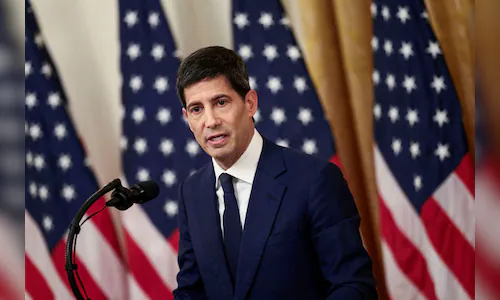
Warsh was sworn in on May 22, succeeding Jerome Powell, whose tenure was defined by detailed and explicit forward guidance. Warsh has previously described the dot plot as a “straitjacket” and has not committed to holding post-meeting press conferences. JP Morgan has characterised this transition as the beginning of a “less guidance-heavy Fed era”.
For investors, that could mean greater uncertainty and sharper market reactions around each policy meeting. Morgan Stanley has described the June gathering as one of the most underappreciated risks facing global currency markets.
Commodity markets have already responded to shifting inflation and policy expectations. Spot gold rebounded on June 12 after touching a more-than-six-month low in the previous session, following signs of easing tensions in West Asia. Silver also remained under pressure, with both metals heading towards weekly losses as investors weighed geopolitical developments against the prospect of higher US interest rates.
For India, a more hawkish Federal Reserve raises the risk of foreign capital outflows by making US assets more attractive. Foreign portfolio investors withdrew ₹32,963 crore from Indian equities in May, taking total equity outflows in 2026 so far to around ₹2.25 lakh crore, according to data available on Moneycontrol.
Market sentiment, however, improved on June 12 after signs of progress in US-Iran discussions. The Nifty 50 rose 1.02% to 23,398.9, while the Sensex gained 1.17% to 74,693.12. Falling crude oil prices and a stronger rupee supported the rally. The rupee appreciated around 0.5% to 95.30 against the dollar, while Brent crude slipped to a two-month low near $88.44 per barrel.
Despite the relief rally, structural risks remain. If crude prices continue to decline and the rupee stays firm, Indian markets could benefit in the near term. However, a more hawkish message from the Federal Reserve on June 17, a possibility increasingly reflected in market pricing, could once again put pressure on the rupee, foreign investment flows and India’s oil import bill.