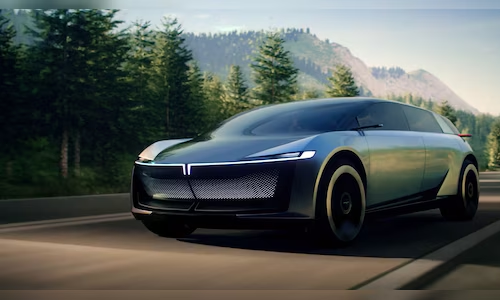
Tata told Reuters in a statement that it will leverage the Freelander platform produced in a joint venture between Chery and Jaguar Land Rover in China, with the cars being manufactured at its newly opened factory in Tamil Nadu in southern India.
While Chinese carmakers remain largely shut out of the world’s third-largest auto market, their technology is quietly becoming hard to avoid, as local manufacturers lean on it to stay competitive in the global EV race.
Tata, India’s biggest electric carmaker, will use Chery’s platform to locally build EVs under its premium Avinya brand with plans for at least two cars, the first of which will be launched in 2027, three of the people said.
The strategy marks a pivot from Tata’s original plan to use JLR’s electrified modular architecture (EMA) for Avinya models targeted for 2025. That roadmap collapsed last year when JLR shelved plans to build EMA-based EVs in India, forcing Tata into a reset, Reuters previously reported.
Chery’s platform deal is expected to make up for the lost time, granting Tata access to advanced features and technology it would otherwise take longer and more capital to develop, the people said.
The first Avinya model on Chery’s platform is due in 2027 and will be shipped from China as a kit and assembled in India, two of the people said, with efforts to source localised components already underway. A second EV is due for launch in 2029, with scope for two more vehicles beyond that, one of them said.
“Avinya is being developed as a global premium brand. Our collaboration with JLR and its partners will be an important pillar of our global premium EV journey,” Tata said, adding that this deal will deliver the desired proposition for its luxury EV segment at scale.
Chery told Reuters in a statement that its agreement with Tata builds on the success of its collaboration with JLR.
“Chery will act as a supplier to Tata Motors Passenger Vehicles. Each project operates under its own separate agreement with standard commercial terms,” the Chinese carmaker said.
JLR has tapped Chery, a longtime partner, to develop and build electrified cars, including EVs and hybrids, under its resurrected Freelander brand. The cars will be based on the Chinese company’s architecture and built at its factory in Changshu.
The deal with Chery is a “stop-gap arrangement” because without fresh products, Tata risks losing its EV lead, one of the people said, adding the company still intends to develop its own dedicated platform over time.
All of the people declined to be identified because they are not authorised to speak to the media.
INDIAN COMPANIES LEAN ON CHINESE TECH
Electric models make up 14% of Tata’s total sales with a target to more than double that to 30% by 2030. But rivals Mahindra & Mahindra and JSW MG Motor are closing in on its lead, exposing gaps in its EV line-up and raising the risk of further market share losses.
The deal talks reflect a broader shift underway in India’s automotive industry. India’s automakers are increasingly importing China’s EV technology while avoiding deeper equity partnerships due to political sensitivities.
Since 2020, New Delhi has placed strict curbs on investment from neighbouring nations mainly targeted at China, effectively freezing large-scale participation in the auto industry. While restrictions have eased slightly in sectors like electronics, carmakers still face high barriers.
JSW Motor, the independent carmaking venture of steel-to-cement billionaire Sajjan Jindal, also has a similar platform licensing deal with Chery.
Indian car companies have increased their spending on research and development of new technologies and powertrains in recent years, but like many global peers they are unable to match China’s speed, cost and tech prowess in EVs.
Chery, China’s largest car exporter, has rapidly expanded its global footprint.
Drawing on inspiration from Toyota and Tesla, the Chinese automaker has pursued joint manufacturing arrangements with foreign companies across key markets, including Europe, Southeast Asia and Latin America.