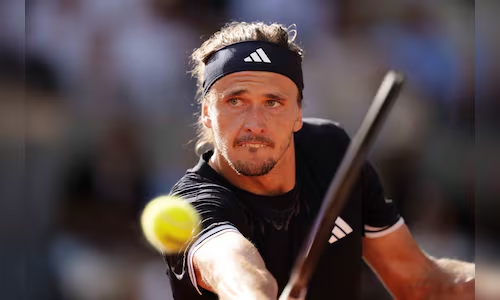
The German star captured his first major title at Roland-Garros, becoming the first German man since Boris Becker in 1996 to win a Grand Slam singles title. Before Sunday’s victory, Zverev had won 125 Grand Slam matches — more than any player in the Open Era before claiming his first Grand Slam Title.
But the significance of this victory goes far beyond tennis.
Zverev has lived with Type 1 diabetes since the age of four. He was told that competing at the highest level with diabetes would be difficult, if not impossible. He refused to accept that.
Type 1 diabetes is an autoimmune condition in which the body’s immune system destroys the insulin-producing cells in the pancreas. Without insulin, the body cannot regulate blood sugar levels. Unlike Type 2 diabetes, it cannot be managed through lifestyle changes alone and requires lifelong insulin therapy.
The challenge is constant. Too little blood sugar can lead to hypoglycaemia — causing dizziness, confusion, weakness and, in severe cases, collapse. Too much can damage blood vessels, nerves, kidneys and eyesight over time.
In elite sport, that challenge becomes more complex.
In this case a a five-set tennis match can last four hours or more and burn thousands of calories. Intense physical activity can cause blood sugar levels to drop rapidly, while the stress and adrenaline of competition can push them higher. The body is effectively pulling in two directions at once, and the athlete has to manage both while competing against the best players in the world.
Zverev himself has described it as playing “two games at once.”
For decades, that reality meant many believed elite professional sport and Type 1 diabetes simply did not mix.
Today, that is changing.
Zverev competes with the support of modern diabetes technology, including continuous glucose monitoring systems. During Sunday’s final, he even paused to take an insulin injection on court — something he successfully campaigned to make permissible under tennis regulations.
His success is also helping others. Through his Foundation, he has supported more than 1,150 children living with Type 1 diabetes.
In many ways, this French Open title is about far more than tennis.
It is a reminder of how advances in diabetes care — from continuous glucose monitors to improved insulin therapies — are redefining what is possible for people living with chronic diseases.
A generation ago, Type 1 diabetes was often viewed as a barrier to elite sport. Today, a child diagnosed at four years old can grow up to become a Grand Slam champion.