The announcement was made at Amazon’s ‘Delivering the Future’ event in London, where the e-commerce giant showcased how artificial intelligence and robotics are increasingly becoming central to warehouse operations.
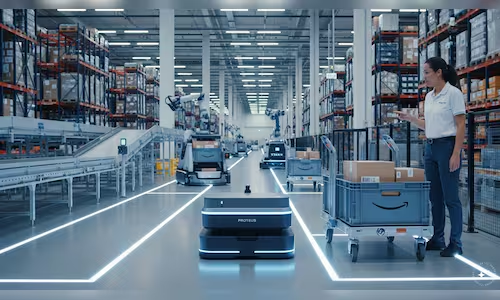
At the heart of the announcement is the next-generation Proteus, an autonomous robot designed to move heavy carts and materials within fulfilment centres — but with a major upgrade. Unlike the current version, which operates in limited dock areas, the new Proteus can work across facilities and respond to natural-language commands, allowing employees to interact with it conversationally rather than through technical programming.
Amazon says employees will simply be able to tell the robot what needs to be done, much like assigning a task to a colleague, with the system independently determining routes, priorities and timing. The company says the goal is to reduce physically strenuous work, including moving carts weighing up to 400 kilograms, repetitive lifting and long-distance movement within warehouses.
The development is significant because it signals Amazon’s next phase of warehouse automation — one that combines robotics with generative AI-style interfaces. While robotics in fulfilment centres is not new, enabling frontline workers to communicate with machines using plain language could potentially lower the technical barrier to adoption and make automation more collaborative than prescriptive.
Importantly, Amazon is attempting to address a long-standing criticism that automation replaces jobs. Alongside its robotics expansion, the company said it plans to create 25,000 jobs across European fulfilment centres in the coming years, arguing that automation is generating new categories of employment in maintenance, engineering and reliability functions.
The next-generation Proteus is currently being piloted in Amazon’s laboratories and is expected to be deployed across Europe in the first half of 2027.
Beyond Proteus, Amazon also announced the expansion of Vulcan, its robotic system with a “sense of touch”, which can identify and handle objects in tightly packed warehouse environments. Originally developed in the US, Vulcan is already being deployed for more advanced picking tasks at Amazon’s Hamburg facility in Germany.
Another robotic system, STARK, a collaborative tote-handling robot that works alongside employees to reduce repetitive heavy lifting, will be rolled out to 15 European sites by 2027 after being piloted in Barcelona.
The announcement also comes at a time when global logistics and e-commerce companies are increasingly investing in AI-led supply-chain efficiencies amid rising delivery expectations and labour costs. For Amazon, robotics is becoming not just a warehouse productivity tool but a strategic differentiator in the race to fulfil orders faster and more cost-effectively.
For India, the developments could also be closely watched. Amazon has been steadily expanding its logistics and fulfilment infrastructure in the country, and technologies deployed in global markets have often gradually found their way into Indian operations.