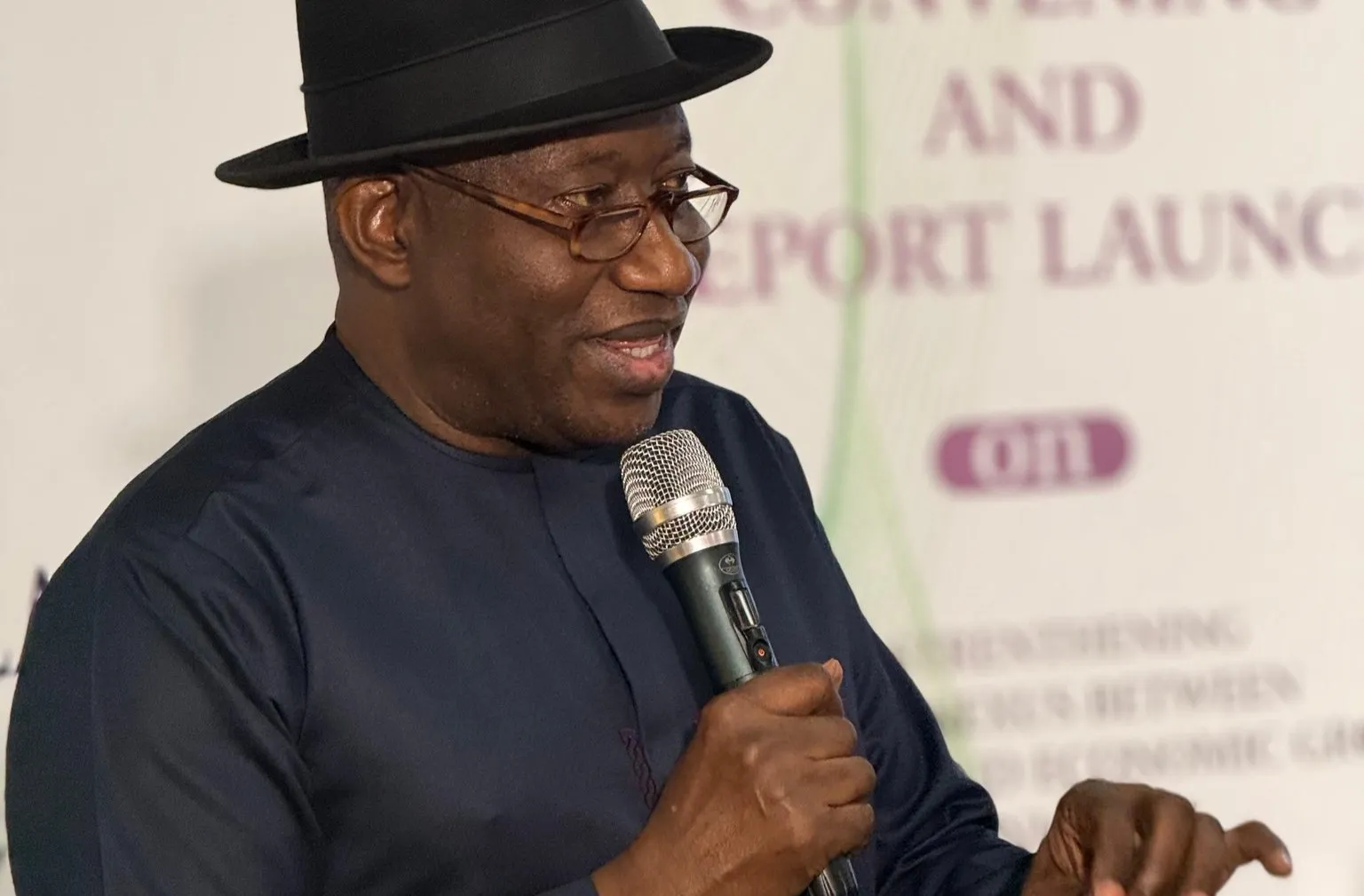
Since his adoption and subsequent ratification by a faction of the opposition PDP as its candidate for the 16 January 2027 presidential election, and his clearance by the court, former President Goodluck Jonathan has kept mute about the developments, provoking confusion in the polity about his intentions.
The adoption of former President Goodluck Jonathan as the presidential candidate of the Taminu Turaki faction of the opposition Peoples Democratic Party (PDP) has become one of the major issues in Nigeria’s evolving 2027 political conversation.
“The party had already given our presidential aspirant the waiver. Like I said in the beginning, he was deputy governor, became governor, became vice president, became president, so we didn’t see anything that needed screening; and therefore, the party had given him a waiver. In other words, he had been declared and cleared as the candidate of the PDP for the presidential election, and that is President Jonathan.” Babangida Aliyu, chairman of the Screening Committee and former governor of Niger State, told journalists on 19 May.
Mr Jonathan’s candidacy was subsequently ratified on Saturday, 30 May, at a ceremony where a member of the House of Representatives, Fred Agbedi, received the flag on his behalf.
While some Nigerians have questioned the development, largely on constitutional grounds, others have cautioned Mr Jonathan, warning that running under a divided PDP could undermine the statesman status he has built since leaving office in 2015.
Mr Jonathan has neither accepted nor rejected the nomination publicly. His silence has further increased speculation in political circles. Some supporters believe he is assessing the political environment before making a decision; others argue that he may be reluctant to abandon the elder statesman image he has cultivated.
Mr Jonathan was Nigeria’s vice president between 2007 and 2010 before succeeding President Umaru Yar’Adua who had died in office. He later won the 2011 presidential election under the PDP.
Jonathan’s presidency remains one of the most debated in Nigeria’s democratic history. His administration witnessed major economic growth, banking reforms, expansion in the telecommunications sector and improvements in agricultural financing. Under his watch, Nigeria rebased its Gross Domestic Product (GDP) in 2014 and temporarily became Africa’s largest economy.
However, his administration also faced corruption allegations, insecurity and weak political coordination. The rise of the Boko Haram insurgency in the North-east significantly damaged public confidence in his government, while the abduction of the Chibok schoolgirls in 2014 intensified both local and international criticism.
Politically, Mr Jonathan entered the 2015 election weakened by internal divisions within his party, the PDP. Several governors and senior party leaders defected to the All Progressives Congress (APC), newly formed from a merger of three legacy parties to challenge the PDP’s dominance.
Mr Jonathan eventually lost the election to the APC candidate, former military ruler Muhammadu Buhari, in what became Nigeria’s first democratic transfer of power from an incumbent president to an opposition candidate.
His defeat was historic not only because of the outcome, but also because he conceded defeat before the final declaration of results, a move widely praised for helping to stabilise Nigeria’s democracy.
Since leaving office in 2015, Mr Jonathan has largely stayed away from frontline partisan politics, shunned PDP’s events and meetings, and reinvented himself as a statesman and international democracy advocate.
Through the Goodluck Jonathan Foundation and his involvement with regional and global organisations, he has become one of Africa’s prominent election observers and mediators.
He has led or participated in election observation and peace missions in countries including The Gambia, Mali, Liberia, Zambia and South Africa. He has also served as an ECOWAS and African Union mediator in political disputes across the continent.
Many analysts argue that his international reputation improved significantly after leaving office, particularly because of his peaceful concession of defeat in 2015, which contrasted sharply with the political tensions often associated with elections in several African countries.
Mr Jonathan has consistently advocated electoral reforms, peaceful transitions, and democratic stability across Africa. His interventions in regional conflicts and democratic negotiations have earned him recognition among African leaders and international organisations.
The move for Mr Jonathan’s return to power is driven by several political calculations.
First, some politicians see him as a unifying figure capable of attracting support across regional and religious divides. Unlike many active politicians, the former Nigerian leader has maintained a relatively moderate public image since leaving office.
Second, supporters believe public frustration over economic hardship, insecurity and political instability under successive administrations has created nostalgia among sections of Nigerians, who now view his tenure more favourably.
Third, within the PDP, some stakeholders believe only a nationally recognised figure like Mr Jonathan can revive the party’s declining fortunes ahead of the 2027 election.
Fourth, if he contests and wins, Mr Jonathan will only be able to spend one term in office having served one term in his first tenure. This would ensure that power returns to northern Nigeria in 2031 to fulfil an unwritten rule among Nigeria’s political elites for power to rotate between the North and South every eight years.
However, Mr Jonathan’s adoption appears to be a political gamble by the PDP faction. Mr Turaki served as Minister of Special Duties and Inter-Governmental Affairs in the Jonathan administration. Both men reportedly held several private meetings in recent months, which insiders say centred on the 2027 election and the future of the PDP.
The PDP has been struggling with internal crises since the 2023 general elections, leading to deep divisions, as rival power blocs battle for control of the party’s structure and direction.
Aside from the Turaki-led faction, the other bloc is aligned with the Minister of the Federal Capital Territory (FCT), Nyesom Wike. Officially headed by Abdulrahman Mohammed, it is the one currently recognised by the Independent National Electoral Commission (INEC).
The Turaki-led faction’s adoption of Mr Jonathan also reflects the deepening fragmentation within the PDP. Since losing power in 2015, the opposition party has struggled with internal leadership disputes, defections and disagreements over zoning arrangements.
By projecting Mr Jonathan as a consensus candidate, the faction may be attempting to reposition itself as the legitimate political centre within the PDP crisis.
However, not all reactions have been positive. Some Nigerians argue that the move reflects the inability of major political parties to develop younger leadership and fresh alternatives. Others remain sceptical about another Jonathan candidacy, arguing that Nigeria needs a new generation of political leadership rather than a return to former officeholders.
The Jonathan adoption has become even more complicated because of competing developments within the opposition.
Recently, Oyo State Governor, Seyi Makinde, declared his intention to seek the presidency under a proposed alliance between the APM and the same faction of the PDP, which adopted Mr Jonathan. However, the coast may now be clear for the former president following Mr Makinde’s recent emergence as the candidate of the APM.
Even so, there is the Nyesome Wike-backed faction to contend with. The INEC-recognised faction has picked Sandy Onor, a former senator, as its flagbearer.