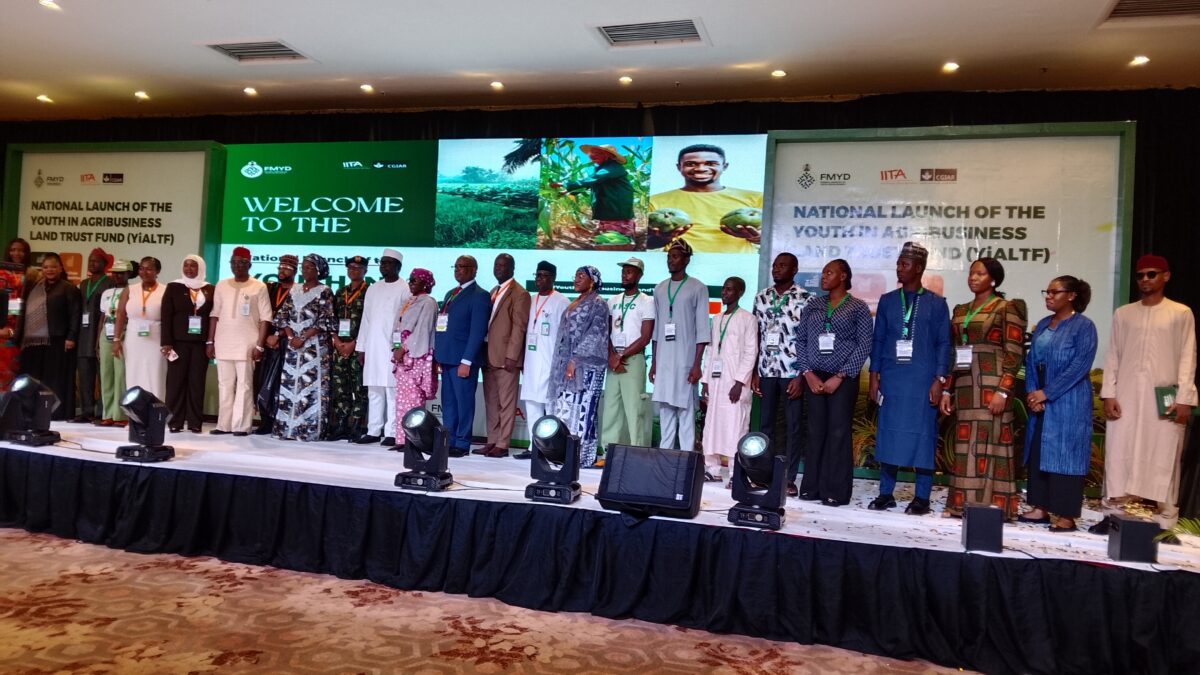
The initiative seeks to provide young Nigerians with access to land, training, financing, technology and markets.
The Nigerian government has launched the Youth in Agribusiness Land Trust Fund (YiALTF), an initiative designed to tackle youth unemployment and improve access to land for young farmers amid rising concerns over food insecurity and conflicts linked to land use across Nigeria.
The initiative, unveiled in Abuja on Monday by the Federal Ministry of Youth Development in partnership with the International Institute of Tropical Agriculture (IITA) and financial institutions, seeks to provide young Nigerians with access to land, training, financing, technology and markets.
Speaking at the launch, the Minister of Budget and Economic Planning, Atiku Bagudu, said access to land remains one of the biggest barriers facing young Nigerians interested in agriculture.
Mr Bagudu said many of Nigeria’s longstanding communal conflicts and contemporary security challenges are tied to land management and competition over land resources.
“This initiative demonstrates that the Ministry of Youth should be everywhere in a collaborative manner because when you meet young people in agriculture, the first issue they identify is land,” he said.
The minister said Nigeria could not achieve its agricultural ambitions without addressing land-related challenges and involving young people in agribusiness.
He said the government believes agriculture can drive inclusive economic growth under President Bola Tinubu’s Renewed Hope Agenda, but noted that youth participation would be critical to achieving that goal.
He also said conflicts between farmers and herders were also connected to land use pressures and outdated agricultural systems.
“Our farmer-herder clashes are likely a land problem. Competing land uses between people accustomed to farming in traditional ways and livestock management in traditional ways require new thinking and better land utilisation,” he said.
He added that the federal government is working with states and local governments to develop a coordinated framework for land management and economic planning across Nigeria’s 8,809 wards.
The minister also argued that macroeconomic reforms implemented by the Tinubu administration had improved the country’s investment climate, adding that the challenge now is to organise young people and attract private capital into agribusiness.
During his ministerial address, the Minister of Youth and Development, Ayodele Olawande, described the initiative as a response to unemployment and limited economic opportunities facing young Nigerians.
Mr Olawande noted that more than 70 per cent of Nigeria’s population is under 30 years old, making youth inclusion central to the country’s future.
He said agriculture remained one of Nigeria’s biggest opportunities for job creation beyond traditional farming.
“Today, agriculture is no longer just about farming. It includes technology, processing, packaging, marketing, exports and innovation across the value chain,” he said.
He said many young Nigerians were discouraged from entering agriculture due to difficulties in accessing farmland, insecurity, and boundary disputes.
He also revealed that the ministry had reviewed assets under its control nationwide and identified unused lands within youth development centres that could be converted into agricultural hubs.
“This initiative is not just about giving land. It is about giving young people the support they need to succeed,” he said.
According to him, the programme aims to train more than six million young Nigerians within three years and support at least 500,000 youth-led agribusinesses.
He added that the initiative would provide training, mentorship, financial support, technology and access to local and international markets.
In his opening remarks, the Director-General of the International Institute of Tropical Agriculture, Ehui Simeon, said the initiative aligned with the organisation’s mission of transforming agriculture through science and innovation.
Mr Simeon stated that Africa’s farming population was ageing while youth unemployment remained one of the continent’s biggest development challenges.
He said the land trust fund could help address both problems by connecting young people to productive assets and agribusiness opportunities.
“We have seen young agronomists transform entire villages when given the resources. We have seen youth-led agriculture create jobs, improve systems and stimulate local economies,” he said.
He added that the success of the initiative should not be measured by the number of hectares allocated but by the number of young people whose lives are transformed.
“It will be the number of businesses created, the number of jobs generated, the volume of food produced and the number of communities empowered,” he said.
Presenting the framework for the initiative, Magisho Aline, chief executive officer of IITA’s Youth in Agribusiness Unit, said the initiative was designed to address the high failure rate among youth-owned businesses during their first three years.
Ms Aline said many young entrepreneurs struggle because they lack financial support and cannot bear the cost of starting businesses independently.
“The land trust fund creates an environment where young people can share costs, access technology, learn financial discipline and build sustainable businesses,” she said.
She added that the programme planned to reposition 500,000 young Nigerians as agribusiness entrepreneurs and open access to 22 million hectares of land within three years.