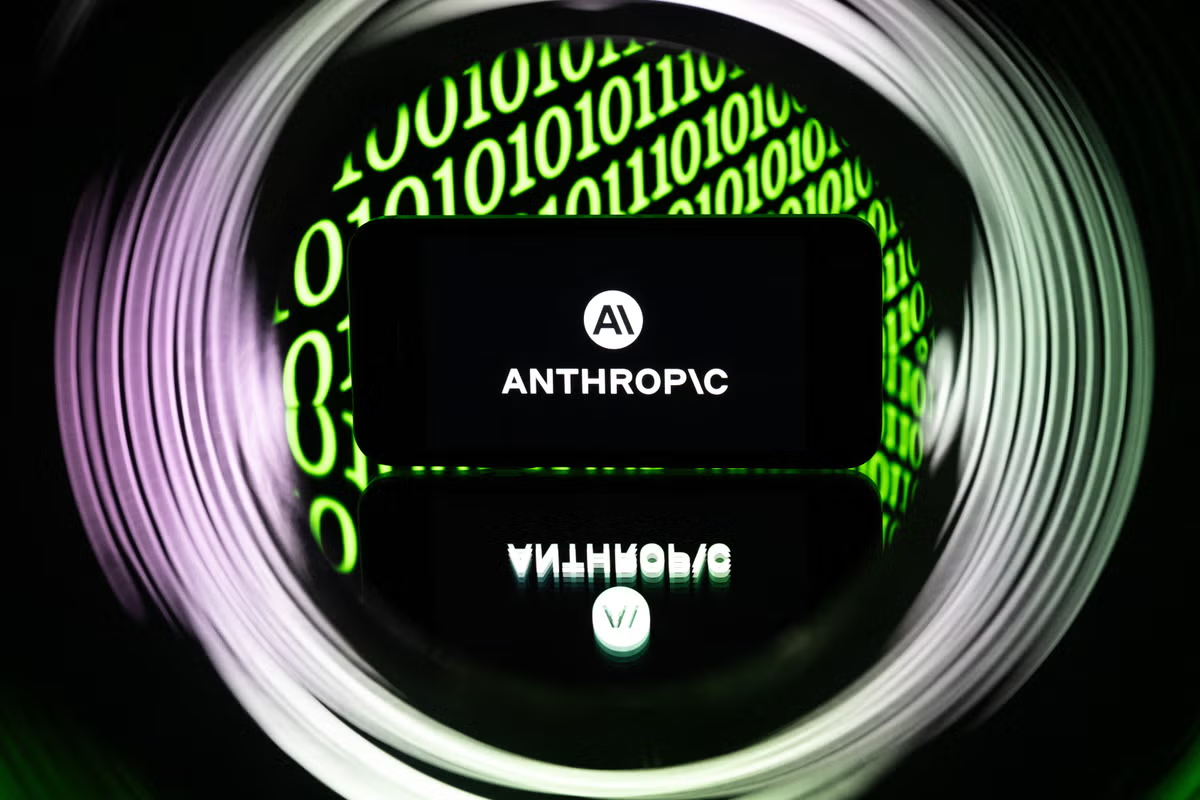
Leading artificial intelligence firm Anthropic has withdrawn its newest AI models, Fable 5 and Mythos 5, from public access.
Anthropic said Friday that it was forced to “abruptly disable “its most advanced AI models for all users after the US government issued an export control directive, citing national security concerns.
The company stated it received the order without specific details regarding the national security concern. However, Anthropic understands the government believes a method exists to bypass, or “jailbreak,” a safeguard designed to prevent Fable 5 from being used to identify software vulnerabilities.
The order comes just as a previous dispute between Trump administration officials and IPO-bound Anthropic showed signs of easing across parts of the U.S. government.
Anthropic’s relationship with the government had been strained this year after it declined to permit the US military to utilise its AI models for domestic surveillance and fully autonomous weapons systems. In response, the government placed Anthropic on a supply chain blacklist, set to take effect later in the year.
The action also signifies a significant escalation in US efforts to curb foreign adversaries’ AI capabilities. For years, US export controls primarily focused on the chips and tools powering AI, rather than restricting direct foreign access to the AI itself.
Anthropic expressed its disagreement with the government’s stance, stating it had only been provided with “verbal evidence of a potential narrow, non-universal jailbreak”. The company added: “We disagree that the finding of a narrow potential jailbreak should be cause for recalling a commercial model deployed to hundreds of millions of people.”
The government directive and Anthropic’s response underscore growing tensions between AI developers and regulators concerning the assessment of risks posed by “jailbreaks,” which are methods used to bypass model safeguards. Ironically, as recently as Wednesday, Anthropic had advocated for greater US oversight of AI, including the power to block models with unacceptable risks. However, it contended that Friday’s government action did not adhere to principles of fair and fact-based regulation.
Kirsten Davies, the Pentagon’s chief information officer, voiced support for prioritising national security in a post on X. “Some things are simply more important than revenue cycles, clickbait, and pre-IPO valuation. America First. Always,” Davies wrote.
Earlier this week, Anthropic had launched Claude Fable 5, an AI model representing a new “Mythos-class” capability. This model incorporates guardrails prohibiting its use in risky areas such as cybersecurity, though some users have complained these are “overly broad,” according to Anthropic.
Experts have warned that Mythos models, if misused, could dramatically accelerate sophisticated cyberattacks, particularly in sectors like banking that rely on complex, interconnected, and often decades-old technology systems.
Anthropic asserted that it had collaborated with the US government and others on safety measures prior to the Fable launch, and noted that models from rival AI providers exhibited a similar capacity to uncover minor bugs in code.
“The net effect of this order is that we must abruptly disable Fable 5 and Mythos 5 for all our customers to ensure compliance. Access to all other Anthropic models will not be affected,” Anthropic stated.
The company believes there is a “misunderstanding” and is actively working to restore access to the models as swiftly as possible.
“If this standard was applied across the industry, we believe it would essentially halt all new model deployments for all frontier model providers,” Anthropic warned.
Amazon’s cloud unit AWS confirmed late oFriday that Anthropic had requested it revoke access to the models for “all users in all regions.” A US official corroborated that the Commerce Department had issued an export control directive to suspend all access to Fable 5 and Mythos 5 by foreign nationals.
Dean Ball, a former White House official who contributed to the AI Action Plan issued in the summer of 2025, suggested on X that the order implies all “non-Americans” would be restricted from using Anthropic’s latest models, including those based in the US.
“This means you should expect to have to prove your citizenship to use Anthropic models,” Ball commented.
Several key Anthropic personnel, including co-founder Chris Olah, AI researcher Andrej Karpathy, and philosopher Amanda Askell, were born outside the United States.
Reuters was unable to ascertain their citizenship status, and an Anthropic spokesperson declined to comment on whether such staff would lose AI model access.