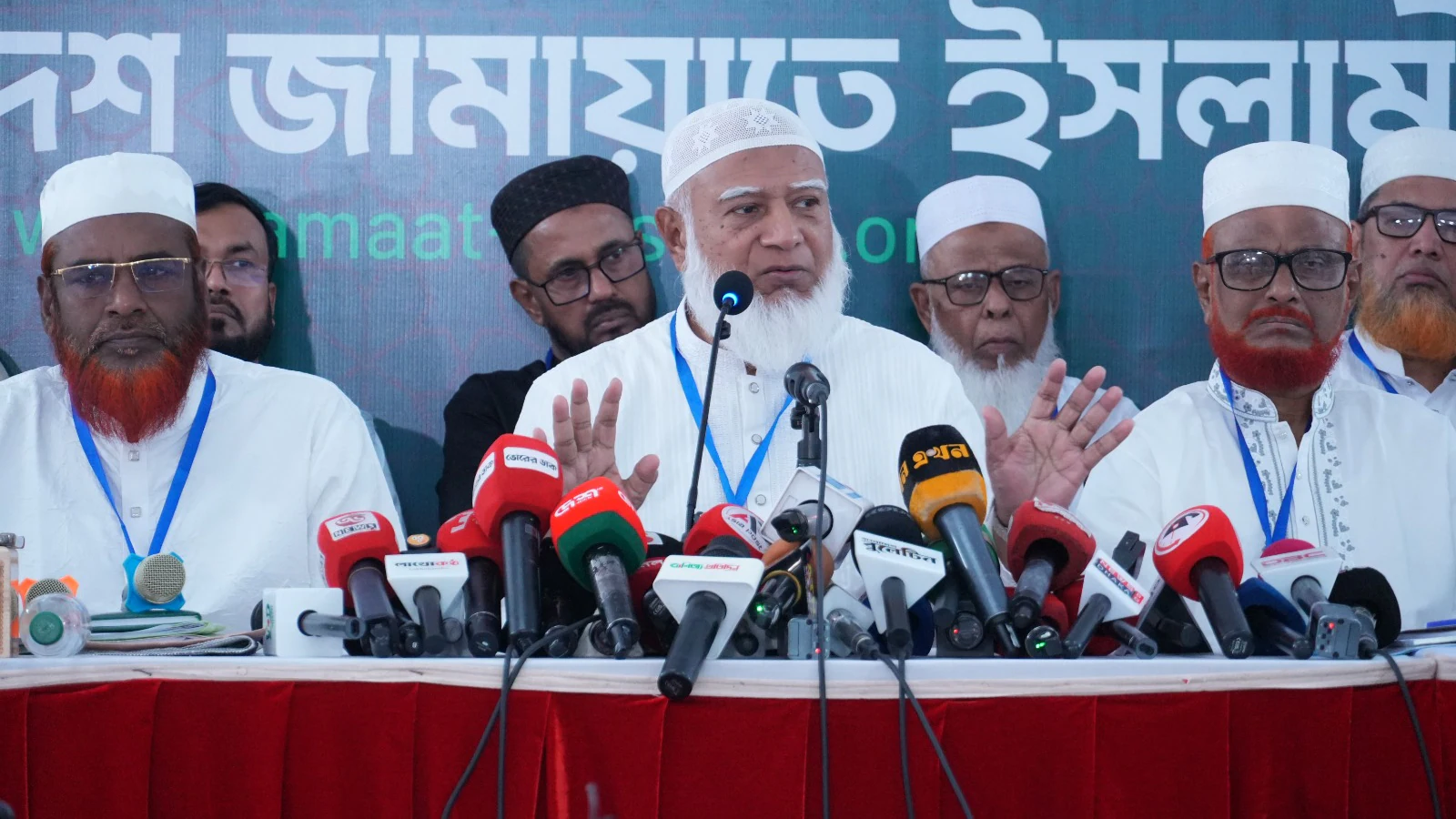
Bangladesh’s opposition party, the Jamaat-e-Islami, has intensified its opposition to the proposed 2026-27 national budget, calling it “anti-people” and accusing the Prime Minister Tarique Rahman-led government of shielding the wealthy while increasing the burden on ordinary citizens.
The party also termed the revenue target unrealistic, warned of rising inflation due to higher operational spending, and demanded greater transparency, accountability and a more people-centric fiscal policy.
Jamaat and BNP – A Sour Relationship
When the Bangladesh Nationalist Party-led four-party alliance emerged victorious in the parliamentary elections in 2001, Jamaat-e-Islami entered the government for the first time since the restoration of democratic politics in the country. Despite having only 17 MPs in the 300-member body of the Jatiya Sangsad, Jamaat got two important ministries: Agriculture and Social Welfare.
The coalition marked a landmark in the history of Jamaat. Though the BNP had provided numbers, it was the ideological influence of Jamaat which made it different from the rest of the alliance partners.
Influence Beyond Numbers
The legislative performance of Jamaat between 2001 and 2006 cannot be examined independent of that of the BNP, as the party enjoyed a majority in the parliament. Given the small number of its MPs, Jamaat had no say in determining the legislation; rather, its influence depended on coalition politics and mobilising its supporters.
The analysts claim that this influence determined the stance of the coalition on ideologically contentious issues. The questions relating to secularism, constitutional status of Islam and minority protection remained sensitive issues, and any vote in favour of these issues was a prerequisite for Jamaat’s support for the government.
Constitutional Questions
In August 2013, the High Court of Bangladesh revoked the electoral registration of Jamaat-e-Islami on the grounds that the provisions in the party’s constitution were in conflict with those of the Constitution of Bangladesh.
Though the registration of Jamaat was reinstated by the Supreme Court of Bangladesh, its ideological base remains unaltered.
From Parliament To Streets
After coming back to power in 2009, the government of the Awami League set up the International Crimes Tribunal to put on trial the senior Jamaat leaders charged with atrocities committed during the 1971 Liberation War of Bangladesh.
The verdicts of this court brought the country into one of its most turbulent periods of political turmoil when Jamaat held protests throughout the country. As per estimates provided by the Centre for Policy Dialogue, the researchers measured the economic losses in billions of taka. More than 500 people were killed in political violence in that year, making it one of the bloodiest episodes of political confrontation in the history of Bangladesh.
The episode reaffirmed Jamaat as a party capable not only of influencing the political processes in the parliament but also in the streets of the entire country.
Coalition Politics And Democratic Limits
The parliamentary politics in Bangladesh was continuously influenced by the relationship between the BNP and Jamaat.
While the former tried to separate itself from the latter in order to increase its electoral popularity, the latter was indispensable for the BNP as an ally in politics.
This relationship created problems for the establishment of the political consensus on sensitive issues like secularism, minority rights and religion-based governance.
The result was that ideological disputes frequently extended beyond the parliamentary boundaries into the national politics in the form of nationwide mobilisation.
Jamaat’s Best Parliamentary Performance
The parliamentary election of 2026 became the greatest electoral success of Jamaat throughout its history.
Despite the absence of the Awami League from the election, Jamaat participated in the elections as part of the National Citizen Party. The party won 68 seats – a great leap over its previous best of 18 seats in 1991. Yet the BNP outperformed it, indicating that despite great expansion of Jamaat in the parliament, it did not become the dominant political party of Bangladesh.
Soon after the elections, the chief of Jamaat, Shafiqur Rahman, said that his party was ready to join the coalition government if the circumstances would require.
An Enduring Democratic Dilemma
Over two decades since its first entry into the government, Jamaat occupies a special place in the political landscape of Bangladesh. It actively engages in electoral democracy while holding an ideological quest of Islamic rule – this dilemma raised constitutional and political disputes time and again.
Expansion of its influence in the parliament after the 2026 elections indicates that the issue of inconsistency between the secular constitution of Bangladesh and the ideology of Jamaat will continue to be a significant feature of the country’s democracy in the future.