PROSPER OKOYE
The first thing that catches the eye in Ejigbo is not what is there, but what is missing.
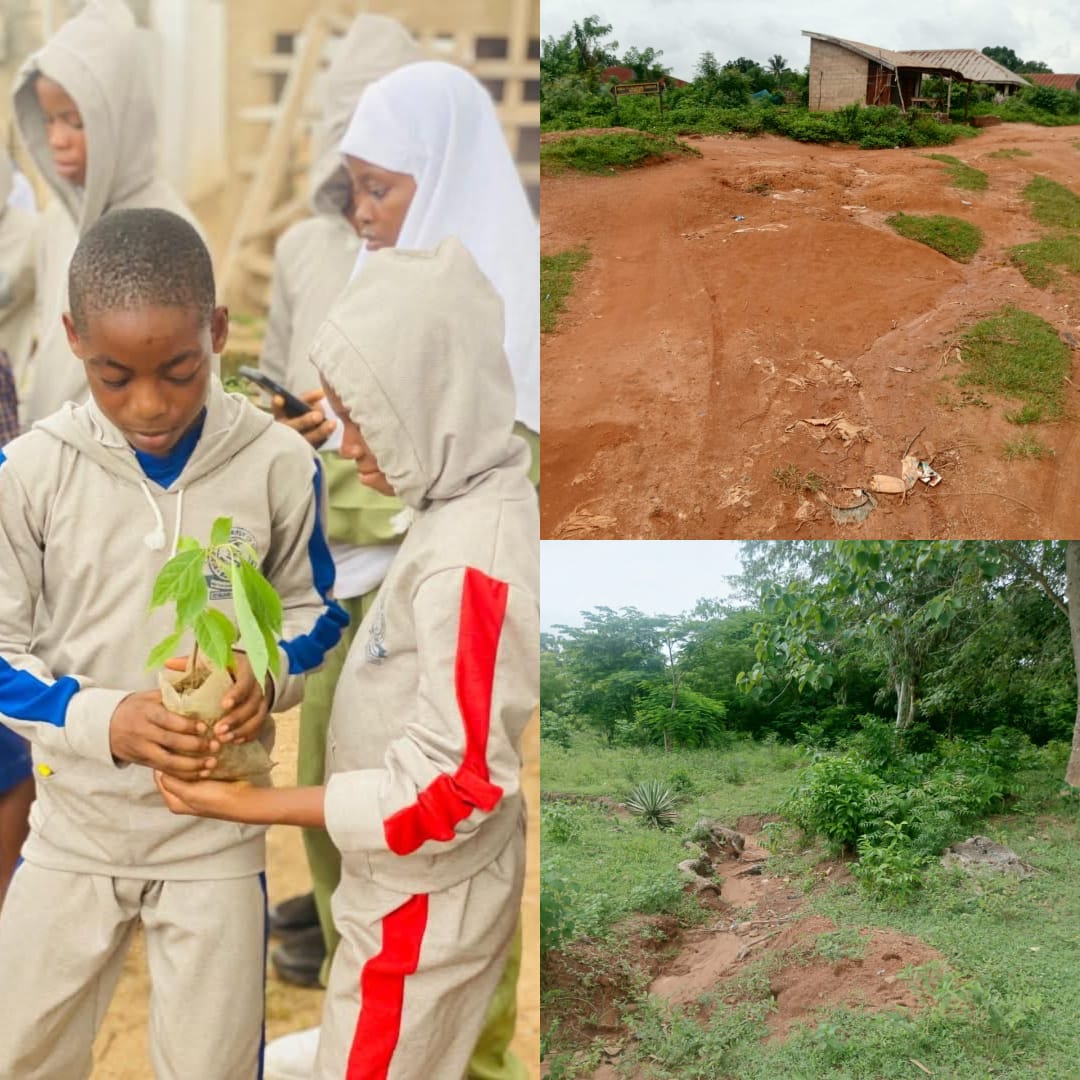
Along dusty roads that wind through the ancient Yoruba town in Osun State, tree stumps protrude from the earth like unfinished sentences. In some places, bare patches of land stretch toward the horizon where thick vegetation once stood. During heavy rains, muddy water carves channels through exposed soil, carrying away pieces of the land. Under the afternoon sun, there is little shade left to soften the heat.
For many residents, however, the disappearing trees are not symbols of environmental decline. They are furniture, farmland, firewood, income, and survival.
The story of Ejigbo is not simply about deforestation. It is about the difficult choices people make when economic necessity collides with environmental protection.
“The trees are being cut for several reasons,” said Dr Undo Jacob, Executive Director of the One Health and Eco Sustainability Initiative, who has spent the past year working in the area.
“Some are cut for furniture, some for agriculture, and some for fuel. But from what I have observed, furniture production and farming are the dominant reasons.”
In communities where economic opportunities remain limited, trees often represent one of the few immediately accessible resources. A mature tree can fetch between ₦5,000 and ₦10,000 depending on its size, species, and location. To an outsider, that may seem insignificant. To a family struggling with rising food prices and uncertain income, it can mean school fees, medicine, or the next meal.
The result is a quiet but persistent transformation of the landscape.
Ejigbo occupies a space between rural tradition and urban expansion. It is neither entirely rural nor fully urban. Dr Jacob describes it as “pre-urban”—a community in transition, where growing human needs increasingly place pressure on natural resources.
As trees disappear, so do many of the benefits they provide.
One afternoon, standing near a section of eroded land not far from his residence, Jacob pointed to a tree that had once anchored the soil.
“The tree was cut down,” he said. “After that, erosion started taking over the area.”
The connection is visible. Without roots to bind the soil, rainwater washes earth away. Small gullies appear. Over time, they deepen. What begins as a patch of erosion can become a threat to roads, homes, and farms.
But erosion is only one consequence.
Trees regulate temperature, filter pollutants from the air, absorb carbon dioxide, and provide shelter for birds, insects, and countless organisms that sustain local ecosystems. Their loss affects everything from biodiversity to water retention.
“These trees provide shade for us,” Jacob explained. “They also provide a natural ecosystem for animals and other organisms. When we remove them, we affect those habitats.”
In recent years, residents have also noticed changes in rainfall patterns and flooding. Streets that once drained naturally can remain submerged for hours after heavy rains. While no single flood can be blamed entirely on tree loss, environmental experts say deforestation often worsens such conditions by reducing the land’s ability to absorb water.
The effects extend beyond the physical environment.
Climate change is often discussed through global statistics, international agreements, and scientific projections. Yet in places like Ejigbo, its impacts are experienced in everyday ways: hotter afternoons, changing seasons, unpredictable rainfall, and declining environmental stability.
Climate change, Jacob said, is ultimately driven by the accumulation of countless human activities, including deforestation.
“It has a way of disrupting the way things normally happen,” he said.
What makes the situation in Ejigbo particularly challenging is that many residents do not initially connect the environmental changes around them with the gradual disappearance of trees.
For years, deforestation has been treated as an invisible problem—a background issue overshadowed by more immediate concerns such as employment, food security, and household income.
That is where education enters the story.
Last year, Jacob’s organisation launched Project Green Shade, an environmental awareness campaign designed to promote tree planting and environmental stewardship among young people.
The initiative reached three secondary schools in Ejigbo and engaged between 500 and 700 students through advocacy programmes focused on the environmental value of trees.
What surprised organisers was not the scale of participation but the enthusiasm.
“Many of the students voluntarily committed themselves to planting trees when they got home,” Jacob recalled.
Around fifty trees have already been planted through the initiative. In numerical terms, that may appear modest compared to the scale of deforestation. Yet the project’s significance lies elsewhere.
Every environmental movement begins with a shift in perception.
A tree is no longer just timber waiting to be sold. It becomes shade for future generations. It becomes protection against erosion. It becomes cleaner air. It becomes part of a larger ecosystem.
The challenge facing Ejigbo, like many communities across Nigeria, is that environmental protection often demands long-term thinking while poverty demands immediate action.
The farmer clearing land for cultivation is responding to today’s hunger. The carpenter purchasing timber is responding to today’s market. The family gathering fuelwood is responding to today’s needs.
The consequences, however, belong to tomorrow.
This tension between present survival and future sustainability is visible across much of Nigeria’s landscape. It is reflected in shrinking forests, expanding farmlands, changing weather patterns, and growing environmental vulnerability.
In Ejigbo, the struggle is written into the land itself.
Each tree that falls creates opportunities for someone. Each tree that disappears creates risks for everyone.
The question confronting the community is not whether people need livelihoods. They do.
The question is whether a path can be found where people no longer have to choose between feeding their families and protecting the environment that sustains them.
Until then, the remaining trees of Ejigbo stand as silent witnesses to a contest that is becoming increasingly familiar across the developing world—a contest in which survival and nature are often forced to compete for the same space.