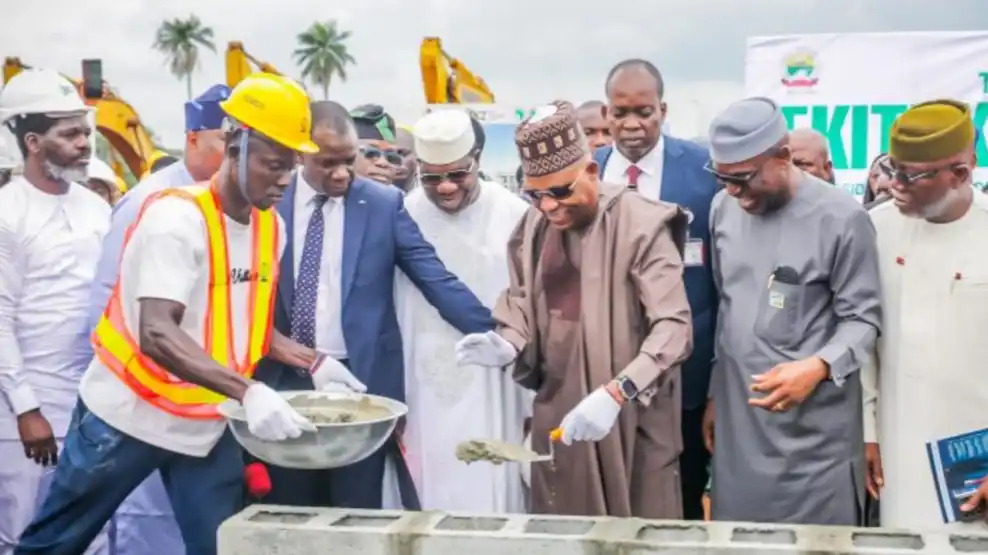
Ekiti State is projecting the creation of up to 100,000 jobs through the Ekiti Knowledge Zone (EKZ), a major innovation and technology-driven development project designed to position the state as a hub for research, skills development, innovation and industrial growth.
The ambitious target was disclosed by Governor Biodun Oyebanji during the official turning of the sod ceremony for the project at Ago Araromi in Ado Ekiti on Tuesday. The event also drew support from the Federal Government, with President Bola Ahmed Tinubu describing the initiative as a strategic investment capable of unlocking the potential of talented Nigerians and accelerating innovation-led economic growth.
The EKZ project has been in development for more than a decade. According to Governor Oyebanji, the initiative was first conceived on August 12, 2013, under the administration of former Governor Kayode Fayemi as part of efforts to harness the intellectual capacity of Ekiti people and create a platform for innovation-driven development.
Over the years, the project has evolved into one of the state’s most significant economic and technology infrastructure initiatives. Oyebanji said his administration decided to sustain and advance the project in line with its continuity agenda while also making long-term investments in science, technology, industrial development, healthcare, research and innovation.
The governor explained that the EKZ forms part of Ekiti State’s 30-year development plan aimed at unlocking the state’s economic potential and attracting investments capable of generating sustainable growth.
“This project is part of the 30 years Development Plan of this administration in its efforts to unlock the economic potentials of our state,” Oyebanji said.
To move the project forward, the state secured $80 million in financing through support from the Federal Government and the African Development Bank (AfDB). The funding is expected to support the development of critical infrastructure and facilities required to transform the zone into a functional innovation ecosystem.
The governor noted that the EKZ had earlier received Free Trade Zone status under the administration of former President Muhammadu Buhari, a designation expected to enhance its attractiveness to investors, technology companies, research institutions and manufacturing firms.
According to Oyebanji, the vision extends beyond creating a technology park. He described the EKZ as a world-class economic ecosystem that will support industrial development, innovation, entrepreneurship, skills acquisition and technology-driven enterprises.
“This EKZ is not only going to be the giant of innovation in Africa, but it represents a world class economic ecosystem that will serve as a catalyst for industrial development, innovation, job creation, opportunities for technology driven industries and skill acquisition platform,” he said.
The employment projections attached to the project are among its most significant features. The governor revealed that the first phase alone is expected to create more than 20,000 jobs when completed. Across all phases of development, the project is projected to generate about 100,000 jobs spanning research, science, technology, industry and education-related sectors.
The expected jobs will come from a combination of direct employment opportunities within the zone and indirect opportunities generated through supporting businesses, service providers, construction activities, educational institutions and technology companies operating within the ecosystem.
For a state widely recognised for its strong educational heritage, the EKZ represents an attempt to convert academic excellence into economic value. Ekiti is often referred to as one of Nigeria’s leading centres of learning and has produced a significant number of professors and academics over the years. State officials believe the knowledge zone can help bridge the gap between education, innovation and commercial enterprise.
President Tinubu, represented by Vice President Kashim Shettima at the ceremony, said the project aligns with global development models that place education and technology at the centre of economic transformation.
Describing the EKZ as a “masterpiece”, the President said the initiative reflects the principle that economies can be unlocked through investments in education, innovation and technological advancement. He added that the Federal Government remains committed to supporting projects that encourage research, technological development and job creation.
“Under President Tinubu’s administration, we are gradually moving from dependency to sustainability and self sufficiency. We are determined to encourage research, innovation and technological development to create jobs for our teeming youths,” he said.
The project is also expected to strengthen Ekiti’s position within Nigeria’s growing innovation ecosystem by attracting startups, technology companies, researchers, investors and development partners seeking opportunities outside traditional commercial centres.
CCECC, the contractor handling the development, expressed confidence in the project’s impact. The company’s Chief Executive Officer, Eric Shem, said the initiative would help attract investments, develop human capital and create employment opportunities while contributing to long-term economic growth.
As construction activities commence, expectations remain high that the Ekiti Knowledge Zone will become a major driver of innovation-led development in Nigeria. If the projected 100,000 jobs are achieved, the project could rank among the country’s most significant state-backed innovation investments, creating opportunities across technology, research, education and industrial sectors while helping position Ekiti as a leading knowledge and innovation hub in Africa.