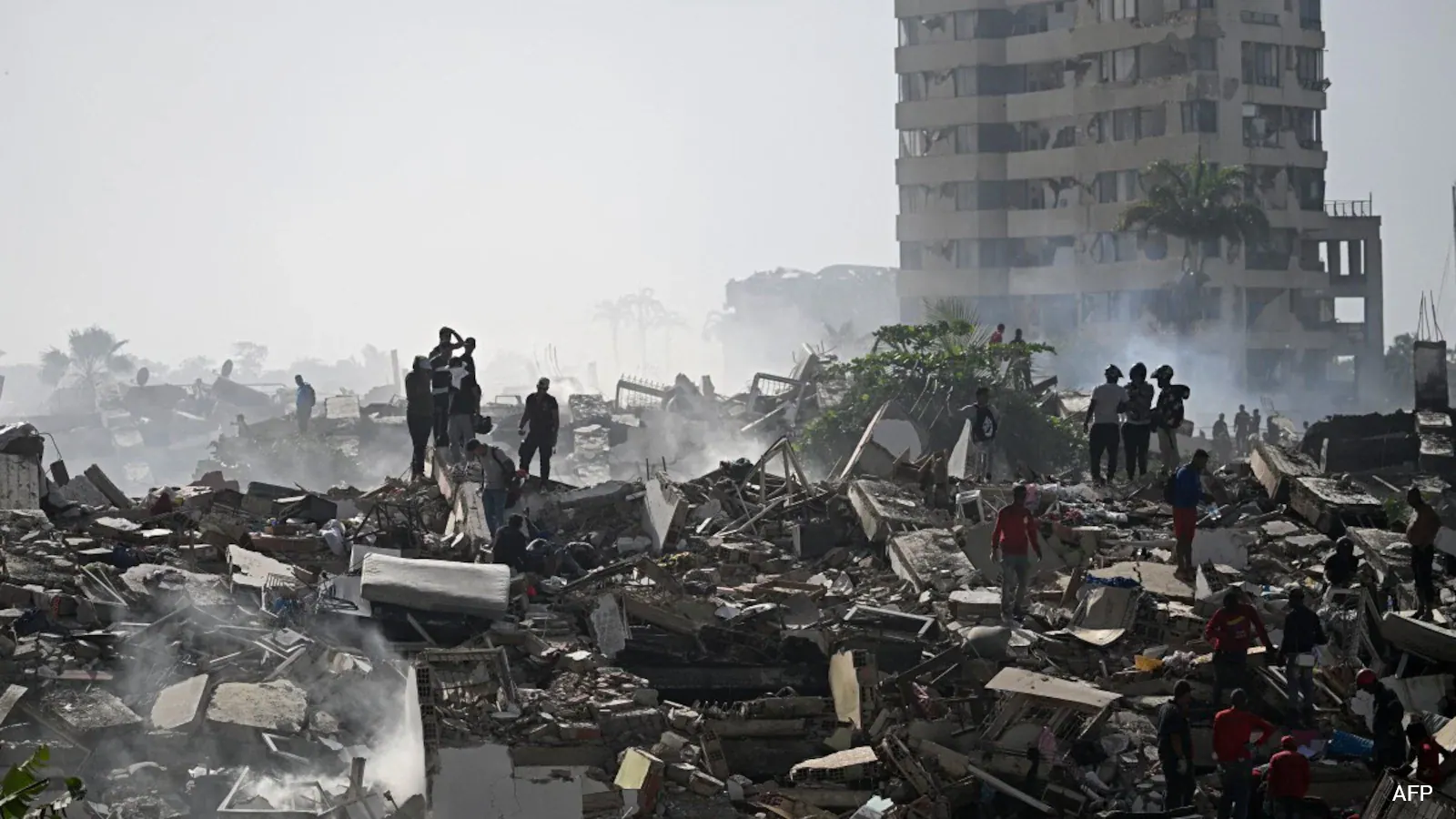
Two powerful earthquakes that struck the northern coast of Venezuela and capital Caracas on Wednesday claimed at least 188 lives, a toll that could increase as rescue teams comb the debris of collapsed buildings.
Until now, the deadliest quake in Venezuela’s modern history was a 1967 event that left 240 people dead.
Historically, a number of major tremors in Latin America, which is home to complex fault zones, have caused widespread destruction and loss of life. Here is a look at 10 of the region’s deadliest quakes, from 1812 in Venezuela to 2010 in Haiti:
1. The 2010 Haiti Earthquake
Magnitude: 7.0
Death toll: 316,000
Despite registering a weaker magnitude than other quakes on this list, the 2010 Haiti earthquake was the second-deadliest in history, following only the 1556 Shaanxi Province quake in China that left an estimated 830,000 dead.
This earthquake was particularly deadly because it struck the densely populated capital of Port-au-Prince, which lacked strong infrastructure and buildings designed to withstand heavy shaking. Poor building practices, concrete buildings and a lack of services to respond to the disaster all contributed to the high death toll.
The earthquake led to an estimated $8 billion in losses, nearly 120% of the country’s 2009 GDP.
2. The 1868 Ecuador-Colombia Earthquakes
Magnitude: 7.7
Death toll: 70,000
Starting with a smaller-intensity earthquake in the early hours of August 15 and culminating with 7.7 magnitude shaking the next morning, this cluster of earthquakes destroyed several towns and led to an estimated 40,000 dead in Ecuador and 30,000 dead in Colombia.
In a book published that year documenting the disaster, a government commission wrote that the city of Ibarra was asleep when the earthquake struck at 1:15 a.m. The book stated: “In less than three seconds (Ibarra) was turned into a large and dismal burial ground. Almost all of its population buried under the ruins of their own bedrooms.”
3. The 1970 Peru Earthquake
Magnitude: 7.9
Death toll: 66,794
This undersea earthquake triggered the deadliest landslide in history after it destabilized the northern wall of Peru’s tallest mountain. The mass of glacial ice and rock picked up speed and debris as it hurtled toward the towns of Yungay and Ranrahirca at speeds of up to 335 kmph (208 mph).
The landslide reached the towns with nearly 80 million cubic meters (2.8 billion cubic feet) of ice and rocks, burying them in up to 4 meters (13 feet) of sludge. An estimated 19,000 people died in Yungay while just 2,500 survived. Up to 70% of other towns like Chimbote and Huaras were destroyed. Nearly one million people were left homeless.
4. The 1797 Ecuador Earthquake
Magnitude: 8.3
Death toll: 40,000
The most powerful known earthquake to strike Ecuador, this temblor hit the second-highest level on the Modified Mercalli intensity scale, which measures effects experienced by people.
The quake triggered landslides and caused widespread destruction across Ecuador, including Quito, Riobamba, Latacunga and Ambato. Historians and witness accounts describe violent shaking that leveled buildings within seconds.
5. The 1939 Chile Earthquake
Magnitude: 8.3
Death toll: 30,000
Chile is known for the strongest recorded earthquake in history – a 9.5 magnitude in 1960 – yet it was the 1939 quake in the southern city of Chillan that marked the country’s deadliest.
In a book documenting Chilean earthquakes, seismologist Cinna Lomnitz said weak construction materials, such as adobe, along with a “virtual absence of engineering design or provisions against lateral force,” contributed to the high death toll.
The earthquake destroyed the cities of Chillan and Concepcion and led to Chile’s first anti-seismic building code.
6. The 1812 Venezuela Earthquake
Magnitude: 7.7
Death toll: 26,000
A 1962 analysis suggests this event was actually a trio of earthquakes triggered by one another and in close proximity. The quake destroyed around 90% of Caracas and caused thousands of deaths in Barquisimeto, Merida, La Guaira and San Felipe.
The disaster struck during Venezuela’s revolutionary war against Spain, which Spanish authorities called divine punishment against the revolutionaries. The United States sent food and money to Venezuela, in an early example of offering foreign aid.
7. The 1868 Arica Earthquake
Magnitude: 8.5
Death toll: 25,000
This earthquake struck the city of Arica in what was then Peru, and is now Chile, destroying the cities of Arica, Arequipa, Moquegua, Mollendo and Ilo.
The force also caused a tsunami that razed Peruvian port cities and caused devastating waves as far away as Hawaii and New Zealand.
8. The 1976 Guatemala Earthquake
Magnitude: 7.5
Death toll: 23,000
After striking a highly populated area including the capital Guatemala City at 3 a.m., this earthquake spurred damage across at least 100,000 square kilometers (38,000 square miles). Adobe houses were obliterated and strong aftershocks caused additional deaths. Nearly 1.2 million people were left homeless and about two-fifths of the country’s hospitals were destroyed.
9. The 1797 Venezuela Earthquake
Magnitude: N/A
Death toll: 16,000
German geographer and naturalist Baron Alexander von Humboldt documented this quake that destroyed the town of Cumana and the surrounding area. Witnesses reported loud underground noises and the smell of sulfur before the quake, and an 1855 catalog of past earthquakes described “flames came up from the earth, followed by a subterranean noise like bubbling, and then (followed) by shocks” near the bay of Cariago.
10. The 1861 Argentina Earthquake
Magnitude: N/A
Death toll: 14,000
The quake hit close to midnight and destroyed most buildings, including the San Francisco Basilica, in the city of Mendoza. The ubiquitous gas lamps of the era contributed to fires that tore through the rubble and lasted for days, leading to widespread pillaging and looting.
The Significant Earthquake Database does not provide the quake’s magnitude, but other records estimate it reached magnitude 7.2.
*All data compiled from the National Centers for Environmental Information and World Data Service for Geophysics Significant Earthquake Database
(Except for the headline, this story has not been edited by NDTV staff and is published from a syndicated feed.)