The federal government, for generations a bulwark in enforcing civil rights laws to remedy systemic discrimination against Black people and other people of color, has dramatically shifted its approach under the Trump administration.
Efforts once aimed at promoting equal opportunity and holding schools accountable for racial bias are now being reinterpreted, with programs designed to address deep-rooted inequities for students of color increasingly cast as discriminatory against white students.
This change has led to programs, long considered legally sound, being swiftly labeled “illegal DEI” (diversity, equity and inclusion) by the White House. Schools that do not comply face threats to their funding, and some have already lost federal grants. Civil rights attorneys describe these actions as a complete inversion of legal history.
“It’s literally flipping the purpose of civil rights law on its head, not just harming Black students and students of color, but entire school communities,” said Michael Pillera, director of educational equity issues at the Lawyers’ Committee for Civil Rights Under Law.
“It’s unmoored from the actual history of our country and untethered to the reality of life in this country.”
The U.S. government has initiated investigations or joined litigation concerning a wide array of efforts to address racial inequality.
The Justice Department is scrutinizing programs in Rhode Island and Iowa that aim to increase the number of teachers of color. Furthermore, grants to districts for teacher training or recruiting school mental health workers have been discontinued due to mentions of diversity in their recruitment strategies.
In a statement, the Education Department affirmed that programs receiving federal funding must adhere to the law, which prohibits discrimination on the basis of race.
“Serving student needs and following the law are not irreconcilable mandates. Advocates and educators have no reason to stress if they abide by the law,” said Amelia Joy, a department spokesperson.
The Trump administration previously investigated Chicago Public Schools and withheld over $20 million when the district refused to dismantle its Black Student Success Program, which seeks to enhance Black students’ access to advanced coursework and reduce overly harsh discipline.
A similar initiative in Los Angeles, designed to close racial achievement gaps, is now facing comparable pressure.
Following the 2020 murder of George Floyd in Minneapolis and a subsequent outpouring of student activism, the Los Angeles Unified School District (LAUSD) established the Black Student Achievement Plan (BSAP). This program provides schools with additional teachers, counselors, and curriculum focused on Black history.
Initially, LAUSD selected schools for BSAP in part based on the number of Black students enrolled. In 2023, Defending Education, a conservative group based in Virginia, filed a complaint with the Education Department, alleging discrimination against non-Black students.
In response, the district announced it would no longer consider Black enrollment, instead focusing solely on metrics such as high absenteeism and low test scores, while emphasizing that all students could participate.
After these adjustments, the Education Department stated in 2024 that it found no evidence of a violation. However, when Defending Education refiled its complaint this year, the department’s Office for Civil Rights launched a new investigation.
Sarah Parshall Perry, senior legal fellow at Defending Education, explained that the complaint was refiled after district leaders were reportedly recorded stating the program had not materially changed, despite the new criteria.
“Our goal is not to make LA Unified a target, but rather to make sure that when people say that they are eliminating racially discriminatory aspects of programs, that they’re actually making good on their word,” Perry said. LAUSD, in a written statement, maintained that its programs align with state and federal laws and are open to all students.
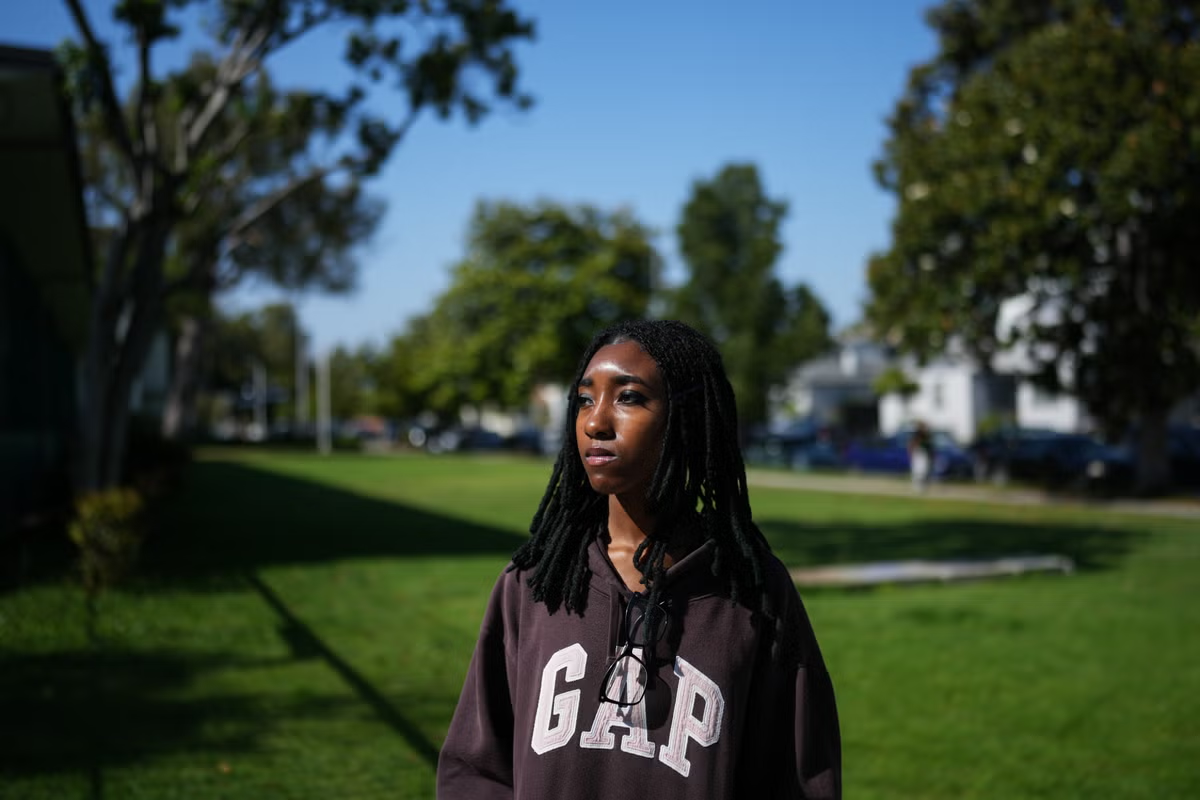
Makeda Walker-Deen, a junior at Dorsey High School, attested to the program’s positive impact throughout her high school career. A program counselor guided her toward college-preparation programs, enabling her to visit the University of California, Berkeley, and Stanford, both of which she is considering for applications.
Psychologists and social workers connected through the program have also helped her manage pressure and anxiety.
“I think that the things a lot of critics are saying are so unreasonable,” she said. “They’re saying that a program that’s meant to help Black students, other students of color, is discriminatory. We’ve been discriminated against in school systems basically our entire lives.”
LAUSD has observed tangible results from BSAP. Recent state testing data show that Black students in the district outperform the average Black student across California.
“When you provide teachers and school personnel with knowledge and skills to help your lowest-performing students, everyone wins,” said Tyrone Howard, an education professor at UCLA who consulted on BSAP.
Organizers express concern that the mounting pressure on the program will impede efforts to address inequities for Black students. “Where is the uproar about the failings of the public education system for Black children?” asked Christian Flagg, director of youth organizing at Community Coalition, which advocated for BSAP’s creation.
“We have had this student group at the bottom for so long, these massive gaps for so long. But when we do something to try to address it, there’s a problem.”
The federal government’s pivot in its approach to civil rights in schools has manifested in several ways under Trump. The Justice Department has released school districts from court-ordered desegregation plans dating back to the Civil Rights Movement, deeming them outdated and burdensome.