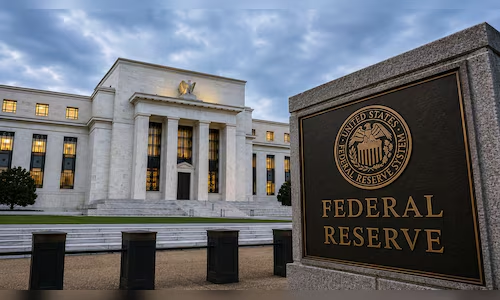
Aziz said the Fed’s projections point to a sustained rate-hiking cycle, a signal that could shape market expectations ahead of upcoming policy meetings.
Aziz expects markets to focus on whether the Fed continues raising rates beyond addressing energy-price pressures. He also said investors will watch for more clarity at the next policy meeting as Fed officials provide further guidance on inflation and economic conditions.
He noted that nine Fed officials projected between one and three rate increases in 2026, while projections for 2027 and 2028 remained above the current federal funds rate.
“So clearly, what the Fed is looking at is a sustained rate-hiking cycle coming into place,” Aziz said.
Aziz also pointed to the absence of clear guidance from the central bank, adding that policymakers also provided little indication of how they currently assess inflation or the broader economy.
Aziz said the recent decline in oil prices eases some immediate pressures in India but does not address longer-term concerns around capital flows. He noted that foreign direct investment (FDI) flows had been weakening well before the recent geopolitical tensions.
This is an edited transcript of the interview.Q: What do you make of Kevin Walsh’s first statement? A lot on the Street was worried about how he was going to project himself and the Fed going forward, but it seems like he’s a lot more hawkish than the Street would have actually anticipated.A: We don’t know whether Kevin Walsh is hawkish. We know that the statement was hawkish, so I would say that the communication was made up of two parts. There was one part which was a statement and the other part which was a press conference.
So, if you look at the statement, the market had been expecting, and we had been expecting, language of the kind that would suggest a dovish bias, namely that the phrase ‘needed readjustment’ would be dropped. That phrase was dropped.
What was surprising was the near-complete removal of the section on forward guidance. In fact, the only forward guidance we got from the statement was that price stability would be delivered.
I think what was surprising, and that’s why the market reacted so negatively to the statement, was the dot plots. If you look at the 2026 expected rate increases, there were nine members who had one, two, or three – in fact, one member had three rate hikes in 2026.
If you look at the 2027 dot plots, all of them remained above the current level of the Fed funds rate, and even in 2028, the projections were far more hawkish.
So clearly, what the Fed is looking at is a sustained rate-hiking cycle coming into place, which is very different from raising rates in order to make sure that the oil price increase, because of what was happening in West Asia, would not unanchor inflation expectations. So, I think that was the surprising part of it, in the statement.
In the press conference, the Fed did not give any forward guidance to the market, and the Fed Chair did not even give any present guidance on the state of the economy, how he saw inflation, or the extent to which he was looking at monetary policy to affect inflation.
Q: The next one is in July, right?A: Yes, that’s six weeks’ time.
Q: More time on the job, and perhaps we will hear more.A: That’s our understanding. That is the first one. Let’s see what happens to him once he has a few more weeks on the job.
Q: The market reaction — do you think, as has happened before as well, that the reading on that day is something, and then markets tend to walk back or reassess? Do you think the same thing will happen this time around with the move-in rates?A: So, I think there’s a bit of a difference. What was the market looking for? Obviously, there was not going to be any rate cut, and the question was what the Fed would say about the upcoming rate hikes, because the market had rate hikes already priced in, even as early as October and definitely by December.
We didn’t have them; we have one in January, and we have had that rate hike in January since November of last year, so we were very different from the market.
But the market was looking for signals on whether this is simply an increase in interest rates in order to ensure that the rise in energy prices does not feed into core inflation and unanchor inflation expectations, or whether this is something where you would have rate hikes regardless of whether you have the oil price shock or not, because the economy, unemployment, and the labour market are doing so much better and are stronger than expected.
The two scenarios have different implications. One would require a minimal amount of rate hikes, while the other would require a sustained rate-hiking cycle.
Q: Oil prices are down over the last five or six days by around 16–17%, so it’s a big macro reset once again and takes away a lot of the pressure, right? For a market like India?A: Of course, it takes away the immediate pressures, the pressures that came after February, but it doesn’t take away the pressures that were there for the previous one and a half years. You still have pressure on capital flows. You still have the pressure from private equity and private bond flows.
FDI flows still need to reverse, and I don’t think that was being driven by the Iran war. It was happening about 18 months before that. So, we still have that to deal with.
Q: What are you pencilling in as far as emerging markets go? As far as ex-US markets are concerned, largely because the US has powered ahead and is such a large part of the world economy, both from a GDP perspective and from a market perspective – some 63–65% of the MSCI All Country World Index. What does it mean for the rest of the world?A: So, it depends on where you are. If you are in East Asia — Japan, Korea, Taiwan, or Singapore — you are part of the AI boom. Therefore, you are going to benefit.
If you look at what’s happened to the Korean market, just two stocks have been absolutely screaming hot. And even in Taiwan. But those are very AI-related. If you’re part of the cycle, you’re in a great time.
Then, if you’re one step removed and you look at the commodity exporters out of Latin America, they too are basically part of the AI cycle, but slightly separated.
The problem is if you’re on the wrong side of the AI cycle or if you’re not part of the AI cycle. That part of the emerging market universe is doing well – I’m not saying it’s not doing well – but it’s doing well relative to all the shocks that emerging markets have seen over the last four or five years. It is not doing well in absolute terms.
So, I think you will see a differentiated emerging market landscape this time around.
Yes, the US AI boom will take a whole bunch of countries in North Asia and some countries in Latin America along with it and lift them together. But there will be pockets in the emerging market world that are not part of that cycle, or are on the wrong side of the cycle, which will struggle.
Q: How do you expect policymaking in India, for the GDP growth to pick up once again, to play out from here on? On the one hand, this war has tightened the scope a little bit in terms of the amount of largesse that the government can provide.A: In the near term, I don’t think there is an enormous amount of fiscal space, nor is there space on the monetary policy front to provide any meaningful boost to the economy.
So, in the near term, you will have to fall back on the hope that the external sector improves and, with that, we get a rebound in exports. The fears of AI taking away IT exports are not realised. I think that’s basically what would drive growth in the short term.
In the medium term, the government, the Reserve Bank of India (RBI), and policymakers will have to look much more deeply into the structural side of the economy.
And I’m not talking about labour market reforms and land reforms, etc. We’ve been talking about that for the last 25–30 years, and nothing much has happened on that front.
But clearly, you can make an argument that there are low-hanging fruits in the capital markets, low-hanging fruits in the corporate sector, and low-hanging fruits in other areas where you could see some movement taking place.
But I would argue that the real risk — we’ve got the Iran war out of the way — is probably somewhere in mid-July or late July, when you will see the next round of Section 301 and Section 232 tariffs being imposed by the US.
That’s the next phase, and again, that’s something where India will be pretty much in the firing line.
Q: I hope not — tariffs again. I thought that was the old story. We finished that chapter and moved on.A: I don’t think we’re going to get rid of tariffs anytime soon.
For the full interview, watch the accompanying video

Catch all the latest updates from the stock market here