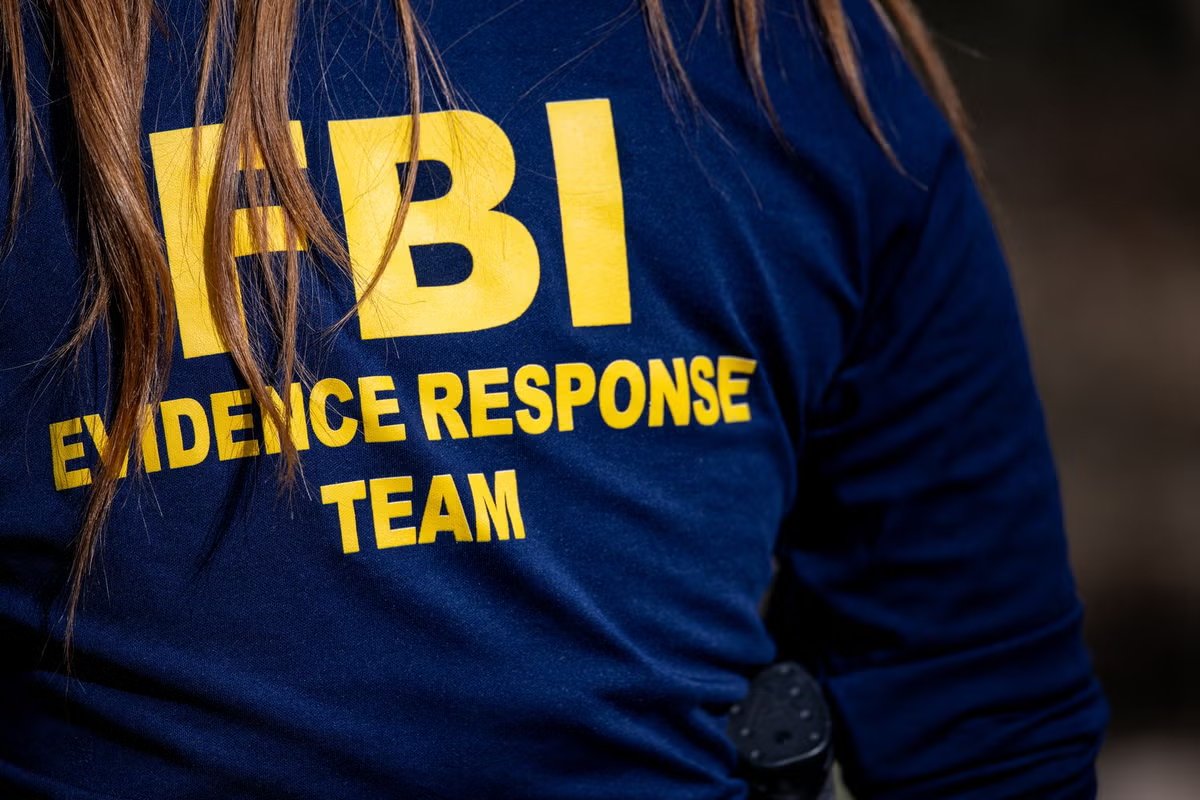
A female FBI agent is suing the Department of Justice over claims her fledgling career stalled out after she rebuffed a senior male agent’s romantic overtures, according to a federal lawsuit reviewed by The Independent.
The rookie agent, who was assigned to the bureau’s San Francisco field office and is anonymized in court filings as “Jane Doe,” says in her complaint that the senior agent fed her alcohol during an out-of-town conference, pressured her to send him nude photos and ultimately “engaged in inappropriate conduct of a sexual nature” while she was so intoxicated, she has no memory or recollection of it.
After Doe reported the situation to higher-ups, the senior agent immediately began to “marginalize, sideline, exclude and isolate [her] from normal workplace activities,” the complaint states. It alleges he no longer looped her in on “critical updates, meetings and interviews related to assigned cases,” and spread false rumors that she was sleeping with a married supervisor.
But when Doe further escalated her concerns to management, the complaint says her boss told her that the bureau was “not going to act on [her] allegations, that there would be no investigative action and that the case was closed.”
Doe was then reassigned to a newly created, unstaffed unit, a significant downgrade for her, the complaint goes on.
“The transfer effectively stripped [Doe] of her existing cases, a professional setback that stunted her advancement, and there were no equivalent new assignments on her new squad,” according to the complaint.
Attorney Matthew Haulk, who is representing Doe, told The Independent he was limited in what he could say publicly at this early stage of the lawsuit, but made a point of noting his client’s “strength and dedication.”
“Ms. Doe pursued a career with the FBI to protect everyday Americans from criminals, and to seek justice on behalf of their victims,” Haulk said. “As detailed in the lawsuit, she experienced pervasive and shocking treatment and, despite her efforts to resolve that treatment within the FBI, she hit a brick wall and her calls for justice remained unanswered.”
Filing the suit “is the first step in seeking justice and accountability on behalf of Ms. Doe,” according to Haulk.
In an email, DOJ spokesman Matthew Nies declined to comment on the lawsuit, which names Acting Attorney General Todd Blanche, President Trump’s former personal attorney, as the lone defendant.
Doe joined the FBI in April 2022, as a probationary special agent, her complaint, which was filed June 17 in San Francisco federal court, states.
In August 2023, it says Doe traveled from San Francisco to a professional conference in Colorado. Two senior coworkers of Doe’s, identified in the complaint as Special Agent 1 and Special Agent 2, were also attending and were already there when she arrived.
Upon landing, Special Agent 1 texted Doe to meet him and Special Agent 2 at a bar, the complaint continues. Although Doe hadn’t yet checked into her hotel and still had her luggage with her, Special Agent 1 “encouraged her to meet with them” before doing so, according to the complaint.
It says Doe agreed because “she believed it was important for developing a positive relationship with two senior agents and would facilitate her field training.”
When Doe got to the bar, it became clear that Special Agent 1 and Special Agent 2 “had been drinking for some time,” the complaint contends, claiming the pair “provided [Doe] with alcoholic drinks that they had already ordered and purchased for her,” and “continued to order and pay for alcoholic drinks until she was visibly intoxicated.”
At a certain point, according to the complaint, Special Agent 1 and Special Agent 2 began to falsely insinuate that Doe and a superior, identified as Supervisory Special Agent 3, were having an affair.
“The interaction left [Doe] feeling demoralized, objectified and uncomfortable,” the complaint states.
Roughly an hour later, the complaint says Doe and the two male agents took an Uber back to their hotel, where Doe checked in and went to her room. There, Special Agent 2 texted Doe, inviting her to his room to make “mistakes” together, according to the complaint. Doe, it maintains, “declined the invitation.”
The next evening, Doe and a group of other agents, including Special Agent 1 and Special Agent 2, went out for dinner and drinks, the complaint explains. Once again, Special Agent 1 and Special Agent 2 bought drinks for Doe “until she was visibly intoxicated,” it says. When the outing was over, and Doe was back in her hotel room, Special Agent 2 texted her, asking for “a nude picture of herself,” the complaint states.
Doe declined, it says.
Special Agent 2 wished Doe goodnight, as she “became physically sick from the alcohol she had consumed and went to bed,” according to the complaint. It says she “subsequently learned, through SA 2’s written admission, that SA 2 entered her hotel room later that evening.”
“On information and belief, SA 2 engaged in inappropriate conduct of a sexual nature with [Doe] while she was intoxicated,” the complaint states. “[Doe] has no independent memory or recollection of those events.”
Once they returned to the San Francisco field office, Special Agent 2 “began to belittle, demean and harass [Doe] in front of her squad mates,” the complaint alleges. “SA 2 and SA 1 scoffed at [Doe] and would roll their eyes when she spoke. The behavior continued unabated.”
By June 2024, the situation had not gotten any better, according to the complaint. Special Agent 1 and Special Agent 2 now started to falsely accuse a married agent, identified in the complaint as Special Agent 4, of having an affair with Doe. When Doe learned of the rumor, she was “so distraught… that she could not focus on her work and was required to leave the office for the day,” the complaint states.
Nearing the end of her rope, Doe went to Supervisory Special Agent 3 and told him everything. And while he said he would have a talk with Special Agents 1 and 2 about it, the complaint maintains Supervisory Special Agent 3 “failed to take appropriate corrective action.”