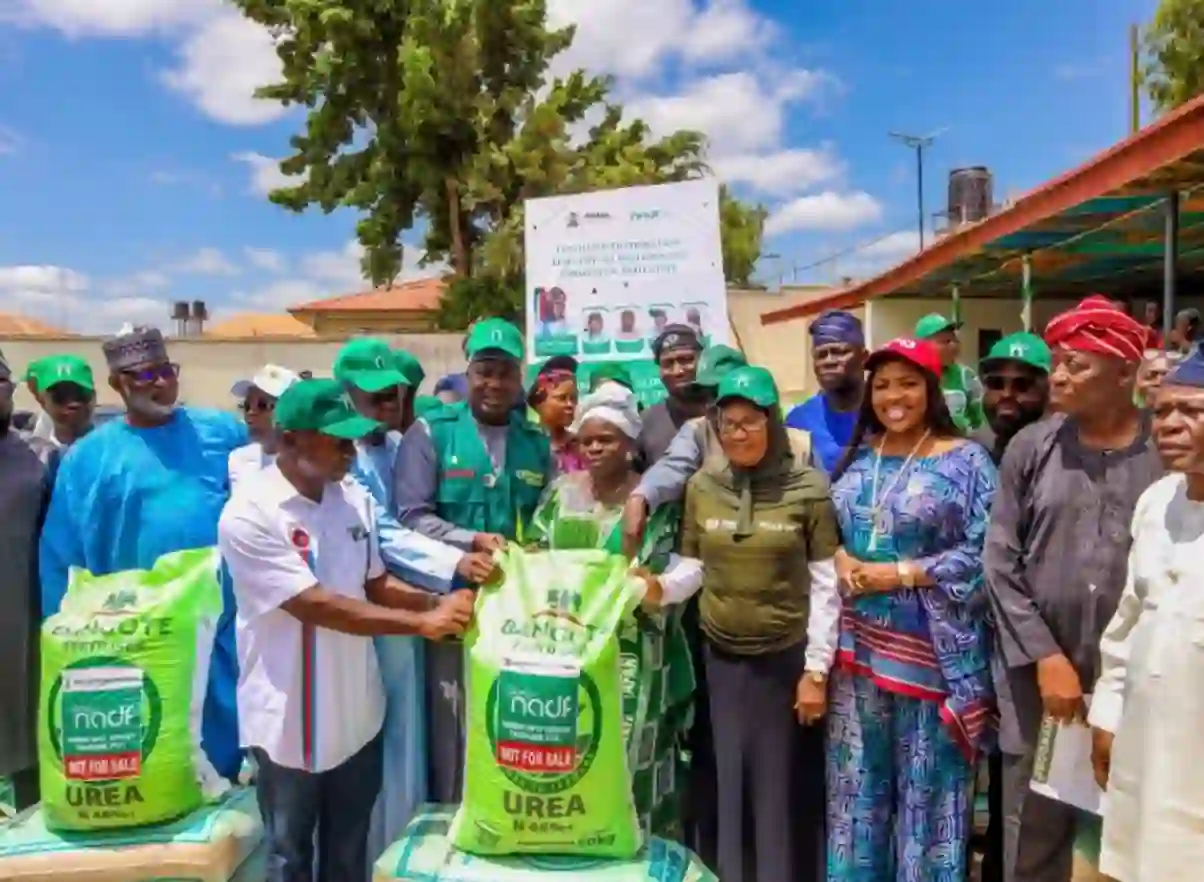
The Federal Government has commenced the distribution of fertilisers to farmers in Ekiti State under the Renewed Hope Farm Inputs Support Programme (FISP) Phase I, a major agricultural intervention aimed at increasing food production, reducing farming costs and strengthening food security across the country.
The programme was officially launched in Ado-Ekiti on Thursday, bringing together farmers, government officials, agricultural stakeholders and development partners. The initiative is being implemented through the Federal Ministry of Agriculture and Food Security in collaboration with the National Agricultural Development Fund (NADF).
Speaking during the inauguration, Ekiti State Governor, Biodun Oyebanji, represented by the Secretary to the State Government, Prof. Habibat Adubiaro, described the programme as a significant step towards supporting farmers ahead of the 2026 planting season.
According to him, the intervention reflects the Federal Government’s commitment to accelerating domestic food production through the timely supply of farm inputs to farmers across the country.
He said the programme aligns with President Bola Tinubu’s Renewed Hope Agenda, which identifies agriculture as a key driver of economic growth, job creation, poverty reduction and sustainable national development.
“The programme demonstrates the Federal Government’s commitment to accelerating domestic food production through the timely provision of fertilisers to farmers,” he said.
Oyebanji commended President Tinubu for prioritising agriculture through various interventions being implemented by the Federal Ministry of Agriculture and Food Security and NADF. He also acknowledged the contributions of the Minister of Agriculture and Food Security, Sen. Abubakar Kyari; the Minister of State for Agriculture and Food Security, Sen. Aliyu Sabi Abdullahi; and the Executive Secretary of NADF, Mohammed Ibrahim, in facilitating the programme.
The governor noted that the Federal Government had previously supplied Ekiti State with 18,000 bags of fertiliser in 2024, consisting of 9,000 bags of NPK and 9,000 bags of Urea, which were distributed to farmers across the state.
He said the latest intervention would further strengthen efforts to increase agricultural productivity and improve food availability.
Highlighting the broader agricultural strategy being pursued in Ekiti, Oyebanji said the state government had continued to complement Federal Government initiatives through programmes designed to support farmers and expand agricultural production.
According to him, these efforts include free land clearing for farming communities and cooperatives, a 50 per cent subsidy on mechanised land preparation, support for farmers’ cooperatives, distribution of improved seedlings and strategic partnerships aimed at improving productivity and market access.
He added that the Bring Back Youth into Agriculture (BBYA) Programme is currently operating in about 12 agricultural clusters across the state, while the Rural Access and Agricultural Marketing Project (RAAMP) has improved transportation links through the construction of rural roads across all 16 local government areas.
The Minister of State for Agriculture and Food Security, Sen. Aliyu Sabi Abdullahi, said the fertiliser distribution programme forms part of broader efforts to achieve the Federal Government’s food security objectives.
He reiterated President Tinubu’s vision of ensuring that Nigeria produces what it consumes and consumes what it produces.
According to the minister, agriculture remains central to the Renewed Hope Agenda and is expected to play a critical role in driving economic growth, strengthening food systems and supporting national development.
Abdullahi also disclosed that the fertiliser being distributed under the programme was blended locally to meet the specific soil requirements of different regions across the country.
Ekiti State Commissioner for Agriculture and Food Security, Ebenezer Boluwade, said the state had consistently aligned its agricultural policies with the Federal Government’s drive towards food sufficiency and sustainability.
He disclosed that the state had cleared close to 5,500 hectares of farmland over the past three and a half years and supported thousands of farmers through its subsidised tractorisation programme.
“As of today, we have cleared close to 5,500 hectares of land, while thousands of farmers have benefited from our subsidised tractorisation scheme,” Boluwade said.
“The distribution of free fertiliser today complements our efforts towards optimal food production and wealth creation.”
He urged beneficiaries to make effective use of the fertiliser provided and avoid diverting or selling the inputs, noting that agricultural extension officers would monitor utilisation to ensure the programme achieves its intended objectives.
Also speaking, the National President of the All Farmers Association of Nigeria (AFAN), Kabir Ibrahim, described the fertiliser support programme as a timely intervention for smallholder farmers.
He revealed that 20,160 bags of fertiliser would be distributed to 5,040 smallholder farmers across the South-West region under the programme.
According to him, the initiative will lower production costs, improve crop yields and enhance the productivity of farmers who often struggle with the rising cost of agricultural inputs.
Ibrahim also commended the beneficiary selection process, describing it as transparent and database-driven. He said the approach would help ensure that support reaches genuine farmers who need it most.
The Executive Secretary and Chief Executive Officer of NADF, Mohammed Ibrahim, said the programme was designed to provide critical farm inputs to farmers ahead of wet-season farming activities.
He urged beneficiaries to utilise the fertilisers effectively to increase productivity, improve harvests and contribute to the Federal Government’s food security targets.
With the commencement of fertiliser distribution in Ekiti, the Renewed Hope Farm Inputs Support Programme is expected to provide direct support to thousands of farmers, strengthen agricultural output and contribute to ongoing efforts to improve food production across Nigeria.