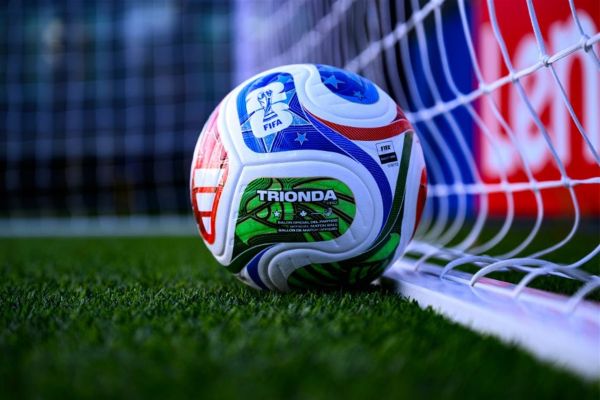
FIFA and Adidas have unveiled the TRIONDA as the official match ball for the 2026 FIFA World Cup, introducing what is being described as the most technologically advanced ball in the tournament’s history.
The ball will be used at the expanded 48-team World Cup across the United States, Canada and Mexico and features integrated tracking technology that requires it to be charged before every match.
Named TRIONDA, meaning “three waves” in Spanish, the ball celebrates the three host nations and features a predominantly white design with red, green and blue graphics representing Canada, Mexico and the United States.
The design also includes symbols linked to each host country, including a maple leaf, an eagle and a star, while gold accents pay tribute to the FIFA World Cup Trophy.
Beyond its appearance, the TRIONDA introduces major technological changes to the game.
At the heart of the ball is a 14-gram sensor chip powered by an internal battery.
The system tracks movement, speed, spin and positioning while transmitting data 500 times per second.
The technology allows officials to determine the exact moment a player touches the ball, helping VAR make more accurate offside and handball decisions.
According to information released ahead of the tournament, the sensor battery provides up to six hours of operation following a full charge, covering a complete match, extra time and penalties if required.
The ball also communicates directly with stadium tracking systems to generate detailed three-dimensional match data in real time.
Adidas has paired the technology with a radical four-panel construction, the fewest ever used on a FIFA World Cup ball.
The thermally bonded panels feature deep seams designed to improve flight stability and reduce the unpredictable movement associated with some previous tournament balls.
The surface is covered with micro and macro textures intended to improve grip and control for both outfield players and goalkeepers, particularly in wet or humid conditions.
The 2026 edition represents a significant evolution from previous World Cup balls, combining advanced analytics technology with a redesigned structure aimed at improving performance on the pitch.
With the introduction of the TRIONDA, FIFA’s flagship tournament will feature a match ball capable of collecting and transmitting vast amounts of data while supporting officiating decisions in real time.
The development marks another step in football’s increasing reliance on technology, transforming the World Cup ball from a simple piece of equipment into a sophisticated data-driven tool at the centre of the game.