Jamiu Folarin, Ph.D
In 2022, I was in Norway to attend the Global Fact Check conference weeks after arrival from Utah, the United States of America as one of the participants at the Solutions Journalism Network Summit.
My partner in progress, Dr. Rasheed Adebiyi had co-opted me into a panel session at the 2022 Lagos Studies Association (LSA) conference to dissect issues around solutions journalism. We were both pioneer fellows of the Solutions Journalism Africa initiatives between 2021 and 2022.
The 2022 Global Fact conference, organised by the International Fact Checking Network (IFCN), brought together stakeholders and players working to improve the information integrity in the world through media literacy, fact-checking, and related projects and initiatives.
It was my first time attending a conference of that magnitude involving hundreds of participants across the globe. I was at the Oslo Metropolitan University, venue of the conference, when I virtually participated in the 2022 LSA conference. At the event, held at the University of Lagos, we reviewed our efforts in institutionalising solutions journalism in the newsrooms and tertiary institutions in Nigeria.
Fast forward to 2026, Dr. Adebiyi again reached out to me asking us to collaborate in order to organise a panel at the 10th edition of the LSA conference scheduled for 16th to 20th June 2026 at the Trinity University, Yaba, Lagos. He suggested that we should use the panel to evaluate our five years advocacy and efforts at integrating solutions journalism into practice and academics.
I did not hesitate a bit to accept the offer. We applied for the panel and after approval, we received over 15 papers from lecturers, researchers, journalists and civil society actors.
The title of the panel was “Changing the Narrative: Exploring Constructive Storytelling as Practice, Pedagogy, and Sustainability Models in African Journalism”. I was fascinated by the array of ideas proposed by over 340 panels dissecting the theme of the conference: “The State of African Studies in the 21st Century: The Lagos Studies Association @ 10”. While perusing through the details of the panels, I had to indicate my Interest to present papers at two other panels focused on protests and misinformation, as well as the one related to issues around newspaper stands and online engagements.
As we interacted with the panelists on the submission and acceptance of their abstracts, we received a series of e-mails from the organisers of the conference which highlighted pre and post conference workshops opportunities that participants could explore. These include Teaching Critical AI Literacy, Documentary Filmmaking, Writing Workshops, among others.
As my research interest is at the intersection of media and technology, I applied for the Teaching Critical AI Literacy workshop. I was elated for being selected as one of the beneficiaries of the four days pre-conference workshop with the organisers sponsoring my conference participation as they provided support for transportation, accommodation, and feeding for nine days.
My experience at the workshop and conference was remarkable for a number of reasons.
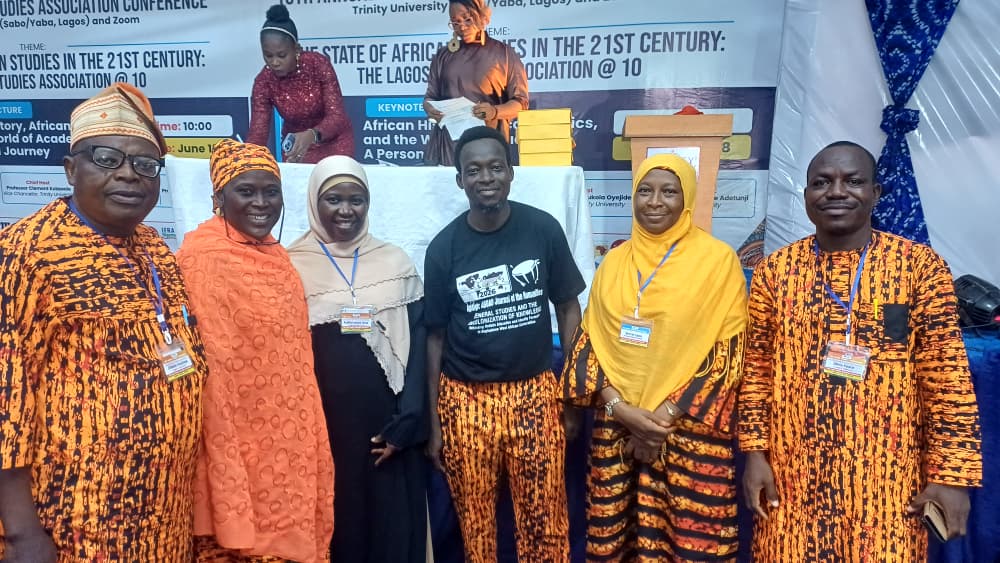
Firstly, I was fascinated by the high level of coordination, efficiency and professionalism exhibited by the organisers of the LSA conference led by Saheed Aderinto, a Professor of History and African Diaspora Studies at the Florida International University. Being the second time of attending a conference of such standard compared to the Global Fact Check experience in Oslo, I recalled with nostalgia the never forgettable moments at the event. I really commend the ability of LSA to effectively organise such an international conference for over nine days with hundreds of participants. In fact, academic conferences used to be boring but LSA proved otherwise. Conversations and activities at the conference were not only intellectually stimulating but entertaining. I thought this experience could only be achieved through the unconference approach I witnessed at the Solutions Journalism Summit in Utah, USA.
Secondly, the conference did not only serve as bridging gap between Town and Gown as participants cut across professional and academic fields, it brought under the same roof, students, young scholars, accomplished academia, local researchers, international scholars, policy makers and members of the civil societies who are working at the intersection of diverse field and African Studies.
The conference provided a platform for mentors and mentees relationships. As the graduate student with the best paper presented and the outstanding Ph.D thesis received awards during the conference, accomplished researchers were also recognised. In the panel I chaired, aside my colleagues who used the academic lens to interrogate issues around solutions journalism, the likes of Adakole James Ojo of Legit.ng newspaper and Oluwaseun Dorojaiye of Social Voices advocated for the need to change the narratives through the prism of their field and professional work.
I sum up my experience at the end of one of the three sessions of the panel thus: “After this conversation, we have been able to identify the gaps as observed by the Town and the Gown, identified the challenges and provided evidence of responses to the social problems, highlighted their limitations and offer relevant insights for present and future change agents.”
Thirdly, one key takeaway from the LSA conference is that Africa should critically interrogate whatever idea, innovation or policy imported into the continent for replication. This became clearer to me after participating in the four days’ workshop on teaching critical AI literacy facilitated by Prof. Eric Covey of the Grand Valley State University in West Michigan and Prof. Helen Olojede of the National Open University of Nigeria (NOUN). Despite my assumed knowledge of media and technology in which generative AI and machine learning are subset, many of my assumptions and convictions were challenged .
In my interrogation of media technology, I did not give adequate attention to the part of decolonisation and Afrocentric media. That the challenges and trade-offs identified with the use of GenAI and machine learning in research and other aspects are not accidental but a system designed to work the way it does (a form of black box).
That the configuration of all technologies including the ones associated with the media are underpinned by a particular philosophy. And in the words of Nizamuddin Siddiqui in an article published in the Medium on April 22nd 2026: “AI Is Not Just a Tool. It Is a System That Learns You….These systems slowly influence what you do, how you act, and even how you think. This is not a conspiracy; this is design.” Resulting from this, we must not take the diffusion of AI in research and other fields in Africa just on the surface level.
Sincerely, the critical lens through which we were made to interrogate the all talk about technology should be the minimum level of knowledge of all African researchers and other adopters of technologies.
Worthy of mention is the need for lecturers and teachers not to only focus on the ethical and responsible use of GenAI by students, but similar advocacy should be propagated among researchers and instructors.