Robert Coles, the distinguished Harvard University professor, psychiatrist, and Pulitzer Prize-winning author who dedicated his life to understanding children navigating the complexities of poverty and segregation, has died at 97.
His son, also named Robert Coles, confirmed on Sunday that his father passed away on Thursday at a hospice facility in Lincoln, Massachusetts.
Coles gained widespread acclaim for his seminal five-volume series, “Children of Crisis,” with the second and third installments earning him a Pulitzer Prize for general nonfiction in 1973.
Through his extensive research, he meticulously documented the profound needs and remarkable resilience of young people caught in the throes of social upheaval.
He challenged prevailing assumptions, noting in a 1965 Washington Post essay, “I was constantly surprised at the endurance shown by children we would all call poor or, in the current fashion, ‘culturally disadvantaged.'”
He pondered, “What enabled such children from such families to survive emotionally and educationally ordeals I feel sure many white middle-class boys and girls would find impossible?”
His unique methodology involved repeated visits to families, often bringing crayons to encourage children to express their experiences and perceptions through art.
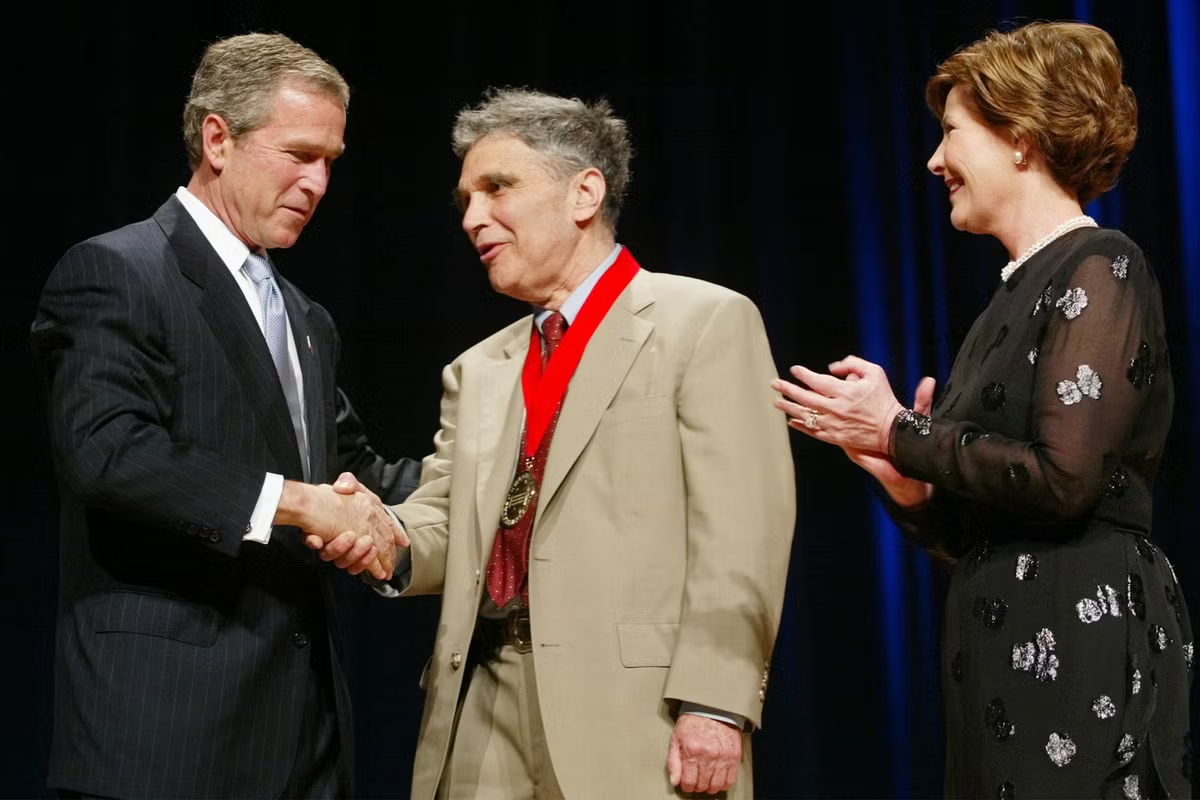
His groundbreaking work garnered significant national recognition. In 1998, he was awarded the Presidential Medal of Freedom, and he was also among the inaugural recipients of a MacArthur Foundation “genius grant.”
The enduring impact of “Children of Crisis” was further cemented in 1999 when a panel of judges ranked it No. 44 on its list of the century’s 100 best English-language works of nonfiction.
Published between 1967 and 1978, the “Children of Crisis” series explored diverse facets of childhood adversity.
The initial volume examined the effects of desegregation, followed by studies on migrant workers, sharecroppers, and others dwelling in mountain areas.
Subsequent volumes delved into the experiences of Black and white Southerners migrating to northern urban centers, Native American, Alaska Native, and Hispanic children, and even children of wealth and privilege.
Beyond this landmark series, Coles authored more than 50 books, including “Their Eyes Meeting the World,” which explored children’s drawings, and “The Moral Life of Children,” “The Political Life of Children,” and “The Spiritual Life of Children.”
He also penned biographies of psychoanalyst Anna Freud and reformer Dorothy Day, extending his studies to children across the globe.
While his empathetic approach resonated with many, some peers viewed his work as leaning more towards journalism and advocacy than traditional psychiatry.
The late Harvard professor Lawrence Kohlberg, a leading authority on moral development, remarked in 1986, “He’s a very good journalist who talks to kids sensitively and tells stories well. But no psychiatrist would take what he says seriously.”
Coles, however, prioritized building trust, recalling to People magazine, “At first the children were frightened to death of us — they’d never had white people in their homes before. But I began to throw away my questions. I threw away my necktie. I began to sit on the floor.”
His empathetic approach was captured in the 1995 PBS documentary “Listening to Children: A Moral Journey with Robert Coles,” which showcased him interviewing a diverse group of American children and analyzing their drawings, mirroring the methods employed in his books.
He often articulated his profound belief in the inherent potential and moral significance of youth, stating, “A child is an opportunity and a moral challenge. How are we going to do justice to this new life with all its possibilities? If we fail as parents, we are failing also as citizens.”
Coles’ interest in children’s responses to crises was sparked in the early 1960s during his service as an Air Force doctor in the South.
He was particularly moved by Ruby Bridges, who, at just six years old, faced a torrent of abuse as the first Black child to integrate an all-white school in New Orleans.
“She demonstrated moral stamina; she possessed honor, courage,” he stated in 1986.
Her heroism also captured the attention of artist Norman Rockwell, who depicted her brave entrance into the school in his iconic 1964 work, “The Problem We All Live With.”
Coles later immortalized her story in his 1995 children’s book, “The Story of Ruby Bridges.”
Throughout his distinguished career, Coles held various appointments at Harvard, including research psychiatrist, professor of psychiatry and medical humanities, and professor of social ethics.