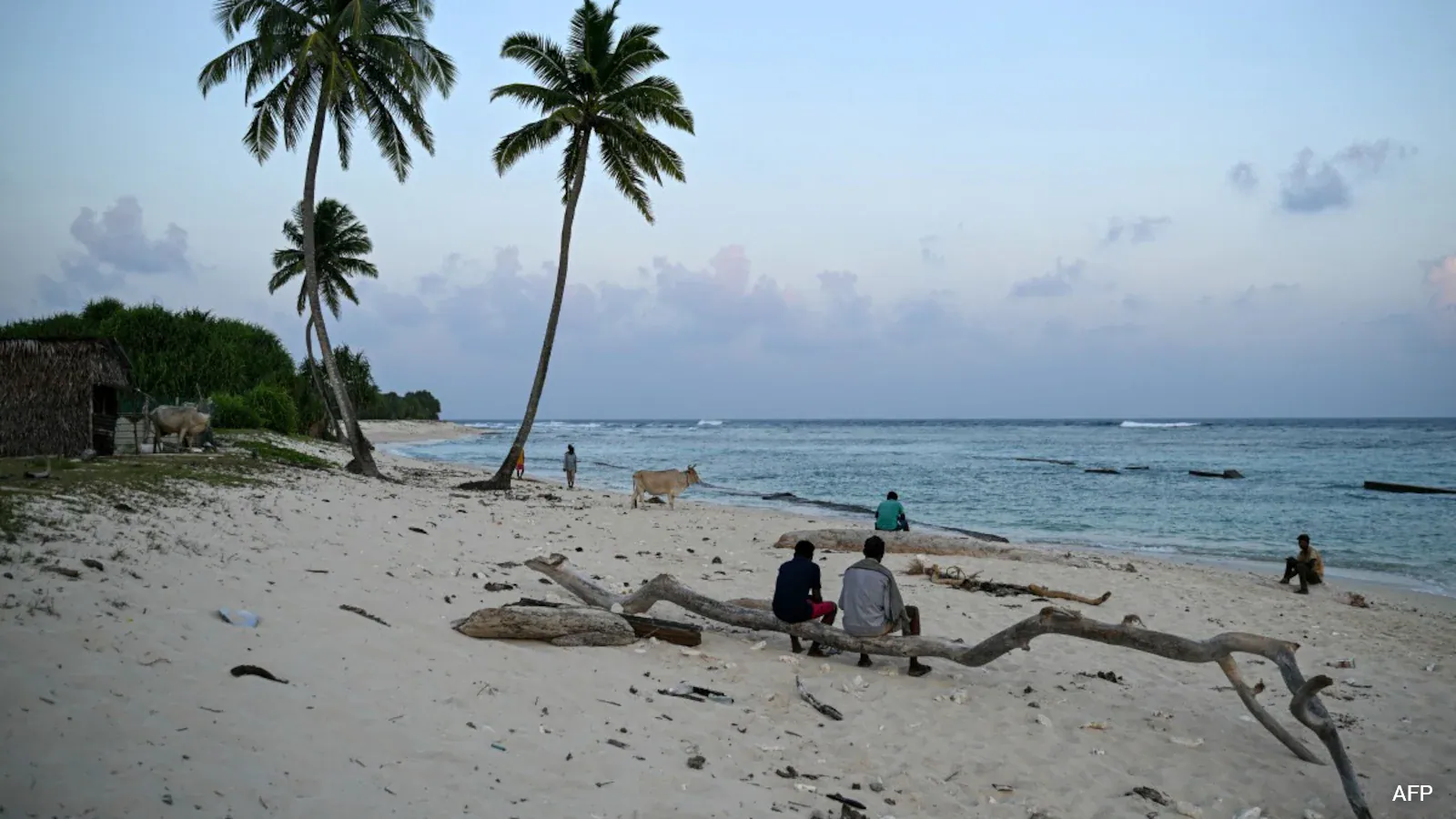
New Delhi:
Great Nicobar Island, the southernmost point of India, which is closer to the coasts of Thailand, Malaysia and Indonesia than to mainland India, is set to witness one of New Delhi’s biggest and most strategic developments in decades. The Prime Minister Narendra Modi government has given the green light to the US $9 billion Great Nicobar project, which will transform the Andaman and Nicobar archipelago into a strategic maritime and economic hub.
Spread across 166 square kilometres, the project includes construction of a transhipment port, a civilian-military airport, a power plant, tourism infrastructure and a township for 350,000 people on the island. It is slated for completion over three decades, with its first phase due by 2028.
Currently, India’s ports lack deep-water berths for large ships. Because of this, cargoes are routed through Colombo and Singapore, resulting in substantial revenue losses for India. When completed, the hub’s 14.2 million TEU (Twenty-Foot Equivalent Unit) International Container Transhipment Terminal will not only reduce India’s reliance on other transhipment hubs but also strengthen the country’s ability to monitor a critical maritime corridor in the Indian Ocean, giving New Delhi a stronger strategic foothold near the Strait of Malacca.
China’s ‘Malacca’ Problem
The image shows a map of Strait of Malacca. Photo Credit: AFP
The Strait of Malacca is the main maritime chokepoint connecting the Indian Ocean to the Pacific through the South China Sea. It is one of the world’s most vital shipping lanes, accommodating around 25 per cent of global maritime trade and nearly 30 per cent of all global petroleum flows.
Because it is the shortest and most cost-effective sea route for energy and manufactured goods, roughly two-thirds of its maritime commerce and close to 70-80 per cent of its oil imports transit through the strait, according to recent data.
Beijing has long tried to shed this heavy reliance on a single, vulnerable artery by developing routes through more southern Lombok and the Sunda Straits to bypass the Malacca Strait, but these deviations add 1,800 km and 3,000 km, respectively, to the journey, adding to both the cost and time of critical imports like crude and gas into China.
Over the past two decades, China has also tried to develop alternative trade and pipeline corridors, such as the China-Pakistan Economic Corridor and routes in Myanmar, to bypass the Malacca Strait, which still remains its main energy route.
But the US-Iran war and the subsequent economic weaponisation of the shipping traffic and energy exports across the Strait of Hormuz have increased the importance of Malacca as a potential chokepoint in the case of any future conflict in South Asia.
China’s anxieties stem from the geography of Great Nicobar, which makes it potentially a valuable sentry for India, watching over the Strait of Malacca.
India’s Strategic Bet
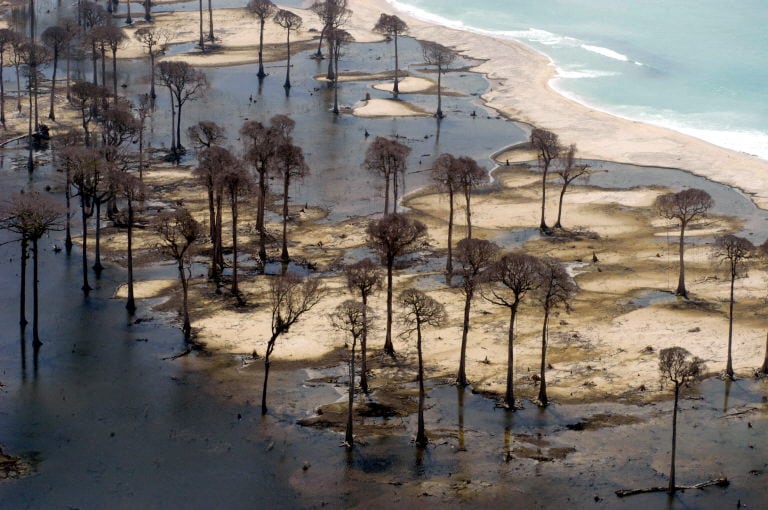
The image shows extensive damage caused by the 26 December 2004 tsunamis to the vegetation of the Great Nicobar island. Photo Credit: AFP
The Indian government, in recent months, has increasingly acknowledged the strategic value of the Great Nicobar Island. In a May release, the government said the Great Nicobar project “is a strategic project which aims to strengthen India’s presence in the Andaman Sea and Southeast Asia.”
The government described the project as a maritime and economic hub close to the East-West shipping route and a key to the country’s defence and national security objectives.
“The project is designed to enhance India’s national security, strategic and defence presence, strengthen the islands’ economic position, and accelerate holistic development in the region,” it added.
Defence and diplomacy analysts also believe the maritime development on the island has a strategic value because it is situated right at the mouth of the Malacca.
“It is a great place to monitor all the traffic coming in and out of the strait,” Shekhar Sinha, a former vice chief of the Indian Navy, told Al Jazeera.
“It would give India an edge in maritime domain awareness,” he added, referring to New Delhi’s ability to track and monitor activity at sea.
Sanjay Iyer, a former brigadier in the Indian army and a military diplomat, also said the Great Nicobar project is probably one of the more consequential strategic bets India has made in recent decades.
“It gives India a persistent presence in the eastern Indian Ocean rather than the occasional visit, better awareness of what’s moving through the region, and a degree of leverage that didn’t exist before,” he said while talking to South China Morning Post.
Iyer noted that New Delhi isn’t going to blockade the Malacca Strait in peacetime. “Nobody seriously expects that. But the infrastructure on Great Nicobar improves India’s ability to monitor [China’s] PLA Navy movements between the western Pacific and the Indian Ocean,” he added.
To avoid the scrutiny, if Chinese vessels sail via alternative routes along the Sunda Strait or Lombok Strait in Indonesia, it would add significant distance and cost for Beijing.
Iyer noted that the Great Nicobar presented a maritime barrier that India could impose on China. “That shifts the calculus in any future stand-off, even if neither side ever fires a shot.”
India’s Maritime Benefits
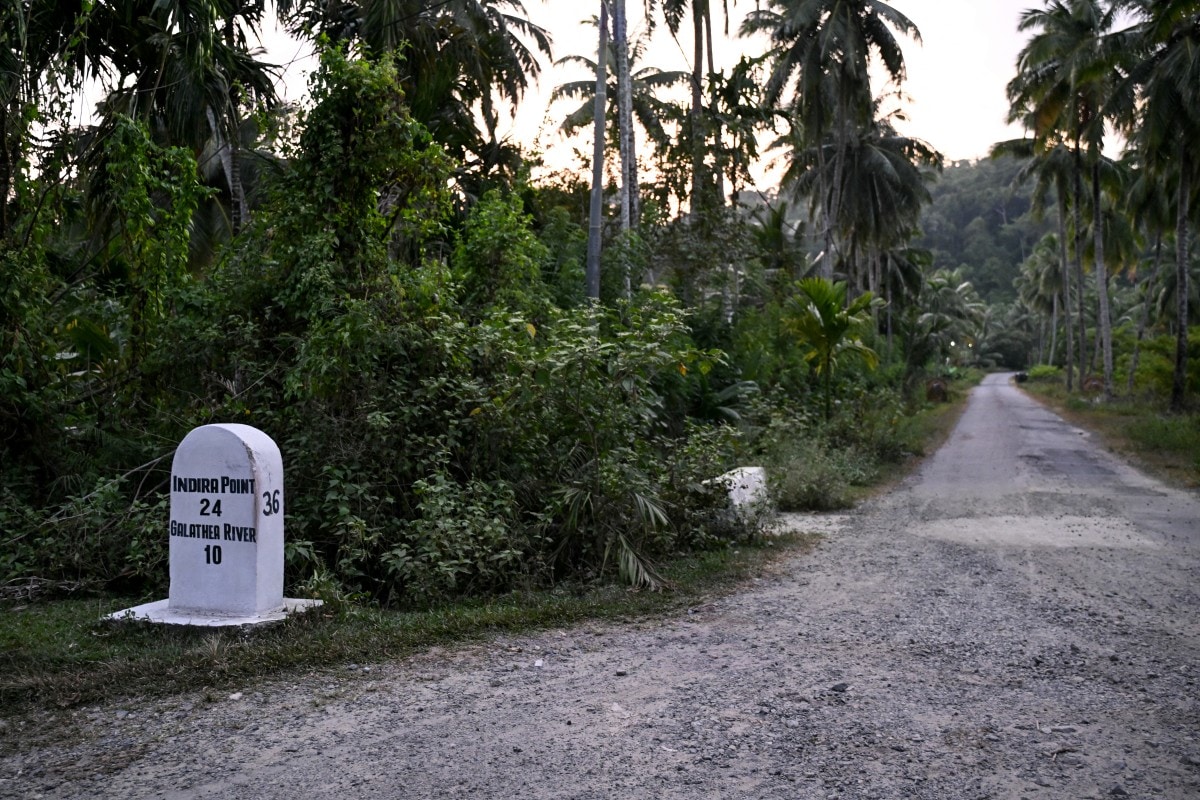
The image shows a milestone along a street leading to Indira Point, the southernmost tip of India, on the outskirts of Campbell Bay in Great Nicobar island. Photo Credit: AFP
Apart from giving a strategic edge over China, the Great Nicobar project will also reduce India’s reliance on the deep-sea ports of neighbouring nations. At the project’s core is the construction of the International Container Transhipment Port at Galathea Bay. For India, which has long trans-shipped a sizeable share of its containers through foreign ports, a deep-water port able to receive the largest container vessels changes the unit economics of trade.
Therefore, a single mainline call can replace several feeder movements through Colombo or Singapore, keeping handling fees, insurance margins and ancillary services within the domestic economy rather than exporting them.
Around 95 per cent of India’s international trade by volume is transited via sea. It is supported by a vast network of 12 major ports and 200 minor and intermediate ports across the country’s 7,516km (4,670 miles) coastline.
According to analysts, India has been under-utilising its potential in the Indian Ocean, which is a vital artery for commerce and energy supplies connecting Europe, Asia and Africa. In contrast, experts pointed out that China has been building a network of overseas commercial and military infrastructure, energy pipelines, and naval facilities in Sri Lanka and Pakistan to gain greater access to the Indian Ocean.
But now, “India wants to reduce its logistical dependence on foreign transhipment hubs such as Colombo, Singapore, and Port Klang,” Uday Chandra, a professor at Ashoka University, told the South China Morning Post.
“It is India’s attempt to convert its inherited colonial geography into maritime leverage in the 21st century. A significant proportion of cargo business on the east-west corridor can be captured by India directly without depending wholly on foreign maritime hubs,” he added.
Chandra noted that the Great Nicobar pushes India to think like a maritime or an island power. “The Andaman and Nicobar chain is where contemporary India blends into Southeast Asia,” Chandra said, adding that the project could mark “the rise of archipelagic India”, enabling it to form “strategic hinges” between the Indian Ocean and the Pacific Ocean for surveillance, logistics, and deterrence.
The Ecological Dilemma
Despite the strategic advantages, critics, including natives, have warned that its development on the island could come at a steep ecological cost. Situated at the far south of the Nicobar Islands, the Great Nicobar is home to a few hundred Shompens — a seminomadic hunter-gatherer tribe living in dense forest interiors — and a few thousand fishing-dependent communities who survive on the island’s ecosystem.
However, a government-appointed environmental panel has approved the project and rejected petitions citing ecological concerns.